
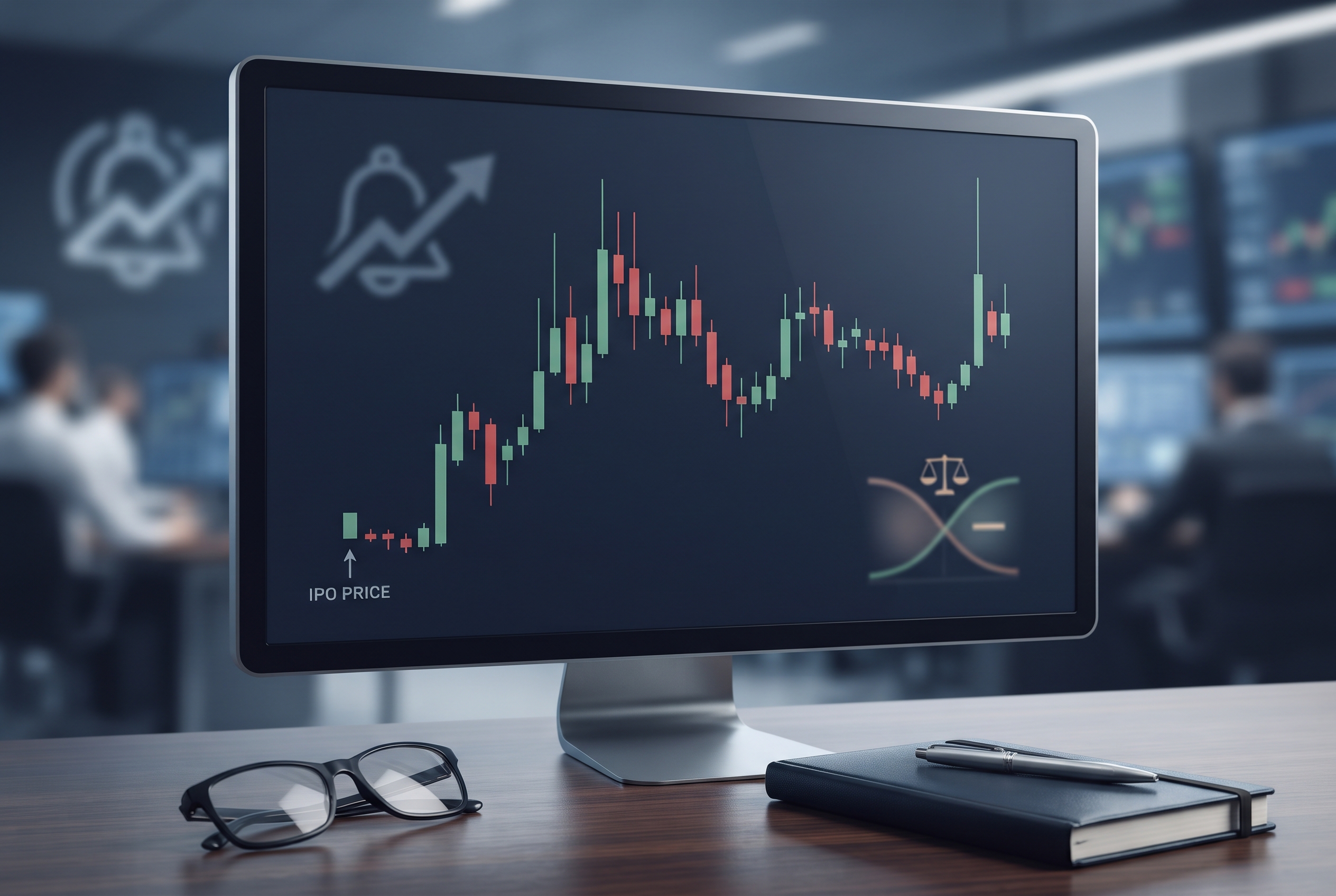
How Do Stock Prices Change After an IPO? A Complete Guide for Investors
When a company goes public, its shares become available for trading on a public stock exchange. For investors, an Initial Public Offering (IPO) can create an opportunity to invest in a business at an important stage of its development. However, one of the biggest questions is what happens to the stock price after the IPO.
Some newly listed stocks rise sharply on their first trading day. Others begin trading below their IPO price, while some experience significant volatility during the first weeks and months. Even companies that attract considerable attention before going public may struggle to maintain their initial valuation once regular trading begins.
Why do these differences occur? The answer involves several factors, including IPO pricing, investor demand, company fundamentals, market conditions, share supply, institutional participation, lock-up agreements, and future growth expectations.
Understanding these factors can help investors evaluate newly listed companies more carefully and avoid making decisions based solely on first-day excitement.
30-Second Summary: What Happens to Stock Prices After an IPO?
- IPO pricing: The initial offering price is determined through a process involving the company, its existing shareholders, and underwriters. It does not guarantee the price at which the stock will trade afterward.
- Investor demand: Strong demand can push a stock above its IPO price, while weak demand may cause it to trade below the offering price.
- Limited public float: When relatively few shares are available for trading, buying or selling pressure can create larger price movements.
- Company fundamentals: Revenue, earnings, profitability, debt, and growth prospects influence how investors assess the business.
- Market conditions: Interest rates, economic expectations, and broader market sentiment can affect newly listed stocks.
- Lock-up expirations: When restrictions on certain shareholders expire, additional shares may become eligible for sale, potentially increasing selling pressure.
- Future expectations: Investors continually reassess whether the company’s actual performance supports its IPO valuation.
- Long-term performance: A successful first trading day does not guarantee long-term returns. Investors need to evaluate the company’s business and valuation independently.
1. What Is an IPO and How Does It Work?
An Initial Public Offering, commonly known as an IPO, is the process through which a private company offers shares to public investors for the first time and becomes publicly traded.
Before an IPO, ownership is generally held by founders, employees, private investors, venture capital firms, private equity funds, and other shareholders. Going public allows a company to access public capital markets and creates a market where its shares can be bought and sold.
Why Do Companies Go Public?
Companies pursue IPOs for several reasons:
- Raising capital: A company can issue new shares to finance expansion, research and development, acquisitions, debt repayment, or other business needs.
- Providing liquidity: Existing shareholders may gain an opportunity to sell some of their ownership, subject to offering terms and applicable restrictions.
- Increasing visibility: A public listing can increase a company’s profile among customers, business partners, analysts, and investors.
- Creating acquisition currency: Publicly traded shares may be used as part of the consideration in future acquisitions.
- Establishing a market valuation: Public trading provides an observable market price for the company’s equity.
Primary Shares vs. Secondary Shares
Understanding the difference between primary and secondary shares is essential when evaluating an IPO.
Primary shares are newly issued shares sold by the company. The proceeds generally go to the company, before relevant offering expenses.
Secondary shares are existing shares sold by current shareholders. The proceeds generally go to those selling shareholders rather than the company.
An IPO may include primary shares, secondary shares, or both. This distinction matters because it determines how much new capital the business receives and how much of the offering represents existing ownership changing hands.
2. How Is the IPO Price Determined?
The IPO price is one of the most important elements of the offering process. It establishes the price at which shares are initially offered to investors, but it does not determine what the stock will trade for once public trading begins.
In a traditional U.S. IPO, the company works with investment banks, commonly referred to as underwriters, to assess its valuation, market conditions, and potential investor demand.
The Role of Investment Banks and Underwriters
Underwriters help structure and manage the IPO. Their responsibilities may include:
- Evaluating the company’s business and financial information.
- Analyzing comparable publicly traded companies.
- Estimating an appropriate valuation range.
- Marketing the offering to potential investors.
- Collecting indications of interest during the book-building process.
- Helping determine the final offering price.
- Coordinating the allocation of shares to investors.
Underwriters also help the company navigate regulatory and listing requirements. The precise structure and responsibilities depend on the offering and the agreements involved.
What Is the IPO Price Range?
During the IPO process, a company may announce an expected price range. For example, it might initially indicate that shares are expected to be offered between $18 and $22.
After marketing the offering and assessing investor demand, the company and underwriters may set the final price within that range, above it, or below it.
The final price reflects an assessment of valuation and demand at that particular point in time. It is not an assurance that public market investors will agree with the valuation.
What Is Book Building?
Book building is the process through which underwriters gather indications of interest from potential investors to assess demand for an IPO.
Institutional investors may communicate the number of shares they are interested in purchasing and the prices they would consider acceptable. This information helps the company and underwriters evaluate demand and determine the final offering terms.
Indications of interest are not necessarily binding purchase commitments. The final allocation and price can still change during the process.
3. What Happens on the First Trading Day?
Once the IPO is completed and the shares are listed, public trading begins. The stock’s market price is then determined through orders from buyers and sellers.
The first trading day can be especially volatile because investors are forming an initial market consensus about the company’s value.
Why Can a Stock Rise Above Its IPO Price?
If demand is strong relative to the shares available for public trading, buyers may be willing to pay more than the offering price.
For example, imagine a company completes its IPO at $20 per share. If investors believe the company’s growth prospects are attractive and demand exceeds available supply, the stock might begin trading at $26.
This would represent a 30% increase compared with the IPO price.
Such an increase is sometimes described as an IPO pop or first-day gain.
Why Can a Stock Fall Below Its IPO Price?
A stock may also begin trading below its IPO price. This can happen when:
- Investor demand is weaker than expected.
- The IPO valuation is considered too aggressive.
- Market conditions deteriorate before listing.
- Investors become concerned about the company’s financial performance.
- The offering receives less interest than anticipated.
- Broader market sentiment turns negative.
For example, a company priced at $20 per share may begin trading at $17 if investors are unwilling to pay the original offering price.
This does not necessarily mean the business has suddenly become weaker. It may indicate that the market’s valuation differs from the IPO pricing assessment.
How Is the First Trading Price Established?
In a traditional exchange-listed IPO, the first public trade generally follows an opening process in which buy and sell orders are collected and matched according to the exchange’s rules.
The opening price may therefore differ from the IPO price. Once regular trading begins, prices continue to change as new orders enter the market.
4. The Difference Between IPO Price and Market Price
One of the most important concepts for IPO investors is that the offering price and the market price are not the same thing.
The IPO price is the price established for the offering. The market price is the price at which shares are subsequently traded between market participants.
| Feature | IPO Price | Market Price After Listing |
|---|---|---|
| How it is determined | Set through the offering process by the company and underwriters | Determined by public-market trading |
| Main influences | Valuation, investor indications of interest, offering structure | Supply, demand, news, expectations, and market conditions |
| When it applies | At the offering | After public trading begins |
| Does it guarantee future value? | No | No |
Investors should not assume that the IPO price represents a guaranteed fair value or a permanent reference point. The market may quickly reassess the company’s valuation once trading begins.
5. Investor Demand and the Size of the Public Float
Supply and demand are among the most important drivers of post-IPO price movements. However, the number of shares actually available for trading can be just as important as the overall level of interest in the company.
What Is Public Float?
Public float generally refers to the shares available for public trading, excluding certain restricted or closely held shares depending on the applicable definition.
A company may have millions of shares outstanding, but only a relatively small portion may be available for trading immediately after its IPO.
When the public float is limited, even moderate buying or selling activity can have a significant impact on the share price.
Why a Small Float Can Increase Volatility
Imagine a company with 100 million shares outstanding, but only 15 million shares are initially available for public trading.
If investor demand increases sharply, the limited supply of available shares may contribute to a rapid price increase.
However, the same mechanism can work in the opposite direction. If investors rush to sell, limited liquidity may amplify downward price movements.
A small public float should therefore not automatically be interpreted as a positive feature. It can create substantial volatility in both directions.
6. The Company’s Financial Health and Business Fundamentals
After the initial excitement surrounding an IPO fades, investors increasingly focus on the company’s underlying business performance.
A strong market debut does not eliminate the need to evaluate revenue growth, profitability, cash flow, debt, and competitive positioning.
Revenue Growth
Investors examine whether the company can consistently increase revenue and expand its customer base.
Rapid growth may support an attractive valuation, but investors should also consider whether the growth is sustainable and whether it comes at the expense of profitability.
Profitability
Some newly public companies are already profitable, while others are still investing heavily in growth and may report operating or net losses.
For companies that are not yet profitable, investors may pay particular attention to operating margins, cash burn, funding requirements, and the path toward sustainable profitability.
Cash Flow and Financial Position
Revenue and accounting earnings do not tell the whole story. Investors should examine operating cash flow, capital expenditures, liquidity, and debt obligations.
A company that depends heavily on external financing may be more vulnerable when capital becomes expensive or market conditions weaken.
Competitive Advantage
A sustainable competitive advantage can help a company defend its market position and maintain profitability.
Investors may evaluate brand strength, technology, intellectual property, customer relationships, network effects, cost advantages, and barriers to entry.
For a deeper look at how financial and business fundamentals influence stock selection, read our guide on how to use fundamental analysis to choose stocks.
7. Market Conditions and Economic Factors
A company’s IPO performance is not determined by its own characteristics alone. The broader financial environment can have a substantial impact on investor demand and stock valuation.
Interest Rates
Higher interest rates can make bonds and other lower-risk investments more attractive relative to stocks. They can also increase the cost of financing for companies that depend on external capital.
Growth-oriented businesses whose valuations depend heavily on expected future cash flows may be particularly sensitive to changes in interest rate expectations.
Inflation
Inflation can increase wages, raw material costs, transportation expenses, and other operating costs. If a newly public company cannot pass these costs on to customers, its profit margins may weaken.
Economic Growth
Strong economic conditions can support consumer spending, business investment, and corporate revenue. A recession or slowdown may weaken demand and reduce earnings expectations.
Stock Market Sentiment
When the broader market is optimistic, investors may be more willing to purchase newly listed companies, especially businesses associated with high-growth industries.
During periods of uncertainty, investors may prefer established companies with more predictable earnings and stronger cash flow.
For a broader explanation of the forces influencing market valuations, see our guide on what factors affect stock prices.
8. Institutional and Retail Investor Behavior
Different categories of investors may have different objectives, investment horizons, and approaches to evaluating newly listed companies.
Institutional Investors
Institutional investors include mutual funds, pension funds, insurance companies, hedge funds, and asset managers.
They often have dedicated research teams and may evaluate IPOs using financial models, industry comparisons, management assessments, and long-term business forecasts.
Institutional participation can provide meaningful demand, but it does not guarantee that a stock will perform well after listing. Institutional investors can also sell shares or change their views as new information emerges.
Retail Investors
Retail investors may participate in IPOs through brokerage accounts, depending on the offering, broker access, eligibility requirements, and share allocation arrangements.
Some retail investors focus on the company’s long-term prospects, while others may be attracted by expected first-day price movements or market excitement.
Heavy retail attention can contribute to short-term volatility, particularly when the available public float is limited.
Why Investor Composition Matters
The identity and objectives of shareholders can influence trading behavior. However, investors should avoid assuming that institutional ownership automatically means a stock is safe or that retail participation necessarily makes it speculative.
The important questions are how the shares are distributed, what restrictions apply, how concentrated ownership is, and whether the company’s valuation is supported by its business prospects.
9. Lock-Up Periods and Potential Selling Pressure
One of the most closely monitored events after an IPO is the expiration of lock-up agreements.
What Is an IPO Lock-Up Period?
A lock-up period is a contractual restriction that prevents certain existing shareholders from selling their shares for a specified period after an IPO.
These restrictions commonly apply to founders, executives, employees, venture capital investors, and other early shareholders, depending on the offering agreements.
In many traditional IPOs, lock-up periods are often around 180 days, although the actual duration and conditions vary. Some agreements contain multiple release dates or exceptions.
Why Can Lock-Up Expiration Affect the Stock Price?
When a lock-up period expires, previously restricted shares may become eligible for sale.
If a significant number of shareholders decide to sell, the additional potential supply can increase selling pressure.
For example, imagine a company with 50 million shares available for trading at its IPO, while another 150 million shares are subject to lock-up restrictions.
If a portion of those restricted shares becomes eligible for sale after the lock-up expires, investors may reassess the stock’s supply-demand balance.
However, lock-up expiration does not mean that all newly eligible shares will be sold. Shareholders may choose to retain their holdings, and some may remain subject to other restrictions.
What Should Investors Check?
- The original lock-up agreement and its expiration dates.
- The number of shares affected by each restriction.
- Which shareholders are subject to the restrictions.
- Whether early-release provisions apply.
- Whether insiders have announced plans to sell.
- Whether the company has other share issuance or resale arrangements.
Investors should distinguish between shares becoming eligible for sale and shares actually entering the market.
10. Insider Selling, Secondary Offerings, and Share Dilution
Lock-up expiration is not the only event that can increase the supply of shares after an IPO. Investors should also understand insider transactions, follow-on offerings, and dilution.
Insider Selling
Founders, executives, directors, and early investors may sell shares after applicable restrictions expire or when permitted under relevant securities laws and company policies.
Insider selling can have several explanations, including portfolio diversification, tax obligations, personal liquidity needs, or a change in investment expectations.
It should not automatically be interpreted as evidence that insiders have lost confidence in the company. Investors should examine the size, timing, and circumstances of the transaction.
Follow-On Offerings
A follow-on offering occurs when a company that is already publicly traded offers additional shares to investors.
It may involve newly issued shares, existing shareholder shares, or both.
A secondary sale by existing shareholders generally does not increase the total number of shares outstanding, while a primary issuance of new shares can increase the share count.
What Is Share Dilution?
Share dilution occurs when a company issues additional shares, increasing the total number of shares outstanding.
If the company’s earnings do not grow sufficiently to offset the increase in share count, earnings per share may decline.
Investors should examine whether new share issuance is being used to finance productive growth, strengthen the balance sheet, or meet ongoing cash needs.
11. Company Performance After the IPO
Once a company becomes public, it enters a new stage in which investors can regularly evaluate its reported performance and compare it with the expectations established during the IPO.
Quarterly Earnings Reports
Public companies in the United States generally report financial results quarterly. Investors examine revenue, earnings, operating margins, cash flow, and management commentary.
A newly public company that consistently meets or exceeds reasonable expectations may strengthen investor confidence.
On the other hand, repeated earnings disappointments can put pressure on the stock price, particularly if the IPO valuation assumed rapid growth.
Management Guidance
Management guidance provides an outlook for future financial performance. Investors may pay close attention to forecasts for revenue, margins, capital expenditures, and profitability.
If actual results or guidance fall short of expectations, the stock may decline even if the company is still growing.
Execution of Growth Plans
Many companies go public to finance expansion. Investors should monitor whether the business uses its capital effectively.
Important questions include:
- Is the company expanding into new markets successfully?
- Are new products generating meaningful revenue?
- Is customer acquisition translating into profitable growth?
- Are operating costs increasing faster than revenue?
- Is management allocating capital responsibly?
Ultimately, the company’s ability to execute its business strategy can become more important than the excitement surrounding its IPO.
12. Why Some IPO Stocks Rise and Others Fall
There is no universal pattern for how a stock behaves after going public. Different companies can experience very different outcomes, even when they enter the market during the same period.
| Factor | Potential Positive Effect | Potential Negative Effect |
|---|---|---|
| Investor demand | Strong demand may push the stock above its IPO price | Weak demand may cause the stock to trade below the offering price |
| IPO valuation | Attractive pricing may leave room for market appreciation | A highly aggressive valuation may limit upside or lead to repricing |
| Public float | Limited supply may amplify buying pressure | Limited liquidity may also amplify selling pressure |
| Company fundamentals | Strong growth, cash flow, and profitability may support valuation | Weak financial performance may reduce investor confidence |
| Market conditions | Positive market sentiment may support IPO demand | Market volatility and risk aversion may reduce demand |
| Lock-up expiration | Little selling activity may limit additional supply pressure | Significant shareholder selling may increase supply |
| Future guidance | Strong outlook may improve expectations | Weak guidance may lead to valuation adjustments |
The key point is that no single factor determines the outcome. IPO performance reflects the interaction of valuation, supply, demand, company performance, and market expectations.
13. Practical Example: How an IPO Stock Price Can Change
Consider a fictional technology company called NovaCloud Inc. The company provides cloud-based software solutions to businesses and decides to go public to finance international expansion and product development.
NovaCloud and its underwriters set an IPO price of $25 per share.
The company has 100 million shares outstanding after the offering, but only 20 million shares are initially available for public trading. The remaining shares are held by founders, employees, and early investors, with some subject to contractual restrictions.
Scenario A: Strong First-Day Demand
Institutional and retail investors show considerable interest in the offering. The limited public float contributes to strong buying pressure, and the stock begins trading at $32.
The first-day gain compared with the IPO price is:
($32 – $25) / $25 × 100 = 28%
The stock has gained 28% relative to its offering price. However, this does not automatically mean that its valuation is justified or that further gains are likely.
Scenario B: Valuation Concerns Emerge
During the following months, investors begin examining the company’s financial results more closely. Revenue is growing, but operating losses remain high and cash consumption is greater than expected.
Investors also become more cautious about high-growth technology stocks because interest rate expectations increase.
As a result, NovaCloud’s stock falls to $21.
Compared with the original IPO price, the decline is:
($21 – $25) / $25 × 100 = -16%
Scenario C: Lock-Up Expiration Approaches
Several months later, the market begins focusing on the expiration of certain shareholder lock-up restrictions.
Investors examine how many shares may become eligible for sale and whether early shareholders intend to sell. The stock becomes more volatile as market participants reassess potential supply.
Scenario D: Business Performance Improves
NovaCloud subsequently reports stronger customer retention, improving operating margins, and better-than-expected revenue growth.
Investors revise their expectations for future profitability, and the stock recovers to $29.
This fictional example demonstrates that IPO performance is not a one-time event. The stock price can change as new information becomes available and investors continuously reassess the company’s value.
14. Should Investors Buy a Stock Immediately After Its IPO?
Buying a stock immediately after its IPO can be attractive, especially when the company operates in a promising industry or has strong growth potential. However, newly listed stocks also carry risks that investors should understand.
Potential Advantages
- Access to new investment opportunities: An IPO can introduce investors to companies that were previously available only through private markets.
- Growth potential: Some newly listed companies may have significant opportunities to expand their markets and operations.
- Public financial information: Public companies are subject to ongoing disclosure requirements, giving investors access to regular financial reports and material announcements.
- Market price discovery: Public trading allows investors to observe how the market values the company over time.
Potential Risks
- Valuation uncertainty: The IPO price may not reflect a sustainable long-term value.
- Limited trading history: Newly listed stocks do not have an extensive public-market price history.
- High volatility: Changes in investor demand can lead to sharp price movements.
- Information asymmetry: Existing shareholders and early investors may have a longer history with the business than new public investors.
- Lock-up expiration: Additional shares may become eligible for sale after the IPO.
- Business execution risk: The company may fail to achieve the growth or profitability targets implied by its valuation.
Investors should avoid treating IPO participation as an automatic opportunity for short-term gains. A company can be attractive as a business but still be expensive at its IPO price.
15. How to Evaluate an IPO Before Investing
Before investing in a newly listed company, investors should review the available offering documents and evaluate the business independently.
Step 1: Read the Registration Statement and Prospectus
For U.S. IPOs, the registration statement and prospectus provide important information about the company, its financial statements, business model, ownership structure, risks, and offering terms.
Investors can generally access relevant filings through the SEC’s EDGAR database.
Pay particular attention to the risk factors, use of proceeds, capitalization, dilution, selling shareholders, and lock-up arrangements.
Step 2: Understand How the Company Will Use the Proceeds
Determine whether the proceeds will finance growth, repay debt, support working capital, or provide liquidity to existing shareholders.
An IPO that raises capital for productive investment may have different implications from an offering in which a substantial portion consists of existing shareholders selling their holdings.
Step 3: Evaluate the Company’s Financial Performance
Review revenue growth, gross margins, operating expenses, cash flow, debt, and profitability.
Compare performance across several reporting periods and identify whether growth is sustainable.
Step 4: Examine the Valuation
Compare the company’s valuation with relevant publicly traded competitors.
Depending on the industry and business model, useful measures may include:
- Price-to-sales ratio (P/S)
- Price-to-earnings ratio (P/E), when earnings are meaningful
- Enterprise value-to-sales (EV/Sales)
- Enterprise value-to-EBITDA (EV/EBITDA), when applicable
- Growth-adjusted valuation measures, interpreted carefully
Comparable-company analysis should account for differences in growth, profitability, financial risk, and business quality.
Step 5: Review Ownership and Share Supply
Examine the number of shares being offered, the expected public float, the ownership structure, and the shares subject to lock-up restrictions.
Also consider whether the company may need to issue additional shares in the future.
Step 6: Understand the Industry
Assess the company’s competitive position, market size, customer demand, regulatory environment, and major industry risks.
A promising industry does not guarantee that every company operating within it will succeed.
Step 7: Develop an Investment Plan
Before investing, determine your time horizon, risk tolerance, position size, and the conditions that would cause you to reconsider the investment.
Newly listed stocks can experience sharp price movements, so investors should avoid committing more capital than they can comfortably expose to risk.
16. IPO Investing vs. Buying Established Public Companies
Investing in an IPO is different from buying shares in a company that has been publicly traded for many years.
| Feature | Newly Listed Company | Established Public Company |
|---|---|---|
| Trading history | Limited public-market history | Usually has an established trading record |
| Price discovery | May be more uncertain during early trading | Market valuation has developed over time |
| Volatility | Can be elevated, especially with a limited float | Depends on company and market conditions |
| Financial information | Historical disclosures are available, but public reporting history may be limited | Often has a longer history of public financial reporting |
| Share supply | May be affected by lock-ups and post-IPO share releases | Generally follows an established ownership and trading structure |
| Investor expectations | May be heavily influenced by IPO marketing and growth narratives | Usually shaped by a longer record of results and guidance |
Neither category is automatically better. The right decision depends on valuation, business quality, risk, and the investor’s objectives.
17. Are IPO Stocks Better for Short-Term or Long-Term Investors?
IPO stocks can attract both short-term traders and long-term investors, but their approaches are different.
Short-Term Trading Perspective
Short-term traders may focus on:
- First-day price movements.
- Trading volume and liquidity.
- Opening price behavior.
- Public float and share availability.
- News announcements and market sentiment.
- Technical price levels after trading begins.
This approach can involve significant risk because newly listed stocks may experience wide price swings and unpredictable liquidity conditions.
Long-Term Investment Perspective
Long-term investors generally focus more on:
- Business model and competitive advantages.
- Revenue growth and profitability.
- Management quality and capital allocation.
- Long-term market opportunity.
- Valuation relative to future earnings and cash flow.
- Financial sustainability and dilution risk.
A long-term investor may decide that it is better to wait until the company has reported several quarters as a public business before making an investment decision.
For more on the principles of long-term investing, read our guide on how long-term investors think and build wealth.
18. Common Mistakes to Avoid When Investing in IPOs
Assuming Every IPO Will Rise
Not every IPO trades above its offering price. Some stocks decline immediately after listing, while others initially rise and then lose value.
Buying Only Because of First-Day Excitement
A large first-day gain may reflect temporary demand, limited supply, or speculative interest. It does not necessarily indicate that the company is fundamentally undervalued.
Ignoring the Company’s Valuation
Even a high-quality company can be a poor investment if the share price already reflects unrealistic growth expectations.
Overlooking Lock-Up Expiration
Investors who ignore lock-up arrangements may fail to anticipate changes in the number of shares eligible for sale.
Confusing Revenue Growth With Financial Strength
Rapid revenue growth can be encouraging, but investors should also evaluate cash flow, margins, debt, and the cost of acquiring customers.
Investing Without Reading the Prospectus
The prospectus contains important information about risks, ownership, share structure, financial performance, and the use of IPO proceeds. Ignoring it can lead to an incomplete understanding of the investment.
Investing Too Much in One IPO
Concentrating a large portion of a portfolio in a newly listed company can expose investors to substantial company-specific and market risk. Position sizing and diversification remain important.
19. IPO Investor Checklist: What to Review Before Buying
Use this checklist to structure your research before investing in a newly listed company.
- Have I read the company’s IPO prospectus or registration statement?
- Do I understand the company’s business model and sources of revenue?
- Is revenue growth sustainable?
- Is the company profitable, or does it have a credible path toward profitability?
- Does the company generate sufficient cash flow?
- How much debt does the company have?
- How will the IPO proceeds be used?
- How many shares are being offered?
- What is the expected public float?
- Are existing shareholders subject to lock-up restrictions?
- When do important lock-up periods expire?
- How does the IPO valuation compare with competitors?
- What are the main risks described in the prospectus?
- How sensitive is the business to interest rates and economic conditions?
- Does the investment fit my time horizon and risk tolerance?
Conclusion: An IPO Is the Beginning of a New Market Journey, Not a Guaranteed Opportunity
When a company goes public, its stock price can move significantly in either direction. Strong investor demand, limited public float, and positive market sentiment may push the price above the IPO level. Weak demand, aggressive valuation, disappointing financial results, or broader market uncertainty can cause the stock to decline.
Over time, company fundamentals and future expectations become increasingly important. Revenue growth, profitability, cash flow, competitive positioning, management decisions, and capital allocation all influence how investors assess a newly public business.
Investors should also monitor share supply, lock-up agreements, insider transactions, and potential dilution. These factors can affect the balance between available shares and investor demand after the IPO.
The most important lesson is that an IPO price is not a guarantee of value or future performance. A strong first trading day does not make a stock a good long-term investment, just as a weak debut does not automatically mean the company has poor prospects.
Rather than chasing short-term excitement, investors should examine the business, understand the valuation, read the offering documents, and develop a disciplined investment strategy.
Frequently Asked Questions About Stock Prices After an IPO
1. What happens to a stock price after an IPO?
After an IPO, the stock begins trading on a public exchange and its price is determined by buying and selling activity. It may rise above the offering price, fall below it, or remain relatively close to the original IPO price. The outcome depends on demand, valuation, share supply, company fundamentals, and market conditions.
2. Does a stock always rise after an IPO?
No. Some IPO stocks rise on their first trading day, while others decline. A company’s listing does not guarantee positive returns. Investors should evaluate the offering price, business quality, valuation, and market demand.
3. What determines the IPO price?
The IPO price is established through a process involving the company and its underwriters. They consider the company’s financial performance, valuation, comparable businesses, investor demand, and prevailing market conditions.
4. Why can a stock rise significantly on its first trading day?
Strong investor demand relative to the available public float can push the stock above its IPO price. Positive market sentiment, strong interest from institutional investors, and expectations of future growth may also contribute.
5. Why can a stock fall below its IPO price?
A stock may fall below its IPO price when demand is weaker than expected, the valuation is considered too high, market conditions deteriorate, or investors become concerned about the company’s prospects.
6. What is an IPO pop?
An IPO pop is the increase in a stock’s market price above its IPO offering price, typically on the first trading day. It represents an initial gain relative to the offering price, but it does not guarantee future appreciation.
7. What is the difference between IPO price and opening price?
The IPO price is the price at which shares are offered in the offering. The opening price is the price at which the stock begins public exchange trading. Strong or weak demand can cause the opening price to differ significantly from the IPO price.
8. What is public float in an IPO?
Public float generally refers to shares available for public trading, excluding certain restricted or closely held shares. A relatively small float can increase price volatility because changes in buying or selling activity may have a greater effect on the available supply.
9. What is a lock-up period after an IPO?
A lock-up period is a contractual restriction that prevents certain shareholders, such as founders, executives, employees, and early investors, from selling their shares for a specified period. The duration and conditions vary by offering.
10. What happens when an IPO lock-up period expires?
When a lock-up period expires, previously restricted shares may become eligible for sale. If shareholders sell significant quantities, additional supply may create downward pressure. However, expiration does not mean that all eligible shares will be sold.
11. Do institutional investors influence IPO performance?
Yes. Institutional investors can contribute substantial demand and influence how shares are allocated during an IPO. Their participation may affect trading activity, but it does not guarantee that the stock will perform well after listing.
12. Can retail investors buy shares in an IPO?
Depending on the offering and brokerage arrangements, eligible retail investors may be able to participate in an IPO through a broker. Access, allocation, minimum investment requirements, and eligibility conditions can vary.
13. What is share dilution after an IPO?
Share dilution occurs when a company issues additional shares, increasing the total number of shares outstanding. If earnings do not grow sufficiently to offset the increase, earnings per share may decline. Investors should review the company’s share structure and future financing needs.
14. Why do some IPO stocks decline months after listing?
Stocks may decline after an IPO because of disappointing earnings, weaker management guidance, high valuations, lock-up expirations, insider selling, dilution, or deteriorating market conditions. Investors may also reassess expectations after the initial excitement fades.
15. Should investors buy an IPO on the first day?
There is no universal answer. First-day trading can involve high volatility and uncertain price discovery. Investors should evaluate the company’s financial performance, valuation, public float, and risks rather than buying simply because the stock is newly listed.
16. Is a low IPO price a sign that a stock is cheap?
No. A low nominal share price does not necessarily indicate an attractive valuation. Investors should consider the company’s total market capitalization, number of shares outstanding, earnings, revenue, cash flow, and growth prospects.
17. How long should investors wait before buying an IPO stock?
There is no fixed waiting period. Some investors prefer to observe several trading sessions, while others wait for the first quarterly earnings reports or the expiration of certain lock-up restrictions. The appropriate approach depends on the company’s characteristics and the investor’s strategy.
18. Are IPO stocks suitable for long-term investing?
Some newly public companies may become successful long-term investments, but an IPO alone does not make a company attractive. Long-term investors should evaluate business quality, competitive advantages, financial sustainability, valuation, and management execution.
19. Where can investors find information about a U.S. IPO?
Investors can review the company’s registration statement, prospectus, and other regulatory filings through the U.S. Securities and Exchange Commission’s EDGAR database. Company investor relations websites and exchange announcements can provide additional information.
20. Does a successful IPO mean the company is financially strong?
Not necessarily. A successful offering may indicate strong investor demand, but it does not prove that the company is profitable, financially stable, or capable of achieving its growth targets. Investors should examine the company’s financial statements and risk disclosures.
Disclaimer
This article is for educational and informational purposes only. It does not constitute investment advice, a recommendation to buy or sell any security, or a guarantee of investment performance. Investing in IPOs involves significant risks, including price volatility, valuation uncertainty, limited trading history, liquidity risk, and the possible loss of principal. Investors should review the relevant offering documents, conduct independent research, and consider their financial circumstances, investment objectives, and risk tolerance before making investment decisions.