
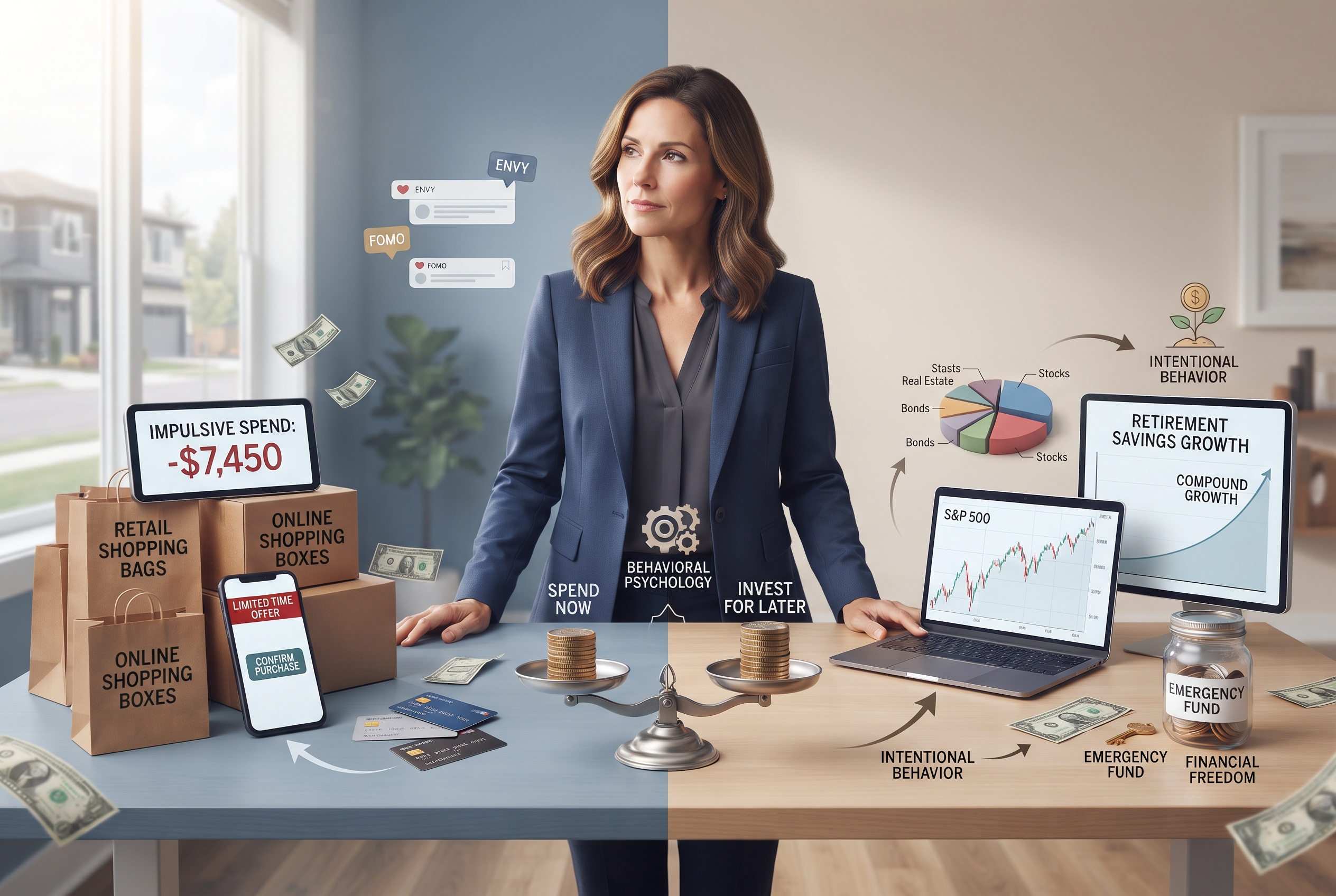
The Psychology of Spending: Why Do We Spend Money?
Have you ever bought something you didn’t really need?
Maybe it was a $7 coffee.
Maybe it was a $150 pair of shoes.
Maybe it was a new phone even though your current one worked perfectly.
Or perhaps you ordered something online late at night and wondered the next morning:
“Why did I buy this?”
If this has happened to you, the problem may not be a lack of financial knowledge.
It may be spending psychology.
Human beings do not always spend money rationally.
We spend because we are happy.
We spend because we are stressed.
We spend because we are bored.
We spend because everyone around us seems to have something we don’t.
We spend because shopping provides an immediate reward while saving offers a future benefit.
This is one of the most important ideas in personal finance:
Knowing what you should do financially does not always determine what you actually do.
Your emotions, environment, habits, social circle, digital platforms, and even the way a price is presented can influence your spending decisions.
Understanding these psychological forces can therefore be just as important as creating a budget.
30-Second Summary
- Spending is not purely a mathematical decision; emotions and psychology strongly influence it.
- People often prefer immediate rewards over larger future benefits.
- Stress, boredom, social comparison, FOMO, and advertising can trigger unnecessary spending.
- Credit cards and one-click checkout can reduce the psychological pain of paying.
- Lifestyle inflation can cause spending to increase as income rises.
- Impulse spending is often driven by triggers rather than genuine needs.
- Understanding your personal spending triggers can be more effective than relying on willpower.
- Creating friction between the desire to buy and the actual purchase can reduce impulse spending.
- Automatic saving can protect money before psychological spending decisions occur.
- The goal is not to stop spending completely but to spend intentionally.
Why Do We Spend Money?
At the most basic level, money allows us to exchange resources for goods and services.
But human spending behavior is much more complicated.
We do not simply ask:
“Do I need this product?”
Instead, our brains may ask:
- Will this make me feel better?
- Will this make my life easier?
- Will other people notice it?
- Will I regret not buying it?
- Does this make me feel successful?
- Can I afford the monthly payment?
- Is everyone else buying it?
- Is it a limited-time opportunity?
These questions can influence purchasing decisions without us consciously realizing it.
This is why two people with identical incomes can have completely different financial outcomes.
One may save and invest consistently.
The other may spend nearly everything.
The difference is not necessarily income.
It may be behavior.
Immediate Gratification: Why Spending Feels Better Than Saving
One of the strongest forces behind spending is instant gratification.
Imagine two choices.
Choice A: Spend $200 today on a dinner, clothes, entertainment, or a new gadget.
Choice B: Invest the $200 and potentially use it for a much larger financial goal years from now.
Choice A provides an immediate emotional reward.
Choice B provides a potential future reward.
The human brain often has a natural preference for immediate rewards.
This tendency is related to what behavioral economists call present bias.
We tend to place more psychological value on something we can enjoy today than something we may receive years from now.
This creates a difficult conflict in personal finance.
Spending gives you something now. Saving asks you to trust your future self.
That is one reason long-term financial planning requires systems rather than relying entirely on self-control.
Emotional Spending: When Feelings Become Financial Decisions
Sometimes we do not buy something because we need it.
We buy it because we want to change how we feel.
This is known as emotional spending.
Common emotional triggers include:
- Stress
- Sadness
- Boredom
- Anxiety
- Loneliness
- Frustration
- Celebration
- Reward-seeking
For example, imagine someone has had a terrible day at work.
On the way home, they stop at a store and buy a $120 item they had not planned to purchase.
The purchase creates a short-term emotional lift.
But the emotional benefit may disappear quickly.
The credit card bill does not.
This creates a dangerous cycle:
Negative emotion → spending → temporary relief → regret → financial stress → more negative emotion.
Breaking this cycle requires identifying the emotion before making the purchase.
Why Shopping Can Feel Like a Reward
Shopping can activate the brain’s reward system.
The anticipation of getting something new can be emotionally stimulating.
Notice the important distinction.
The psychological reward does not necessarily come only after receiving the product.
Sometimes the excitement begins when you:
- See the product
- Add it to your cart
- Read reviews
- Compare alternatives
- Imagine owning it
- Receive the confirmation email
The buying process itself can become rewarding.
This is one reason online shopping can be particularly powerful.
The entire process can happen within minutes.
There is almost no time for reflection.
Credit Cards Can Reduce the Pain of Paying
Credit cards changed the psychological experience of spending.
When you hand someone $100 in cash, you physically lose something.
When you tap a card or click “Buy Now,” the payment can feel much less tangible.
The money leaves your financial system, but the psychological experience is different.
This can reduce what behavioral economists describe as the pain of paying.
The lower the psychological pain, the easier it can become to spend.
Buy-now-pay-later products can make this effect even stronger.
A $600 purchase may be presented as:
“Only $50 per month.”
The total price has not changed.
But the framing has changed.
The consumer is encouraged to focus on the smaller monthly commitment rather than the total financial cost.
The Monthly Payment Trap
One of the most powerful spending tricks is to think in monthly payments instead of total prices.
Consider two statements:
“This car costs $42,000.”
versus
“You can drive it for only $599 per month.”
The second statement may feel much more affordable.
But the financial obligation remains.
This is why consumers should always ask:
- What is the total price?
- What is the APR?
- How long will I make payments?
- How much interest will I pay?
- What happens if my income falls?
A low monthly payment does not necessarily mean a low-cost purchase.
Social Comparison: We Spend Because of Other People
Humans are social creatures.
We compare ourselves with others.
That comparison can strongly influence spending.
Imagine you earn $90,000 per year.
You might feel financially successful.
Then you discover that your coworkers drive luxury SUVs, live in expensive neighborhoods, and take international vacations several times a year.
Suddenly, your lifestyle may feel inadequate.
Your income did not change.
Your financial situation did not change.
But your reference point changed.
This phenomenon is closely related to relative consumption.
People do not evaluate wealth only in absolute terms.
They often evaluate it relative to the people around them.
Social Media Has Made Spending Psychology Stronger
Social media can intensify social comparison.
Every day, users can see:
- Luxury vacations
- New cars
- Designer clothing
- Restaurant experiences
- Beautiful homes
- New technology
- “Successful” lifestyles
But there is a major problem.
You are usually seeing the consumption.
You are not seeing the balance sheet.
You do not know whether someone paid cash, used debt, received financial help, or is simply spending far beyond their means.
Social media therefore creates a distorted financial benchmark.
Someone else’s lifestyle should not become your spending plan.
FOMO: The Fear of Missing Out
FOMO is not limited to investing.
It also affects consumer spending.
Retailers understand this very well.
Messages such as:
- “Only 2 left!”
- “Sale ends tonight!”
- “Limited edition”
- “Thousands bought this today”
- “Last chance”
create urgency.
The psychological message is:
“If you don’t act now, you will lose the opportunity.”
This can cause consumers to make decisions before they have time to evaluate whether they actually need the product.
The same psychological mechanism can appear in financial markets, where FOMO can push investors into poorly timed decisions. Understanding the connection between consumer and investor psychology can be valuable for anyone interested in financial decision-making and FOMO.
The Scarcity Effect: Why “Limited” Feels More Valuable
Humans tend to place greater value on things that appear scarce.
A product available indefinitely may not feel urgent.
A product available for only 24 hours suddenly feels more important.
This is called the scarcity effect.
Retailers use scarcity because it can shorten the decision-making process.
Instead of asking:
“Do I really want this?”
you start asking:
“Can I buy this before it disappears?”
That is a completely different question.
Anchoring: Why the Original Price Can Fool You
Another important behavioral bias is anchoring.
Suppose a jacket is displayed like this:
$300 → $180
Your brain may interpret $180 as a bargain.
But what if the jacket was never worth $300 to you?
The $300 price becomes an anchor.
You evaluate the $180 price relative to the anchor rather than asking whether the product is worth $180.
A better question is:
“Would I pay $180 for this if I had never seen the $300 price?”
That simple question can eliminate a surprising amount of unnecessary spending.
Mental Accounting: Why We Treat Money Differently
People often divide money into imaginary mental categories.
For example:
- Salary money
- Bonus money
- Tax refund
- Birthday money
- Lottery money
- Investment gains
Psychologically, these amounts may feel different even though a dollar is a dollar.
Imagine receiving a $2,000 tax refund.
You might immediately think:
“I’ll use this for a vacation.”
But if your employer had simply paid you $2,000 more during the year, you might have used the money for bills or savings.
The source of the money changed your psychological treatment of it.
This is an example of mental accounting.
Lifestyle Inflation: Why Higher Income Doesn’t Always Create Wealth
One of the biggest spending traps occurs when income rises.
Imagine someone receives a $15,000 annual salary increase.
Instead of saving or investing most of the additional income, they:
- Move into a more expensive apartment
- Upgrade their car
- Eat at more expensive restaurants
- Take more vacations
- Upgrade their technology
After a few years, their income is much higher.
But their savings rate has barely changed.
This is known as lifestyle inflation.
The problem is not spending more as you earn more.
The problem is allowing every increase in income to become a permanent increase in expenses.
A healthier approach is to divide raises between:
- Better quality of life
- Debt reduction
- Emergency savings
- Retirement contributions
- Long-term investments
Why We Underestimate Small Purchases
Large purchases usually receive careful consideration.
Small purchases often do not.
A $6 coffee does not feel financially significant.
Neither does a $12 lunch.
Neither does another $15 streaming subscription.
But recurring small expenses can become meaningful when repeated hundreds of times.
Imagine spending:
$15 per day × 300 days = $4,500 per year.
The problem is not necessarily the individual purchase.
It is the repetition.
This is why reviewing recurring spending patterns is often more useful than obsessing over one isolated purchase.
Why Subscriptions Are So Effective
Subscription businesses understand spending psychology extremely well.
A one-time $240 payment feels significant.
A $20 monthly payment feels much smaller.
Once the subscription is activated, another psychological effect appears:
Inertia.
Canceling requires action.
Keeping the subscription requires doing nothing.
As a result, consumers can accumulate:
- Streaming services
- Fitness memberships
- Software subscriptions
- Cloud storage
- Premium apps
- Food delivery memberships
Individually, each may seem inexpensive.
Together, they can represent hundreds or thousands of dollars per year.
Impulse Buying: The Trigger-Action-Reward Cycle
Impulse spending often follows a predictable pattern.
Trigger → Desire → Purchase → Reward.
For example:
Trigger: You receive an email about a 40% sale.
Desire: You imagine owning the product.
Purchase: You click “Buy Now.”
Reward: You feel excited and satisfied.
The key insight is that you can intervene before the purchase.
You do not need to eliminate the desire.
You simply need to create enough space between desire and action.
The 24-Hour Rule
One of the simplest ways to reduce impulse spending is to delay non-essential purchases.
For purchases above a certain amount, wait 24 hours.
For larger purchases, wait a week.
During that time, ask:
- Do I actually need this?
- Do I already own something similar?
- Would I buy it at full price?
- Where will I use it?
- Will I still want it next month?
- Does it fit my financial goals?
Many impulse purchases lose their emotional power after the initial excitement disappears.
How to Stop Emotional Spending
The goal is not to become someone who never spends money.
The goal is to recognize why you are spending before you spend.
Try identifying your personal triggers.
For one person, it may be stress after work.
For another, it may be social media.
For someone else, it may be boredom late at night.
Once the trigger is visible, you can replace the behavior.
If Stress Triggers Spending
Try walking, exercising, talking to a friend, or taking a break before shopping.
If Boredom Triggers Spending
Remove shopping apps from your phone and replace browsing with a non-financial activity.
If Social Media Triggers Spending
Unfollow accounts that constantly encourage consumption.
If Sales Trigger Spending
Stop treating discounts as savings.
You only save money when you avoid spending money you did not need to spend.
Make Saving Automatic
One of the most effective solutions to spending psychology is to reduce the amount of money available for impulse decisions.
Instead of saying:
“I’ll save whatever is left at the end of the month.”
reverse the process.
Save first.
Spend what remains.
Automatic transfers can move money into savings or investment accounts immediately after payday.
This works because it reduces the number of decisions you have to make.
It also creates distance between your everyday spending account and your long-term financial goals.
This principle is closely related to the idea of building a saving system instead of relying on willpower.
Use Friction to Your Advantage
Retailers try to eliminate friction.
Good personal-finance systems should sometimes create it.
For example:
- Delete stored credit-card information from shopping websites.
- Remove shopping apps from your phone.
- Unsubscribe from promotional emails.
- Turn off shopping notifications.
- Keep savings in a separate account.
- Use a waiting period for large purchases.
The objective is not to make your life difficult.
It is to make impulsive decisions slightly harder.
That small delay can give rational thinking time to catch up with emotion.
Build a “Fun Money” Category
There is another mistake people make when trying to control spending.
They create an extremely restrictive budget.
No restaurants.
No entertainment.
No vacations.
No shopping.
No small pleasures.
This may work for a few weeks.
Then the person becomes frustrated and abandons the entire plan.
A better approach can be to create a specific fun-money budget.
For example:
- 10% of income for discretionary spending
- 90% for financial priorities and essential expenses
The exact percentage does not matter.
The principle does.
Planned spending is very different from uncontrolled spending.
Spend According to Your Values
Not every purchase is bad.
Money should be used to improve your life.
The question is whether your spending reflects what actually matters to you.
Suppose someone spends $400 per month on restaurants but rarely travels.
Another person spends very little on dining but saves for two major trips every year.
Neither approach is automatically better.
The important question is:
Does your spending reflect your priorities?
This is the difference between intentional spending and mindless consumption.
A Realistic Example: The $500 Monthly Spending Leak
Consider James, a 35-year-old professional earning $100,000 per year.
He believes he is financially disciplined.
But after reviewing his transactions, he discovers:
- $140 on food delivery
- $90 on unused subscriptions
- $120 on impulse online purchases
- $80 on convenience purchases
- $70 on unnecessary upgrades
Total:
$500 per month.
That equals:
$6,000 per year.
James does not need to eliminate every enjoyable expense.
He simply needs to understand the behavior behind the spending.
If he redirects even $400 per month toward savings or investments, he creates a meaningful long-term financial change.
The most important discovery was not the $500.
It was the realization that his spending was being driven by convenience, habit, and impulse rather than deliberate choices.
How Spending Psychology Affects Wealth Building
Wealth is not determined only by how much you earn.
It is also influenced by what you keep.
Imagine two people who each earn $120,000 per year.
Person A spends almost all of it.
Person B spends $90,000 and invests the remaining $30,000.
Over one year, the difference is $30,000.
Over ten years, the difference becomes enormous even before investment returns are considered.
Compounding then amplifies the gap.
This is why spending psychology matters for investors.
Every dollar you avoid spending unnecessarily can potentially become a dollar invested for your future.
The Connection Between Spending and Financial Freedom
Financial freedom does not necessarily require an extraordinary income.
It requires a sustainable relationship between income, spending, saving, and investing.
If every raise immediately becomes a new expense, your financial position may not improve much.
If part of every raise becomes savings or investments, your financial flexibility can increase over time.
The goal is not maximum frugality.
The goal is maximum value per dollar spent.
Common Spending Psychology Mistakes
1. Confusing Discounts With Savings
If you spend $100 on something you did not need because it was 50% off, you did not save $100.
You spent $100.
2. Using Monthly Payments to Justify Purchases
A small monthly payment can hide a large total financial commitment.
3. Comparing Yourself With People Online
You see other people’s consumption but rarely see their debt, savings, or financial stress.
4. Treating Every Raise as Spendable Income
Automatically increasing lifestyle expenses can prevent your savings rate from improving.
5. Relying Only on Willpower
Willpower fluctuates.
Systems are more reliable.
6. Ignoring Recurring Expenses
Small monthly charges can become significant annual costs.
7. Shopping When Emotional
Major financial decisions should ideally not be made during moments of intense stress, excitement, or sadness.
What Should You Do Before Your Next Purchase?
Before buying something that was not planned, pause and ask five questions:
- Do I actually need this?
- Would I still want it if there were no discount?
- Am I buying this because of an emotion?
- Could this money serve a more important financial goal?
- Will I still be happy with this purchase in six months?
If the answer to the first question is no, wait.
You can always buy it later.
But you cannot undo every financial decision once the money is gone.
Frequently Asked Questions About Spending Psychology
Why do I spend money when I am stressed?
Spending can provide a temporary sense of reward or control. The emotional relief can make shopping feel attractive during stressful periods, even when the purchase is unnecessary.
Why do I buy things I don’t need?
Impulse purchases can be triggered by emotions, discounts, social comparison, advertising, scarcity, convenience, and the desire for immediate gratification.
Why does shopping make me feel good?
The anticipation and reward associated with acquiring something new can create a positive emotional response. That feeling can reinforce the shopping behavior.
What is emotional spending?
Emotional spending occurs when a person purchases something primarily to change or regulate their emotional state rather than to satisfy a genuine need.
How can I stop impulse buying?
Use waiting periods, remove saved payment information, unsubscribe from promotional emails, delete shopping apps, and create a specific discretionary spending budget.
Does social media make people spend more?
It can. Constant exposure to other people’s lifestyles, products, and experiences can increase social comparison and create pressure to consume.
What is lifestyle inflation?
Lifestyle inflation occurs when spending increases as income rises. It can prevent salary increases from translating into higher savings and investment rates.
Why do discounts make me buy things?
Discounts can create a perception of scarcity and value. Consumers may focus on the amount supposedly saved instead of whether the purchase was necessary.
How does credit card spending affect psychology?
Credit cards can reduce the immediate psychological pain of paying because the transaction does not feel as tangible as handing over cash.
Is spending money always bad?
No. Spending is necessary and can improve quality of life. The goal is intentional spending that reflects your priorities rather than uncontrolled consumption.
What is the 24-hour spending rule?
It is a strategy that requires you to wait at least 24 hours before making a non-essential purchase. The delay can reduce impulse decisions.
How can I save more without feeling deprived?
Automate savings, identify low-value spending, keep a discretionary budget, and focus spending on experiences or products that genuinely matter to you.
Why is saving harder than spending?
Spending creates an immediate reward, while saving usually produces benefits in the future. This difference creates a psychological bias toward present consumption.
How can I control emotional spending?
Identify your emotional triggers first. Then create alternative responses such as exercise, walking, social interaction, or other activities that do not involve spending.
Can spending psychology affect investing?
Yes. The same emotional forces that influence consumption can affect investment decisions. FOMO, fear, greed, social comparison, and impatience can all influence financial markets.
Final Thoughts: Your Spending Habits Are Part of Your Investment Strategy
Most people think investing begins when they open a brokerage account.
In reality, investing begins much earlier.
It begins with what you do with the money you earn.
Every unnecessary purchase is money that cannot be saved or invested.
Every intentional spending decision creates more room for future financial goals.
This does not mean you should stop enjoying your money.
Quite the opposite.
Money is supposed to serve your life.
The goal is to make sure your spending serves your priorities rather than your emotions, advertising algorithms, social pressure, or temporary impulses.
The most financially disciplined person is not necessarily the person who spends the least.
It is the person who understands why they spend.
Once you understand your triggers, you can build systems around them.
Automate savings.
Create friction around impulse purchases.
Use waiting periods.
Ignore other people’s financial lifestyles.
Allow yourself intentional fun spending.
And redirect the money you no longer waste toward assets that can grow over time.
Financial freedom is not created by never spending money.
It is created by making sure the money you spend—and the money you keep—both move you toward the life you actually want.