
How to Build a Saving Habit: Create a System Instead of Relying on Willpower
Almost everyone wants to save more money.
Yet millions of people reach the end of each month wondering where their paycheck went.
The problem usually isn’t income.
It isn’t a lack of financial knowledge either.
The real problem is that saving often depends on motivation—and motivation doesn’t last.
Successful savers don’t rely on willpower.
They rely on systems.
A well-designed financial system makes saving automatic, consistent, and almost effortless.
In this guide, you’ll learn how to build a saving habit that sticks, create lasting financial discipline, and make saving a natural part of your everyday life.
Before building a savings habit, make sure you have a clear financial roadmap by reading our guide to Money Management and Budgeting. Creating a realistic monthly budget is also an essential first step toward consistent saving.
Why Most People Fail to Save Consistently
Many people follow the same approach:
“I’ll save whatever is left at the end of the month.”
The problem?
There’s usually very little left.
Unexpected expenses, impulse purchases, subscriptions, and everyday spending gradually consume the available cash.
Financial experts often recommend reversing the process by “paying yourself first”—saving before spending rather than waiting to see what’s left.
Discipline Comes From Systems, Not Motivation
Motivation changes from day to day.
Systems continue working even when you don’t feel motivated.
Think about brushing your teeth.
You probably don’t debate whether you’ll do it today.
It’s simply part of your routine.
Your savings should work the same way.
Research on financial habits consistently shows that automation and repeatable routines outperform relying on self-control alone.
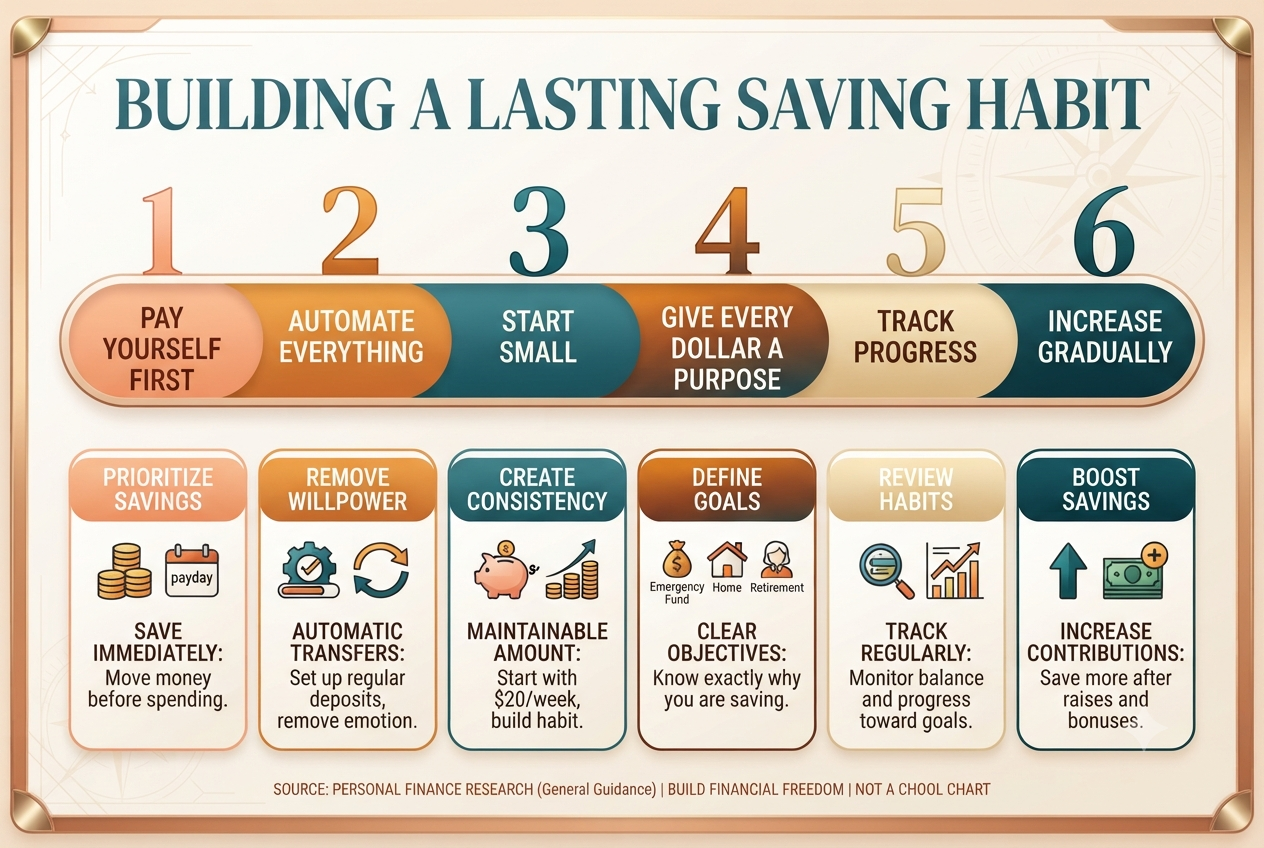
Step 1: Pay Yourself First
One of the most effective financial habits is saving immediately after you get paid.
Instead of waiting until the end of the month, move money into savings first.
Then build your spending plan around what’s left.
This simple shift changes saving from an afterthought into a priority.
Step 2: Automate Everything
Automation removes emotion from financial decisions.
Set up an automatic transfer every payday.
Even small automatic transfers create momentum.
You don’t have to remember to save.
The system does it for you.
Many successful savers say automation was the single biggest change that helped them stay consistent.
Step 3: Start Small
One of the biggest mistakes people make is believing they need to save hundreds of dollars every month.
You don’t.
Start with an amount you know you can maintain:
- $20 per week.
- $50 per paycheck.
- 1% of your income.
The goal isn’t to impress anyone.
The goal is to create consistency.
Once saving becomes automatic, increasing the amount becomes much easier.
If you’re unsure whether small amounts really matter, read The Power of Small Savings to see how consistency creates long-term wealth.
Step 4: Give Every Dollar a Purpose
People save more consistently when they know exactly why they’re saving.
Your goals might include:
- An emergency fund.
- A home down payment.
- Retirement.
- A vacation.
- Investing.
- Financial independence.
Clear goals make daily financial decisions easier because every saved dollar has a purpose.
Our guide to Financial Goals explains how to build motivating financial objectives.
Step 5: Track Progress, Not Perfection
You don’t need to monitor every penny every day.
Instead, schedule a weekly or monthly financial check-in.
Review:
- Your savings balance.
- Your spending.
- Your progress toward goals.
- Areas where you can improve.
Small, consistent reviews help prevent minor issues from becoming major financial problems.
Step 6: Increase Your Savings Gradually
Whenever you receive:
- A raise.
- A bonus.
- A tax refund.
- Additional freelance income.
Increase your automatic savings before increasing your lifestyle.
This strategy helps prevent lifestyle inflation while steadily improving your financial future.
If your income varies throughout the year, you can adapt this strategy using the methods explained in How to Budget with an Irregular Income.
Common Mistakes That Prevent Saving Habits
- Trying to save too much too soon.
- Depending entirely on willpower.
- Not automating transfers.
- Having no clear financial goal.
- Giving up after one bad month.
Remember:
Missing one month doesn’t erase your progress.
Consistency over years matters far more than perfection every month.
Build an Emergency Fund First
Your first major savings goal should usually be an emergency fund.
Without one, unexpected expenses often lead to credit card debt or personal loans.
Learn how much you should save in our guide to Emergency Fund: The Financial Safety Net Everyone Needs.
Small Habits Lead to Big Results
Many people underestimate the power of saving small amounts consistently.
Over time, regular contributions combined with compound growth can produce remarkable results.
Our article on The Power of Small Savings explains why tiny financial habits often outperform occasional large deposits.
Saving Today Creates Freedom Tomorrow
A saving habit isn’t just about growing a bank account.
It’s about creating choices.
When you consistently save money, you gain flexibility.
You reduce financial stress.
You become less dependent on debt.
And you move steadily toward long-term financial independence.
Our guide to Financial Freedom explores how disciplined saving becomes the foundation for lasting wealth.
Final Thoughts
You don’t need extraordinary discipline to become a successful saver.
You need an extraordinary system.
Automate your savings.
Start with an amount you can maintain.
Review your progress regularly.
Increase your savings as your income grows.
Over time, saving will stop feeling like a difficult decision and become part of who you are.
That’s when financial discipline transforms into lifelong financial freedom.