
Types of IPOs: A Complete Guide to Different Public Offering Methods
When a company decides to enter the public markets, it must determine how its shares will be offered, who will sell them, and how the transaction will be structured.
Although the term initial public offering (IPO) is often used to describe the entire process of a private company becoming publicly traded, not all offerings work in the same way.
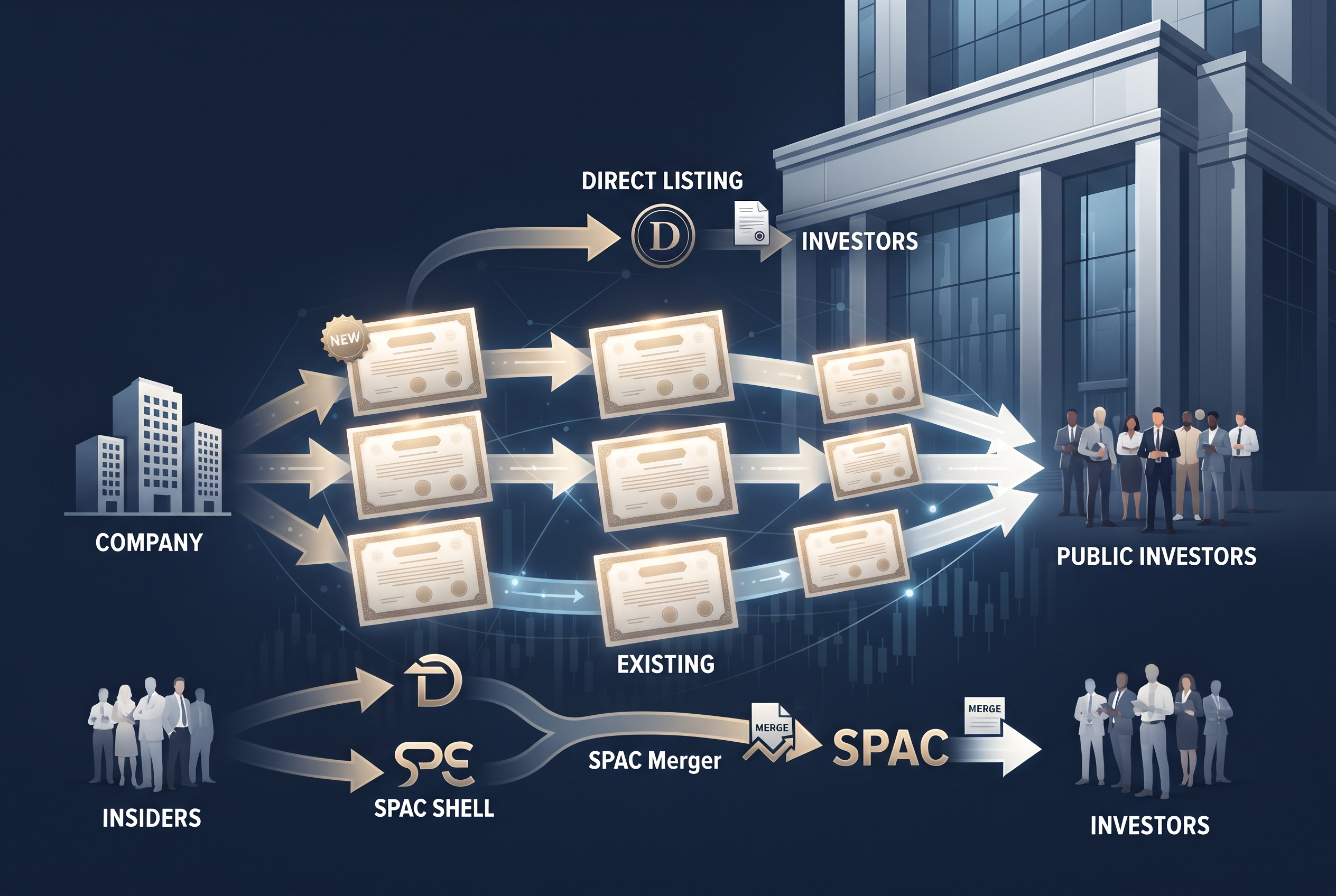
Some IPOs involve newly issued shares that bring fresh capital into the company. Others allow existing shareholders to sell part of their ownership. Some combine both approaches. Companies may also choose alternative routes to public markets, such as direct listings or mergers with special purpose acquisition companies (SPACs).
Understanding these differences is important for investors because each structure has different implications for the company’s finances, ownership, share supply, and future growth plans.
In this guide, we explain the main types of IPOs, how they work, how companies choose between them, and what investors should examine before participating in a public offering.
30-Second Summary: What Are the Different Types of IPOs?
- Primary offering: A company issues new shares and receives the proceeds to finance its operations, expansion, acquisitions, or debt repayment.
- Secondary offering: Existing shareholders sell some of their shares. The proceeds generally go to the selling shareholders rather than the company.
- Combined offering: The company issues new shares while existing shareholders also sell part of their holdings.
- Traditional IPO: Investment banks help structure, market, price, and distribute the shares to investors.
- Direct listing: Existing shares are listed for public trading without a conventional underwritten IPO. Certain direct-listing structures can also include newly issued shares.
- SPAC merger: A private operating company becomes publicly traded by merging with an already-listed acquisition company.
- Private placement: Securities are sold to selected investors under an applicable exemption rather than through a conventional public offering. This is not itself an IPO.
- Investor takeaway: Always determine who is selling the shares, where the proceeds go, how the offering is priced, and how the transaction changes the ownership structure.
1. What Is an IPO?
An initial public offering, commonly known as an IPO, is the process through which a private company offers shares to public-market investors for the first time and becomes publicly traded.
Before an IPO, ownership is generally concentrated among founders, early investors, venture capital firms, private equity funds, and employees.
After the company becomes publicly listed, its shares can be traded by a broader range of investors, subject to the applicable market and regulatory requirements.
In the United States, companies commonly pursue listings on exchanges such as the New York Stock Exchange (NYSE) or Nasdaq.
The traditional IPO process generally involves several stages:
- Selecting investment banks and professional advisers.
- Preparing financial statements and legal documentation.
- Filing the required registration documents with regulators.
- Marketing the offering to potential investors.
- Assessing investor demand and determining the offering price.
- Allocating shares to investors.
- Beginning public trading on the selected exchange.
For U.S. offerings, the registration statement is commonly filed with the Securities and Exchange Commission (SEC), often using Form S-1. The prospectus provides information about the company, its financial position, the offering terms, risk factors, and intended use of proceeds.
An IPO is not simply a mechanism for selling shares. It is also a major corporate financing and ownership decision.
To understand how investor demand is collected during this process, see our guide to how IPO book-building works.
2. Primary Offering: Issuing New Shares to Raise Capital
A primary offering occurs when a company issues new shares and sells them to investors.
The proceeds from these newly issued shares go to the company, generally after deducting offering-related expenses.
This structure is commonly used by businesses that want to finance growth, strengthen their balance sheets, or invest in new projects.
How Does a Primary Offering Work?
Imagine a private technology company called NovaTech.
The company wants to expand its operations, develop new software products, and enter international markets. Management estimates that it needs $150 million to finance these plans.
NovaTech decides to issue 7.5 million new shares at $20 per share.
Its gross proceeds are:
7.5 million × $20 = $150 million
The company receives the proceeds, before underwriting fees and other transaction expenses.
It can then allocate the funds according to its disclosed financing plans.
Why Do Companies Choose Primary Offerings?
Companies may prefer primary offerings for several reasons:
Business expansion: New capital can finance production facilities, distribution networks, new offices, and international operations.
Research and development: Technology, biotechnology, pharmaceutical, and manufacturing companies may require significant funding to develop new products.
Debt repayment: Companies can use some of the proceeds to reduce outstanding borrowings and interest expenses.
Working capital: Additional equity capital can help finance inventory, payroll, supplier payments, and other operating requirements.
Acquisitions: Companies may use IPO proceeds to acquire competitors, technology providers, or businesses in complementary industries.
What Should Investors Consider?
A primary offering can be positive because the company receives fresh capital. However, raising money does not automatically create shareholder value.
Investors should evaluate:
- How much capital the company plans to raise.
- Whether the intended use of proceeds is clearly explained.
- Whether the proposed investments support a realistic growth strategy.
- Whether the company has a history of generating attractive returns on invested capital.
- How many new shares will be issued.
- How much existing shareholders will be diluted.
A company that raises substantial capital but invests it inefficiently may fail to generate the expected returns.
3. Secondary Offering: Existing Shareholders Sell Their Shares
In a secondary share sale within an IPO, existing shareholders sell some or all of their shares to public investors.
Unlike a primary offering, the company does not receive the proceeds from these sales. The money goes to the shareholders who are selling their holdings.
These shareholders may include:
- Company founders
- Early-stage investors
- Venture capital funds
- Private equity firms
- Employees with vested shares
- Other existing shareholders
Why Do Existing Shareholders Sell Shares?
There are several possible reasons.
Realizing investment gains: Early investors may have supported the company for many years and want to convert part of their investment into cash.
Portfolio diversification: Founders and early investors may have a large portion of their personal or institutional wealth concentrated in one company.
Fund lifecycle management: Venture capital and private equity funds may need to distribute proceeds to their own investors or return capital as part of their investment strategy.
Reducing ownership concentration: Existing shareholders may want to reduce their exposure while remaining invested in the company.
Example: An Early Investor Sells Part of Its Stake
Imagine that a private equity fund owns 15 million shares in a company preparing for an IPO.
The fund decides to sell 3 million shares at $25 each.
The gross proceeds from the transaction are:
3 million × $25 = $75 million
The fund receives the $75 million, before applicable transaction expenses and taxes.
The company itself does not receive this amount.
Is a Secondary Offering a Negative Signal?
Not necessarily.
Existing shareholders may sell shares for legitimate financial or portfolio-management reasons. A sale does not automatically indicate that insiders have lost confidence in the business.
However, investors should investigate:
- Who is selling the shares?
- What percentage of their ownership is being sold?
- How much ownership will they retain?
- Are founders and key executives continuing to hold meaningful stakes?
- Is the company raising any new capital at all?
A large secondary component may mean that the IPO provides more liquidity to existing shareholders than fresh funding for the business.
This distinction is especially important when investors are evaluating the company’s long-term growth prospects.
4. Combined Offering: Primary Shares and Secondary Shares
A combined offering includes both newly issued shares and existing shares sold by current shareholders.
This structure allows a company to raise new capital while also providing liquidity to some of its existing investors.
It can be an attractive option when the business needs funding but early shareholders also want to realize part of their investment.
How Does a Combined Offering Work?
Consider a fictional healthcare company called MedCore.
The company plans to issue 8 million new shares at $20 each.
At the same time, two existing investors intend to sell 2 million shares at the same price.
The offering consists of:
| Offering Component | Shares | Price Per Share | Gross Proceeds |
|---|---|---|---|
| New shares issued by the company | 8 million | $20 | $160 million |
| Existing shares sold by shareholders | 2 million | $20 | $40 million |
| Total offering | 10 million | $20 | $200 million |
The company receives $160 million before offering expenses.
The selling shareholders receive $40 million before applicable expenses and taxes.
Why Do Companies Use a Combined Offering?
A combined structure can serve several objectives:
- Raise capital for business expansion.
- Give early investors an opportunity to realize part of their investment.
- Broaden the shareholder base.
- Improve the distribution of ownership.
- Provide a public-market exit opportunity for some existing shareholders.
What Should Investors Watch?
The balance between newly issued and existing shares is important.
An offering in which most shares are newly issued may be primarily focused on financing the company’s growth.
An offering dominated by existing shareholder sales may be more focused on providing liquidity to current owners.
Neither structure is automatically good or bad. Investors should evaluate the reasons behind the transaction and the company’s future capital requirements.
For a deeper explanation of how an IPO can affect share prices, read how stock prices change after an IPO.
5. Traditional IPO: The Conventional Route to Public Markets
A traditional IPO is the most familiar method of becoming a publicly traded company.
In this structure, the company works with investment banks, often referred to as underwriters, to prepare and distribute the offering.
The investment banks help determine the offering structure, assess investor demand, develop the marketing strategy, and establish the initial offering price.
How Does a Traditional IPO Work?
The process generally includes:
Preparation: The company reviews its financial reporting, governance structure, legal documentation, and business strategy.
Registration: The company submits the required registration statement and supporting disclosures to the relevant regulator.
Roadshow: Management and the underwriting banks present the company’s business model, financial performance, and growth plans to potential investors.
Book-building: Investment banks collect indications of interest and assess demand at different price levels.
Pricing: The company and underwriters determine the final offering price based on investor demand, valuation, and market conditions.
Allocation: Shares are distributed to investors.
Listing: The company’s shares begin trading on a public stock exchange.
What Is the Role of Underwriters?
Underwriters are investment banks that help organize and execute the IPO.
Their responsibilities may include:
- Advising on the offering structure.
- Assisting with valuation and pricing.
- Coordinating regulatory and documentation processes.
- Marketing the offering.
- Collecting investor demand.
- Managing the share allocation process.
- Supporting the transition to public trading.
In a firm-commitment underwriting arrangement, the underwriters purchase the offered securities from the issuer and resell them to investors, subject to the terms of the underwriting agreement.
In a best-efforts arrangement, the underwriter agrees to use its efforts to sell the securities but does not necessarily guarantee that the entire offering will be purchased.
These underwriting arrangements affect how the financial risk of an unsuccessful offering is distributed.
Advantages of a Traditional IPO
- Access to institutional and individual investors.
- Professional support during pricing and distribution.
- A structured marketing and investor-education process.
- Potentially greater control over the initial investor base.
- Access to public equity capital.
Potential Disadvantages
- Significant underwriting and advisory costs.
- A lengthy preparation and regulatory process.
- Potential ownership dilution.
- Market uncertainty during the pricing period.
- Ongoing reporting and governance obligations.
A traditional IPO is often suitable for companies seeking to raise significant capital and establish a broad public investor base.
6. Direct Listing: Entering the Public Market Without a Conventional IPO
A direct listing is an alternative route through which a company can become publicly traded.
In a conventional direct listing, existing shareholders make their shares available for trading on a public exchange without the traditional underwritten IPO process.
The company may therefore provide liquidity to existing shareholders without necessarily raising new capital at the time of listing.
However, direct-listing rules have evolved. Certain exchange-approved structures now allow companies to issue new shares and raise capital through a direct listing with a capital raise.
How Does a Direct Listing Work?
In a traditional IPO, investment banks generally help determine the offering price and distribute shares to selected investors before public trading begins.
In a direct listing, the initial trading price is generally established through the exchange’s opening auction, based on market supply and demand.
Existing shareholders may be able to sell their shares once trading begins, subject to applicable restrictions and the specific transaction structure.
Why Might a Company Choose a Direct Listing?
A company may consider a direct listing because:
- It wants to provide liquidity to existing shareholders.
- It does not necessarily need to raise new capital.
- It prefers a market-based price discovery process.
- It wants to avoid some elements of a traditional underwritten offering.
- It already has strong brand recognition and investor interest.
Advantages of a Direct Listing
Potentially broader market access: Shares can become available to market participants through the exchange’s trading process.
Market-based price discovery: The opening price is determined through the relevant market mechanism rather than solely through a conventional pre-listing allocation process.
Potentially fewer underwriting-related costs: Depending on the structure, a direct listing may avoid some traditional underwriting expenses.
Shareholder liquidity: Existing shareholders may gain a route to sell shares.
Potential Disadvantages
- The company may not raise new capital in a traditional direct listing.
- There may be less control over the initial investor base.
- The company may face uncertainty about initial trading demand.
- Price discovery can be volatile.
- The absence of a traditional underwriting structure may mean less conventional support for the initial distribution.
It is important to distinguish a traditional direct listing from a direct listing that includes a capital raise.
For example, Nasdaq provides a framework for direct listings with capital raises, allowing a company to sell newly issued shares through the exchange’s opening auction.
More information is available in Nasdaq’s direct listing overview.
7. SPAC Merger: Going Public Through a Special Purpose Acquisition Company
A special purpose acquisition company (SPAC) is a publicly listed company created specifically to raise capital and subsequently merge with or acquire an existing private business.
SPACs are sometimes called blank-check companies because they generally do not have substantial operating businesses when they conduct their own IPOs.
Instead, they raise funds from public investors with the intention of completing a future business combination.
When a SPAC merges with a private operating company, the transaction is commonly called a de-SPAC transaction.
The operating company becomes part of the publicly traded entity, subject to the applicable transaction and regulatory requirements.
How Does a SPAC Transaction Work?
A simplified SPAC process includes:
- A SPAC is formed and raises capital through its own IPO.
- The proceeds are generally placed in a trust account.
- The SPAC identifies a potential acquisition target.
- The parties negotiate and announce a proposed business combination.
- Shareholders receive the disclosures and voting or redemption rights applicable to the transaction.
- The business combination is completed if the relevant conditions are satisfied.
- The combined operating business becomes publicly traded.
Why Might a Company Choose a SPAC Merger?
A private company may consider this route because it offers an alternative transaction structure for accessing public markets.
Potential motivations include:
- Negotiating a business combination with an experienced sponsor.
- Accessing capital held in the SPAC trust account.
- Combining the transaction with additional private financing.
- Pursuing a different timeline or transaction structure from a traditional IPO.
What Are the Risks?
SPAC transactions involve important risks that investors should understand.
Sponsor incentives: SPAC sponsors may have financial interests that differ from those of public shareholders.
Dilution: Sponsor shares, warrants, and additional financing arrangements can affect the ownership of existing investors.
Redemptions: Public shareholders may choose to redeem their shares rather than remain invested in the proposed transaction, potentially reducing the cash available to the combined company.
Valuation uncertainty: The proposed valuation may depend heavily on future projections and assumptions.
Execution risk: The acquired business may not achieve the financial or operational targets presented during the transaction.
SPACs are not simply another name for traditional IPOs. They involve a different transaction structure and require investors to evaluate both the SPAC and the operating company.
For further information, see the SEC’s investor bulletin on SPACs.
8. Private Placement: Selling Securities to Selected Investors
A private placement is a method of raising capital by selling securities to selected investors rather than conducting a conventional public offering.
Depending on the applicable securities laws and exemptions, investors may include:
- Institutional investment funds
- Venture capital firms
- Private equity funds
- Accredited investors
- Other eligible investors
Private placements are commonly used by companies that want to raise capital without immediately becoming publicly traded.
How Does a Private Placement Work?
Imagine a growing software company that needs $30 million to finance product development and expand its sales team.
Instead of launching a public IPO, the company raises the required capital from a group of institutional and eligible private investors.
The investors receive shares or other securities in exchange for their investment, depending on the transaction structure.
The company receives funding while remaining privately held.
Is a Private Placement an IPO?
No.
A private placement is generally a separate capital-raising method. It does not automatically make the company publicly traded.
In the United States, certain private offerings may rely on exemptions from registration under the Securities Act of 1933. The applicable requirements and investor eligibility rules depend on the exemption used.
For example, some Regulation D offerings are limited to accredited investors or subject to specific conditions.
Why Is This Important for IPO Investors?
A company may have raised capital through private placements before going public.
Investors evaluating an IPO should examine:
- Previous private financing rounds.
- The valuation at which earlier investors purchased shares.
- The rights attached to different share classes.
- Potential conversion of preferred shares.
- Ownership concentration.
- Any restrictions affecting existing shareholders.
These details can influence the company’s post-IPO ownership structure and the potential dilution experienced by public investors.
9. Primary vs. Secondary vs. Combined Offerings: Key Differences
The three main share-sale structures are often confused because they can all appear within an IPO.
The following table summarizes their differences.
| Feature | Primary Offering | Secondary Offering | Combined Offering |
|---|---|---|---|
| Who sells the shares? | The company | Existing shareholders | Both |
| Are new shares issued? | Yes | No, for the secondary component | Yes, for the primary component |
| Who receives the proceeds? | The company | Selling shareholders | Both |
| Does it raise fresh company capital? | Yes | No | Yes |
| Can existing shareholders reduce their ownership? | Through dilution of their percentage ownership | By selling shares | Through sales and dilution effects |
| Main purpose | Business financing | Shareholder liquidity | Financing and shareholder liquidity |
Why Does This Distinction Matter?
Suppose two companies each announce a $300 million IPO.
Company A raises the entire amount by issuing new shares.
Company B raises $50 million through new shares and $250 million through existing shareholder sales.
Both offerings have the same gross size, but their financial implications are very different.
Company A receives substantially more capital for its business.
Company B provides much more liquidity to its existing shareholders.
Investors should therefore never evaluate an IPO based solely on the headline offering size.
10. Different Ways IPO Shares Are Sold: Firm Commitment, Best Efforts, and Auction Methods
In addition to the source of the shares, the method used to distribute and price them is important.
Firm-Commitment Underwriting
In a firm-commitment arrangement, the underwriters agree to purchase the securities from the issuer and resell them to investors under the terms of the underwriting agreement.
The underwriters assume the risk associated with reselling the securities, subject to the agreement’s conditions.
This structure is common in traditional U.S. IPOs.
Best-Efforts Underwriting
In a best-efforts arrangement, the underwriter agrees to use reasonable efforts to sell the securities but does not necessarily guarantee that all shares will be sold.
The company may therefore face the risk that the offering will not raise the intended amount.
The precise terms depend on the underwriting agreement.
Auction-Based Pricing
In an auction-based offering, investor bids and market demand play a central role in determining the price and allocation of shares.
The exact mechanism depends on the market and the offering structure.
Auction-based pricing is different from traditional book-building, in which underwriters collect investor indications of interest and use them to help determine the final offering price.
Book-Building vs. Auction Pricing
| Feature | Book-Building | Auction-Based Pricing |
|---|---|---|
| Demand collection | Underwriters collect investor indications of interest | Investors submit bids under the auction rules |
| Price determination | Issuer and underwriters assess demand and valuation | Price is determined through the auction mechanism |
| Underwriter involvement | Typically central | Depends on the offering structure |
| Allocation | Generally managed by the underwriting syndicate | Based on the applicable auction rules |
| Investor access | May involve selected investor groups during allocation | Depends on eligibility and auction design |
Neither method guarantees that the stock will perform well after listing.
Investors should also understand that the initial offering price and the subsequent market price may differ significantly.
11. Which IPO Structure Is Best for Investors?
There is no universally best IPO structure.
Each method serves different corporate objectives and creates different implications for investors.
The important question is not simply which type of offering is being used, but whether the structure makes sense given the company’s financial needs, ownership situation, and growth strategy.
Consider the following framework:
| IPO Structure | What Investors Should Examine |
|---|---|
| Primary offering | Use of proceeds, growth investments, expected dilution |
| Secondary offering | Identity of selling shareholders, reasons for selling, remaining ownership |
| Combined offering | Balance between new capital and shareholder liquidity |
| Traditional IPO | Valuation, underwriter role, allocation, offering expenses |
| Direct listing | Price discovery, share supply, market demand, whether new capital is raised |
| SPAC merger | Sponsor incentives, dilution, redemptions, valuation assumptions |
| Private placement | Investor eligibility, security terms, ownership rights, future dilution |
Questions Every IPO Investor Should Ask
Before investing in an IPO, consider the following:
- Is the company raising new capital?
- What percentage of the offering consists of existing shareholder sales?
- Why are current shareholders selling?
- How will the company use the proceeds?
- Is the proposed valuation reasonable?
- What is the company’s financial position?
- Are there multiple share classes with different voting rights?
- What percentage of ownership will founders and major investors retain?
- Are there lock-up agreements?
- Could future share issuance create additional dilution?
For a more detailed evaluation framework, read what investors should look for before investing in an IPO.
12. Practical Example: Comparing Three Different IPO Structures
Imagine three fictional companies preparing to enter the U.S. public markets.
Each company plans to conduct an offering worth approximately $200 million, but their objectives are different.
Company A: GrowthTech — Primary Offering
GrowthTech issues 10 million new shares at $20 each.
Gross proceeds:
10 million × $20 = $200 million
The company plans to use the money for research and development, international expansion, and new infrastructure.
Investor perspective: The company receives substantial fresh capital. Investors should examine whether management can use that capital efficiently and generate attractive returns.
Company B: RetailPro — Secondary Offering
RetailPro’s existing shareholders sell 10 million shares at $20 each.
Gross proceeds:
10 million × $20 = $200 million
The proceeds go to the selling shareholders rather than the company.
Investor perspective: Investors should understand why the existing owners are selling and whether the company has sufficient financial resources to support its future growth.
Company C: HealthVision — Combined Offering
HealthVision issues 7 million new shares and its existing shareholders sell 3 million shares, all at $20 each.
| Component | Shares | Gross Proceeds |
|---|---|---|
| New shares | 7 million | $140 million |
| Existing shares | 3 million | $60 million |
| Total | 10 million | $200 million |
The company receives $140 million before offering expenses, while existing shareholders receive $60 million before applicable expenses and taxes.
Investor perspective: The company obtains fresh capital, while some early shareholders gain liquidity. Investors should evaluate whether the balance between these two objectives is reasonable.
What Does This Comparison Tell Us?
All three companies conduct offerings of the same gross size.
However, the amount of money received by each company is different.
That is why the type of offering matters. A $200 million IPO does not necessarily mean that the company will receive $200 million in new funding.
13. How to Read an IPO Prospectus and Identify the Offering Type
The IPO prospectus is one of the most important documents investors should examine before participating in an offering.
In the United States, a company conducting a registered IPO generally provides a prospectus as part of its registration statement.
Investors can access many public-company filings through the SEC’s EDGAR database.
The following sections are particularly useful.
1. The Offering Section
This section describes the number of shares being offered, the proposed price range, and the offering structure.
Look for whether the shares are newly issued or being sold by existing shareholders.
2. Use of Proceeds
This section explains how the company intends to use the money it receives from the offering.
It is especially important in a primary or combined offering.
3. Principal and Selling Shareholders
This section identifies major shareholders and, where applicable, the shares they intend to sell.
It can help investors understand the ownership structure before and after the transaction.
4. Capitalization
The capitalization section provides information about the company’s debt and equity structure.
Investors should examine how the IPO changes the company’s share count and capital position.
5. Shares Eligible for Future Sale
This section can provide information about shares that may become available for sale after the IPO, including restrictions and lock-up arrangements.
A large number of shares becoming eligible for sale may influence the stock’s future supply and trading dynamics.
6. Risk Factors
The risk factors section describes important risks related to the company’s business, industry, financial condition, ownership structure, and offering.
Investors should not treat the prospectus as a promotional document. It is a source of material information that should be read critically.
14. Common Mistakes Investors Make When Evaluating IPO Types
Even experienced investors can misunderstand the implications of an IPO structure.
Some common mistakes include:
Mistake 1: Assuming the Entire Offering Proceeds Go to the Company
This is incorrect when existing shareholders are selling shares.
Always distinguish between primary and secondary components.
Mistake 2: Treating Every Secondary Sale as a Warning Sign
Early investors may sell shares for portfolio management, fund distributions, or diversification.
The context matters more than the fact that a sale is taking place.
Mistake 3: Confusing a Direct Listing With a Traditional IPO
A conventional direct listing generally does not involve the same underwritten distribution process as a traditional IPO.
Some direct-listing structures can include a capital raise, so investors should check the exact transaction terms.
Mistake 4: Assuming a SPAC Is the Same as a Traditional IPO
A SPAC merger involves a publicly traded acquisition vehicle and a business combination with an operating company.
Its sponsor incentives, dilution, redemption mechanics, and transaction disclosures require separate analysis.
Mistake 5: Ignoring Dilution
Newly issued shares increase the number of shares outstanding, which can reduce existing shareholders’ percentage ownership.
Investors should understand the post-offering share count and any additional securities that may convert into shares.
Mistake 6: Focusing Only on the Offering Price
A low nominal share price does not necessarily mean a company is cheap.
Investors should consider market capitalization, enterprise value, earnings, revenue, cash flow, and growth expectations.
Our guide to using fundamental analysis to choose stocks explains how to assess these factors.
15. Final Thoughts: Understanding the Structure Behind Every IPO
IPOs are not all structured in the same way.
A primary offering provides fresh capital to a company. A secondary offering provides liquidity to existing shareholders. A combined offering serves both purposes.
Beyond these structures, companies can access public markets through traditional IPOs, direct listings, and SPAC mergers, each with different processes, costs, and investor considerations.
For investors, understanding these differences is essential.
The size of an offering alone does not tell the full story. What matters is who is selling the shares, who receives the proceeds, how the transaction changes ownership, and whether the company has a credible plan for creating long-term value.
A well-informed investor should therefore read the prospectus, examine the use of proceeds, evaluate the ownership structure, and assess the company’s financial fundamentals before making an investment decision.
Disclaimer: This article is for educational and informational purposes only. It does not constitute investment, legal, tax, or financial advice. IPO structures, securities regulations, investor eligibility, and listing requirements differ across jurisdictions. Investors should review the official offering documents and consider their own circumstances before making investment decisions.



Pingback: Primary vs. Secondary Offerings: What Is the Difference and Why Does It Matter? - Daily Stock Markets