
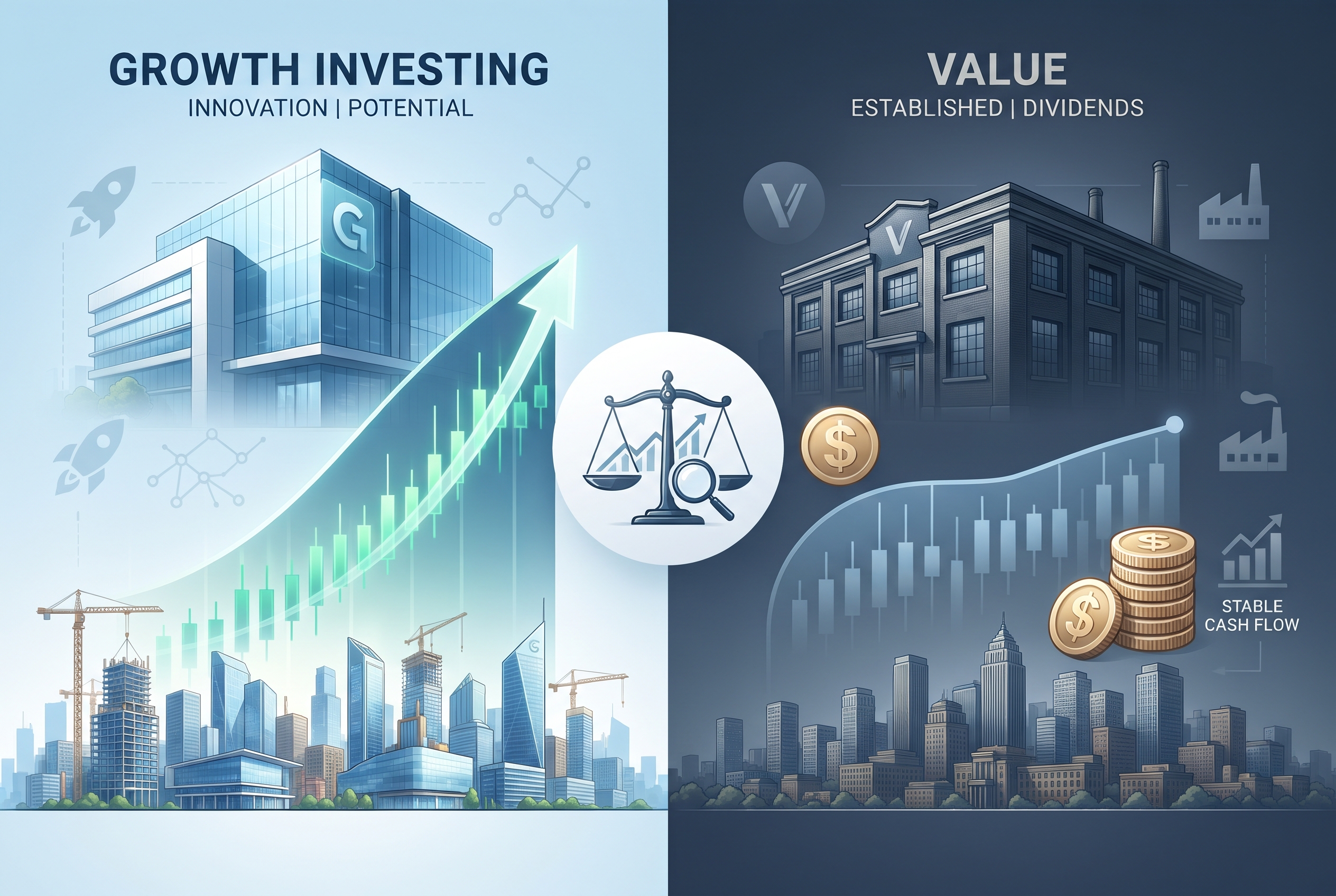
Growth Stocks vs. Value Stocks: Which Investing Style Is Right for You?
When you start investing in the stock market, you quickly encounter two popular investment styles: growth investing and value investing. Both aim to help investors build wealth, but they approach stock selection from different perspectives.
Growth investors look for companies that can expand their revenue, earnings, and market share faster than their competitors. Value investors, on the other hand, search for companies whose shares appear to trade below their underlying or intrinsic value.
But which approach is better? Should you focus on innovative companies with strong growth potential, or established businesses trading at relatively attractive valuations?
The answer depends on more than your preferred investment style. Your financial goals, investment horizon, risk tolerance, valuation discipline, and ability to withstand market volatility all matter.
In this guide, we explain the differences between growth stocks and value stocks, explore their advantages and disadvantages, and show you how to evaluate which approach may fit your investment strategy.
30-Second Summary: Growth Stocks vs. Value Stocks
- Growth stocks represent companies expected to increase revenue and earnings faster than the market or their industry peers.
- Value stocks are shares that investors believe are trading below their intrinsic value based on business fundamentals.
- Growth companies often reinvest profits into expansion and may pay little or no dividends.
- Value companies are often more established and may offer attractive valuations and dividend income.
- Growth stocks can be particularly sensitive to changes in interest rates, earnings expectations, and investor sentiment.
- Value stocks can remain undervalued for years or decline further if their underlying businesses deteriorate.
- You do not have to choose one style exclusively. A diversified portfolio can include both growth and value investments.
What Are Growth Stocks?
Growth stocks are shares of companies expected to increase their revenue, earnings, cash flow, or market share at a faster rate than the broader market or their industry competitors.
These companies often operate in expanding industries or have business models that allow them to scale rapidly. Technology, biotechnology, cloud computing, artificial intelligence, and innovative healthcare are examples of areas where growth-oriented companies may be found.
However, growth stocks are not limited to young technology companies. An established business can also qualify as a growth stock if investors expect it to deliver above-average growth.
Key Characteristics of Growth Stocks
- Above-average growth expectations: Investors expect revenue, earnings, or cash flow to increase faster than the market average.
- Reinvestment: Companies may reinvest a significant portion of their profits into research and development, new products, technology, acquisitions, or geographic expansion.
- Higher valuation multiples: Growth stocks often trade at higher price-to-earnings (P/E) or price-to-sales (P/S) ratios because investors are willing to pay for anticipated future performance.
- Limited dividend payments: Many growth companies prefer to reinvest cash rather than distribute it to shareholders.
- Greater sensitivity to expectations: A disappointing earnings report or weaker growth outlook can lead to a substantial share-price decline.
Why Do Investors Buy Growth Stocks?
The main attraction is the possibility of capital appreciation. If a company successfully expands its business and increases its earnings over time, its stock price may rise as the market recognizes the company’s stronger financial performance.
For example, imagine a software company that generates $500 million in annual revenue and grows its sales by 25% each year. If it maintains attractive profit margins and converts its growth into sustainable cash flow, investors may assign a higher valuation to the business.
However, strong business growth does not automatically translate into strong stock returns. Investors must also consider the price they pay. A company can perform well operationally while its stock underperforms because the market had already priced in even stronger growth.
What Are Value Stocks?
Value stocks are shares of companies that appear to be trading below their intrinsic value or below what their financial fundamentals suggest they may be worth.
Value investors attempt to identify businesses that the market may be overlooking, undervaluing, or temporarily penalizing. They seek opportunities where the market price is lower than a reasonable estimate of the company’s underlying value.
Value stocks are often associated with mature businesses, established industries, consistent cash generation, and relatively attractive valuation multiples. However, a company does not become a value investment simply because its share price has fallen or its P/E ratio is low.
Key Characteristics of Value Stocks
- Relatively low valuation multiples: Value stocks may trade at lower P/E, price-to-book (P/B), or enterprise-value-to-EBITDA multiples than comparable companies.
- Established operations: Many value companies have mature business models, established customer bases, and recognizable market positions.
- Cash-flow generation: Some value-oriented businesses generate relatively predictable operating cash flow.
- Potential dividend income: Mature companies may distribute a portion of their earnings to shareholders through dividends.
- Market pessimism: Their shares may be undervalued because of temporary business challenges, negative sentiment, or concerns about the industry.
Why Do Investors Buy Value Stocks?
Value investors believe that the market sometimes prices companies incorrectly. A business may experience a temporary setback, face unfavorable market sentiment, or attract less investor attention than its fundamentals justify.
If the business remains financially healthy and its long-term prospects are better than the market expects, its share price may eventually move closer to its intrinsic value.
Value investing therefore requires patience and careful analysis. The market may take much longer than expected to recognize a company’s underlying worth.
To understand this approach in greater detail, read our guide to intrinsic value and how to estimate a stock’s real value.
Growth Stocks vs. Value Stocks: Key Differences
Although both categories represent ownership in publicly traded companies, they differ in terms of investor expectations, valuation, financial characteristics, and potential sources of return.
| Characteristic | Growth Stocks | Value Stocks |
|---|---|---|
| Primary focus | Above-average future growth | Price below estimated intrinsic value |
| Revenue and earnings | Expected to grow relatively quickly | Often more mature or slower-growing |
| Valuation multiples | Often higher | Often lower |
| Dividend policy | Often low or no dividends | May offer regular dividends |
| Use of profits | Frequently reinvested into expansion | May be distributed or reinvested selectively |
| Investor expectations | Strong future business performance | Potential market recognition of undervaluation |
| Common risk | Growth expectations may not be achieved | Shares may remain undervalued or deteriorate |
| Potential return drivers | Earnings growth and valuation changes | Business improvement, dividends, and valuation changes |
These are general tendencies, not fixed rules. A growth company can pay dividends, and a value company can experience strong earnings growth. Some businesses display characteristics of both styles.
How to Identify Growth Stocks
Identifying a growth stock requires more than looking at a company’s recent share-price performance. Investors should evaluate whether the underlying business can sustain its growth over time.
1. Examine Revenue Growth
Revenue growth is an important starting point. Consistent sales expansion may indicate that a company is attracting new customers, increasing demand, entering new markets, or expanding its product portfolio.
Compare revenue growth over several years rather than relying on a single quarter. Also compare the company’s performance with competitors and industry averages.
2. Evaluate Earnings Growth
Revenue growth is valuable, but investors also need to understand whether the company can translate sales into profits.
Examine operating income, net income, earnings per share (EPS), and profit margins. A company whose revenue grows rapidly while losses continue to expand may face a different risk profile from one that combines growth with improving profitability.
3. Review Competitive Advantages
Sustainable growth often depends on a company’s ability to protect its market position. Competitive advantages may include:
- Strong brand recognition
- Patents and proprietary technology
- Network effects
- High customer switching costs
- Economies of scale
- Unique distribution channels
Without a defensible competitive position, a company’s growth may attract new competitors and become difficult to sustain.
4. Consider Valuation
Even an excellent company can become an unattractive investment if its shares are priced too aggressively.
Common metrics used to evaluate growth stocks include:
- Price-to-Earnings (P/E): Compares a company’s share price with its earnings per share.
- Price-to-Sales (P/S): Compares market capitalization with annual revenue, which can be useful when earnings are low or negative.
- PEG Ratio: Relates the P/E ratio to an expected earnings growth rate. Its usefulness depends heavily on the quality of the growth estimate.
- Free Cash Flow: Helps investors assess whether the business generates cash after capital expenditures.
These indicators should be considered alongside business quality, financial risk, and future expectations. No single valuation ratio can determine whether a stock is attractive.
How to Identify Value Stocks
Value investing involves finding companies whose market prices appear lower than their underlying business value. The challenge is distinguishing genuine opportunities from businesses that are cheap for good reasons.
1. Look for Attractive Valuation Ratios
Value investors often begin with financial ratios that help compare a company’s market valuation with its financial performance.
- Price-to-Earnings (P/E): A relatively low P/E ratio may indicate that a stock is inexpensive compared with its earnings.
- Price-to-Book (P/B): Compares market capitalization with the accounting value of shareholders’ equity.
- Enterprise Value-to-EBITDA (EV/EBITDA): Compares the total value of a business, including debt and cash adjustments, with its operating earnings before interest, taxes, depreciation, and amortization.
- Dividend Yield: Measures annual dividends relative to the current share price.
A low ratio is not proof of undervaluation. Investors should compare companies with similar business models and investigate why the market assigns a lower valuation.
2. Assess Financial Strength
A potential value investment should be examined for financial resilience. Consider its debt levels, liquidity, cash flow, profitability, and ability to meet financial obligations.
A company may look inexpensive because investors are concerned about excessive debt, declining sales, weak cash generation, or deteriorating competitive conditions.
Our guide to using fundamental analysis to choose stocks explains how to assess these factors systematically.
3. Understand Why the Stock Is Undervalued
This is one of the most important steps in value investing.
Ask yourself:
- Is the company experiencing a temporary setback or a structural decline?
- Are its products and services still competitive?
- Is management allocating capital effectively?
- Can the company maintain its profitability?
- Does the balance sheet provide enough financial flexibility?
- What could cause the market to reassess the company’s value?
If the business is losing market share permanently or facing an unsustainable financial position, a low valuation may be justified.
4. Look for a Margin of Safety
Value investors often seek a margin of safety: a meaningful difference between their estimated intrinsic value and the market price.
This approach recognizes that financial forecasts are uncertain. Estimates of future cash flow, profitability, and growth can be wrong. Buying at a sufficient discount may help reduce the impact of analytical errors, although it cannot eliminate investment risk.
Growth Stocks vs. Value Stocks: Understanding the Risks
Neither investment style is automatically safer or more profitable. Each comes with a different set of risks that investors should understand before making investment decisions.
Risks of Growth Stocks
- High expectations: A company may deliver strong results but still disappoint investors if its growth falls short of expectations.
- Valuation risk: High valuation multiples can leave limited room for error.
- Interest-rate sensitivity: Higher interest rates can reduce the present value of expected future cash flows, potentially putting pressure on highly valued growth stocks.
- Competition: New technologies, competitors, or changing consumer preferences may weaken a company’s growth prospects.
- Profitability challenges: Rapid expansion does not guarantee sustainable earnings or positive free cash flow.
Risks of Value Stocks
- Value traps: A stock may appear cheap because the company’s business is deteriorating.
- Slow recovery: The market may not recognize the company’s value for years.
- Dividend cuts: Dividends can be reduced or suspended when financial conditions deteriorate.
- Structural industry decline: Established businesses may lose relevance because of technological or economic changes.
- Uncertain catalysts: There may be no clear event or improvement that causes the stock to recover.
The key lesson is that a low share price does not necessarily mean a bargain, just as a high-growth business does not necessarily represent a good investment.
A Practical Example: Growth vs. Value Investing
Imagine two fictional companies listed on a US stock exchange: NovaTech and Heritage Industries.
Both companies have a market capitalization of $10 billion, but their business models and financial profiles are very different.
Company A: NovaTech (Growth-Oriented)
- Annual revenue: $2 billion
- Annual revenue growth: 25%
- Net income: $200 million
- P/E ratio: 50
- Dividend yield: 0%
NovaTech operates in the enterprise software industry. It is expanding internationally, investing heavily in product development, and increasing its customer base.
Investors expect its earnings to grow significantly over the next several years. That optimism is reflected in its relatively high P/E ratio.
However, if revenue growth slows from 25% to 10%, investors may reassess the company’s valuation. Its share price could decline even if the company remains profitable.
Company B: Heritage Industries (Value-Oriented)
- Annual revenue: $5 billion
- Annual revenue growth: 3%
- Net income: $500 million
- P/E ratio: 12
- Dividend yield: 3%
Heritage Industries operates in a mature industrial sector. Its revenue is growing slowly, but it has an established customer base, relatively stable cash flows, and a history of dividend payments.
Investors may consider the company attractive if they believe its current share price does not adequately reflect its earnings power and long-term business value.
However, its low P/E ratio could also reflect concerns about declining demand, rising costs, or industry disruption.
Comparing the Two Companies
| Metric | NovaTech | Heritage Industries |
|---|---|---|
| Market capitalization | $10 billion | $10 billion |
| Revenue | $2 billion | $5 billion |
| Revenue growth | 25% | 3% |
| Net income | $200 million | $500 million |
| P/E ratio | 50 | 12 |
| Dividend yield | 0% | 3% |
| Investment profile | Growth-oriented | Value-oriented |
Which company is the better investment?
There is no automatic answer. NovaTech may offer stronger growth potential, but its valuation depends on delivering substantial future earnings. Heritage Industries may offer a lower valuation and dividend income, but investors need to understand why the market is pricing it relatively cheaply.
The decision should depend on the investor’s assessment of each company’s future cash flows, competitive position, financial strength, valuation, and risk.
Which Is Better for Different Types of Investors?
Your investment style should reflect your financial circumstances and objectives rather than simply following whichever category is performing best in the market.
Growth Stocks May Appeal to Investors Who:
- Have a relatively long investment horizon.
- Can tolerate substantial share-price fluctuations.
- Are primarily interested in long-term capital appreciation.
- Understand that high growth expectations can create valuation risk.
- Are comfortable analyzing business models, competitive advantages, and future earnings potential.
Value Stocks May Appeal to Investors Who:
- Prefer to focus on financial fundamentals and valuation.
- Are willing to wait for the market to recognize a company’s underlying value.
- Appreciate the potential for dividend income.
- Look for companies trading at discounts to estimated intrinsic value.
- Are prepared to investigate whether a low valuation reflects temporary problems or permanent business deterioration.
These are broad tendencies, not investor classifications. A long-term investor can pursue value investing, and a growth investor can have a relatively conservative approach to position sizing and diversification.
Can You Invest in Both Growth and Value Stocks?
Absolutely. Growth and value investing are not mutually exclusive strategies.
Combining both styles can help diversify a portfolio across different types of businesses, valuation characteristics, and potential sources of return.
For example, an investor might hold shares in companies with strong earnings growth alongside established businesses with attractive valuations and consistent cash generation.
An Illustrative Portfolio Allocation
Consider a hypothetical stock portfolio with the following allocation:
- 50% growth-oriented stocks
- 40% value-oriented stocks
- 10% broad-market equity exposure
This is simply an illustration, not a recommended allocation. The appropriate mix depends on the investor’s objectives, financial situation, risk capacity, and overall portfolio composition.
Investors can also gain exposure through mutual funds and exchange-traded funds (ETFs) that follow growth or value strategies. Before investing, review each fund’s methodology, holdings, fees, sector exposure, and concentration risk.
It is also worth remembering that growth and value categories can overlap. A company may have strong growth prospects while trading at a reasonable valuation. This is sometimes described as growth at a reasonable price (GARP).
How Do Market Conditions Affect Growth and Value Stocks?
Economic conditions, interest rates, inflation, investor sentiment, and earnings expectations can influence the relative performance of growth and value stocks.
Interest Rates
Growth stocks can be sensitive to changes in interest rates because a larger portion of their perceived value may depend on earnings expected far into the future.
When interest rates rise, the present value of those future cash flows may decline, potentially putting pressure on valuations. However, the actual impact depends on business fundamentals, starting valuations, and the broader market environment.
Economic Expansion
During periods of strong economic activity, companies with expanding sales, rising earnings, and growing market opportunities may attract investor attention.
However, established value-oriented businesses can also benefit from economic growth, especially when demand improves and operating margins recover.
Economic Slowdowns
Some mature businesses with stable demand and strong balance sheets may demonstrate resilience during economic slowdowns. Yet not all value stocks are defensive. Companies in cyclical industries can be particularly vulnerable when economic activity weakens.
Inflation
Inflation can affect companies differently depending on their pricing power, cost structure, debt levels, and ability to protect profit margins.
Businesses that can pass higher costs on to customers may be better positioned than those operating with limited pricing flexibility.
For a broader explanation, see our article on how inflation affects purchasing power and investment decisions.
Common Mistakes to Avoid When Choosing Between Growth and Value Stocks
Investors can make costly mistakes when they focus too heavily on labels or individual financial ratios.
1. Assuming Growth Always Means Higher Returns
A company can grow rapidly while its stock delivers disappointing returns. If investors pay too much for future growth, even strong business performance may not be enough to justify the valuation.
2. Buying a Stock Only Because Its P/E Ratio Is Low
A low P/E ratio may indicate an attractive valuation, but it can also reflect declining earnings, excessive debt, or weak future prospects. Always investigate the reasons behind the valuation.
3. Ignoring Cash Flow
Accounting earnings do not always translate into cash. Investors should examine operating cash flow, capital expenditures, and free cash flow to understand whether a company generates sustainable cash.
4. Confusing a Falling Stock Price With Undervaluation
A stock that has fallen 40% is not automatically cheap. Its underlying business value may have declined even more.
5. Concentrating Too Much on One Investment Style
Growth and value stocks can outperform at different stages of the market cycle. Concentrating exclusively on one style may expose a portfolio to prolonged periods of relative underperformance.
6. Ignoring Investment Discipline
Frequent strategy changes based on short-term market movements can undermine long-term investment decisions. A clear process for evaluating companies, managing risk, and reviewing portfolio allocations is essential.
Read our guide to the most common stock investing mistakes to learn how to avoid other frequent errors.
A Practical Checklist Before Choosing a Stock
Before deciding whether a company fits a growth or value strategy, consider the following questions.
Business Quality
- Does the company have a sustainable competitive advantage?
- Is demand for its products or services likely to remain strong?
- Does management have a credible long-term strategy?
Financial Performance
- Are revenue and earnings growing or declining?
- Are profit margins sustainable?
- Does the company generate positive operating cash flow?
- Is its debt manageable?
Valuation
- How does the company’s valuation compare with its historical levels?
- How does it compare with industry peers?
- Are future growth expectations already reflected in the share price?
- Is there a reasonable margin of safety?
Portfolio Fit
- Does the stock match your investment horizon?
- Can you tolerate its potential volatility?
- Does it increase or reduce concentration in your portfolio?
- Does it support your overall financial objectives?
Final Thoughts: Find the Investment Style That Matches Your Goals
Growth investing and value investing offer two different ways to evaluate opportunities in the stock market.
Growth investors focus on businesses with the potential to expand faster than their peers. Value investors seek companies whose shares appear to trade below their underlying worth.
Neither approach guarantees superior returns. Growth stocks can disappoint when expectations become too optimistic, while value stocks can remain undervalued or lose value when business fundamentals deteriorate.
The most important step is to understand what you are buying, why you are buying it, and what could make your investment thesis wrong.
You also do not need to commit exclusively to one style. A balanced investment approach can include both growth and value companies, provided the overall portfolio reflects your financial goals, risk tolerance, and investment horizon.
Ultimately, successful investing is not about choosing the most popular category. It is about making informed decisions, paying attention to valuation, diversifying appropriately, and maintaining a consistent investment process.
Frequently Asked Questions (FAQs)
1. What is the main difference between growth stocks and value stocks?
Growth stocks represent companies expected to increase their revenue and earnings faster than average. Value stocks are shares that investors believe are trading below their intrinsic value or financial worth.
2. Are growth stocks riskier than value stocks?
Growth stocks can be more sensitive to changes in earnings expectations and valuation multiples. However, value stocks also carry significant risks, including deteriorating fundamentals and the possibility of remaining undervalued. Neither category is inherently safe.
3. Do growth stocks pay dividends?
Some growth stocks pay dividends, but many distribute little or no cash to shareholders because they reinvest profits into expansion, research, development, and other business opportunities.
4. Do value stocks always have low P/E ratios?
No. A relatively low P/E ratio is common among value stocks, but it is not a requirement. Investors should evaluate valuation alongside cash flow, debt, profitability, competitive position, and future business prospects.
5. Can a stock be both a growth stock and a value stock?
Yes. A company can have strong growth prospects while trading at a reasonable valuation. Investors sometimes describe this approach as growth at a reasonable price, or GARP.
6. Which is better for beginners: growth or value stocks?
Neither style is automatically better for beginners. New investors should first understand company fundamentals, valuation, diversification, and risk management. Broadly diversified funds may also help beginners gain exposure without relying on a small number of individual stocks.
7. Are value stocks better during a recession?
Not necessarily. Some value companies have stable demand and strong balance sheets, but others operate in economically sensitive industries. A company’s financial resilience matters more than its value-stock label.
8. Why do growth stocks often have high P/E ratios?
Investors may be willing to pay more for each dollar of current earnings because they expect substantially higher earnings in the future. However, high valuations also create the risk of disappointing returns if expectations are not achieved.
9. What is a value trap?
A value trap is a stock that appears inexpensive based on financial ratios but continues to underperform because the company’s underlying business is deteriorating or its problems are more serious than investors initially expected.
10. How do interest rates affect growth stocks?
Higher interest rates can reduce the present value of future cash flows and increase financing costs. This can put pressure on growth-stock valuations, particularly when a large portion of their estimated value depends on distant future earnings.
11. Are dividend stocks always value stocks?
No. Many value stocks pay dividends, but dividend payments do not automatically make a company a value investment. Some growth companies also distribute dividends, and some value companies do not pay any.
12. What financial ratios are useful for evaluating growth stocks?
Investors often examine revenue growth, earnings growth, P/E, P/S, PEG, operating margins, and free cash flow. The most relevant metrics depend on the company’s industry and business model.
13. What financial ratios are useful for evaluating value stocks?
Common indicators include P/E, P/B, EV/EBITDA, dividend yield, free cash flow yield, and debt-related ratios. These metrics should be compared with industry peers and historical performance.
14. Can growth stocks outperform value stocks?
Yes. Growth stocks can outperform when their earnings expand faster than expected and investors continue to assign attractive valuations to their future prospects. However, performance varies across market cycles.
15. Can value stocks outperform growth stocks?
Yes. Value stocks can outperform when investors become more optimistic about undervalued businesses, earnings recover, or market conditions favor companies with established cash flows. No investment style outperforms consistently.
16. How long should you hold growth stocks?
There is no universal holding period. Investors should evaluate whether the company’s growth prospects, competitive position, and valuation continue to support the original investment thesis. A long investment horizon does not mean holding a company regardless of changing fundamentals.
17. Can I combine growth and value stocks in one portfolio?
Yes. Combining both styles can provide exposure to different types of businesses and investment opportunities. The appropriate allocation depends on your objectives, risk tolerance, and overall diversification strategy.
18. What is the difference between a growth ETF and a value ETF?
A growth ETF generally tracks an index or strategy focused on companies with stronger expected growth characteristics. A value ETF focuses on stocks selected using valuation-related criteria. Their methodologies, holdings, fees, and sector exposures can differ significantly.
19. Is a low stock price the same as a value stock?
No. A stock trading at $5 is not necessarily cheaper than a stock trading at $100. Share price alone does not measure valuation. Investors should consider market capitalization, earnings, cash flow, assets, and estimated intrinsic value.
20. How can I decide whether growth or value investing suits me?
Start by defining your financial goals, investment horizon, and ability to tolerate losses. Then consider whether you prefer analyzing future business growth or identifying companies trading below estimated intrinsic value. You can also combine both approaches rather than choosing only one.