What Are Stock Buybacks? How Share Repurchases Affect Investors
When a publicly traded company announces a stock buyback program, investors often interpret the news as a positive signal. Headlines such as “Company Announces a $5 Billion Share Repurchase Program” can attract attention because they suggest that the business may be returning capital to shareholders or believes its shares are undervalued.
But what exactly is a stock buyback? Why do companies purchase their own shares, and how can these transactions affect existing shareholders?
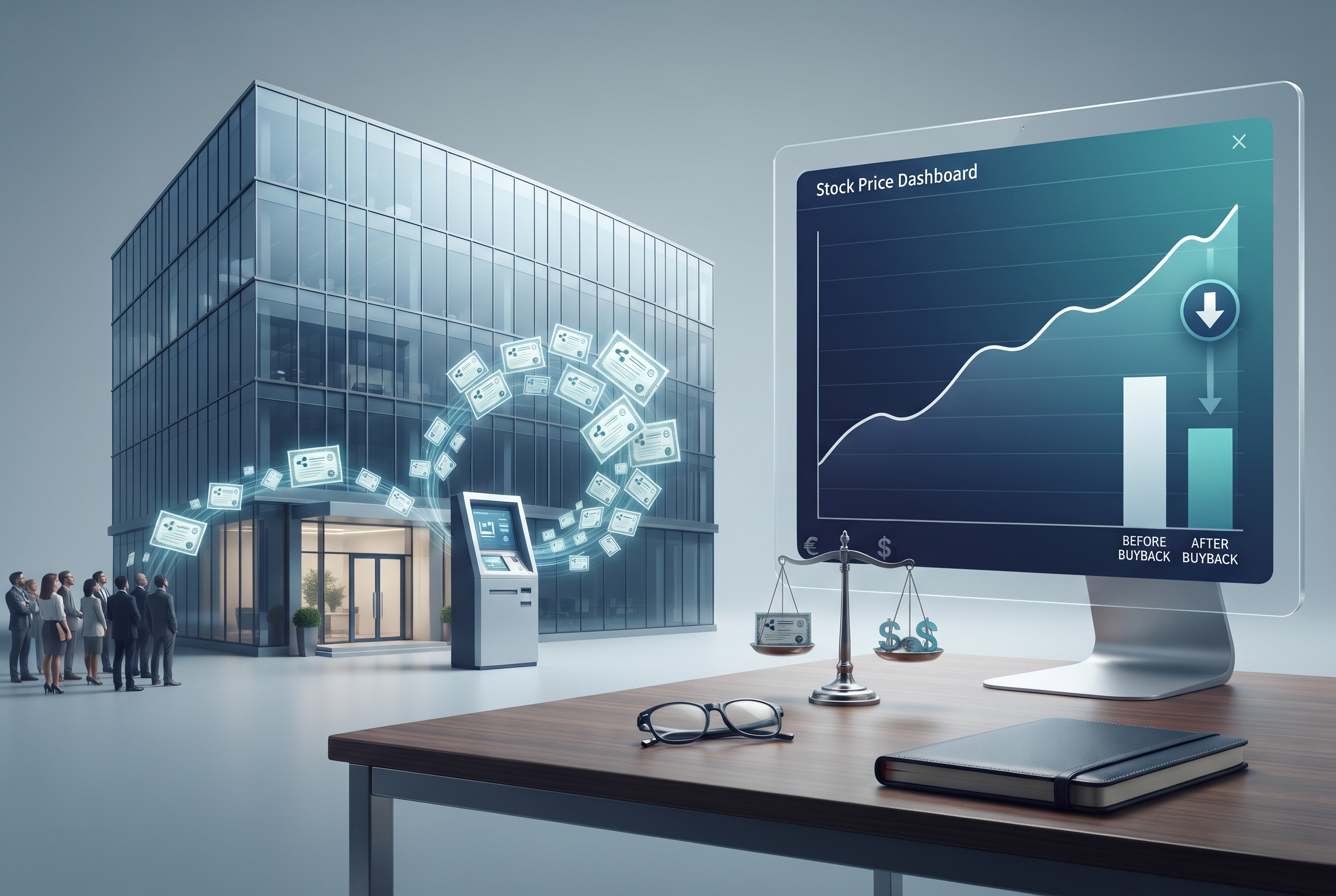
A stock buyback, also known as a share repurchase, occurs when a company purchases its own outstanding shares, usually in the open market or through a structured offer to shareholders. By reducing the number of shares outstanding, a buyback can increase existing shareholders’ proportional ownership and potentially improve earnings per share (EPS).
However, buybacks are not automatically beneficial. Their impact depends on the price paid, the company’s financial position, the source of funding, and whether the repurchase creates value over the long term.
In this guide, we explain how stock buybacks work, why companies use them, how they affect investors, and what you should examine before interpreting a repurchase announcement as good news.
30-Second Summary: What Investors Need to Know About Buybacks
- A stock buyback occurs when a company purchases its own shares from existing shareholders.
- Companies may repurchase shares because they have excess cash, believe their stock is undervalued, or want to return capital to shareholders.
- Buybacks can reduce the number of shares outstanding and mechanically increase earnings per share (EPS), even if total net income remains unchanged.
- Existing shareholders who do not sell may own a larger percentage of the company after shares are repurchased and removed from circulation.
- A buyback announcement is not the same as an executed repurchase. An authorization does not guarantee that the company will purchase all, or any, of the approved shares.
- Buybacks can destroy shareholder value if a company overpays, borrows excessively, or neglects more productive investment opportunities.
- Investors should examine actual repurchases, net share-count changes, valuation, cash flow, debt, and management’s capital-allocation decisions.
What Is a Stock Buyback?
A stock buyback is a corporate action in which a company purchases its own shares from investors. These shares may be held as treasury stock or formally retired, depending on the company’s legal and accounting treatment.
When a company buys back shares and holds or retires them, those shares generally cease to count as outstanding shares for purposes such as earnings per share and voting ownership calculations.
Consider a simple example:
A company has 100 million shares outstanding. An investor owns 1 million shares, representing 1% of the company.
The company then repurchases 10 million shares and removes them from the outstanding share count. Assuming the investor does not sell any shares, the investor’s ownership percentage increases from 1% to approximately 1.11%.
The investor now owns a larger proportion of the company without purchasing additional shares.
This is one of the main reasons buybacks can benefit continuing shareholders. However, the economic benefit depends on whether the company paid a reasonable price and whether the remaining business is still financially strong.
Why Do Companies Buy Back Their Own Shares?
Companies have several ways to use the cash they generate. They can invest in new projects, acquire other businesses, reduce debt, build cash reserves, pay dividends, or repurchase their own shares.
A buyback is therefore a capital-allocation decision. Management must determine whether purchasing the company’s own stock is a better use of capital than the available alternatives.
1. To Return Excess Cash to Shareholders
A company with strong cash generation may accumulate more money than it needs to fund operations, maintain its assets, and pursue attractive growth opportunities.
Instead of allowing excess cash to remain on the balance sheet indefinitely, management may decide to return some of it to shareholders through dividends or share repurchases.
Unlike a regular dividend, which distributes cash to shareholders who own shares on the relevant payment date, a buyback gives shareholders the choice to sell their shares into the repurchase process or remain invested.
2. Because Management Believes the Stock Is Undervalued
Executives may believe that the market price of their company’s shares does not reflect its underlying business value.
If management estimates that the stock is worth $100 per share but it trades at $75, purchasing shares could be an attractive use of corporate cash, provided the valuation assumptions are reasonable.
Buying shares below their intrinsic value may benefit continuing shareholders because the company acquires a portion of its own equity at a discount to its estimated worth.
However, management’s confidence is not proof that the stock is undervalued. Investors should independently evaluate the company’s financial performance, competitive position, and valuation.
For a deeper understanding, see our guide to intrinsic value and how to estimate a stock’s real worth.
3. To Improve Earnings Per Share (EPS)
One of the most visible financial effects of a share repurchase is its potential impact on earnings per share.
EPS is calculated by dividing net income available to common shareholders by the weighted-average number of common shares outstanding.
Basic EPS formula:
EPS = Net Income Available to Common Shareholders ÷ Weighted-Average Common Shares Outstanding
If a company maintains the same level of net income while reducing its weighted-average share count, EPS increases mechanically.
This does not mean the company’s operations have become more profitable. It means the same earnings are now distributed across fewer shares.
4. To Offset Shares Issued Through Employee Compensation
Many publicly traded companies compensate employees and executives through stock options, restricted stock units (RSUs), and other equity-based awards.
When these awards result in new shares being issued, the total share count can increase and dilute existing shareholders’ ownership.
A company may repurchase shares to offset some or all of this dilution.
However, investors should distinguish between gross repurchases and the net change in shares outstanding. If a company buys back 10 million shares but issues 8 million new shares through compensation programs, the net reduction is only 2 million shares.
5. To Signal Confidence in the Business
A buyback announcement may communicate management’s belief that the company’s financial position is strong or that its stock is attractively valued.
Investors sometimes interpret repurchases as a positive signal because management is committing corporate resources to purchasing the company’s own equity.
Nevertheless, a buyback announcement should not be treated as proof of future business success. Management can misjudge the company’s value, and repurchases can be motivated by considerations other than long-term shareholder returns.
How Do Stock Buybacks Work?
Companies can repurchase shares through several methods. The approach they choose depends on the company’s objectives, market conditions, shareholder participation, and applicable regulations.
1. Open-Market Repurchases
Open-market repurchases are among the most common buyback methods in the United States.
The company purchases its shares through the stock market, usually over an extended period, using brokers or other financial intermediaries.
For example, a company may announce that its board has authorized up to $2 billion in share repurchases. It may then purchase shares gradually, depending on market prices, cash availability, and management’s assessment of valuation.
The company does not necessarily have to purchase the entire authorized amount. It may buy fewer shares, pause the program, or decide not to execute the authorization at all.
2. Tender Offers
In a tender offer, a company invites shareholders to sell a specified number of shares at a stated price or under defined pricing terms.
A fixed-price tender offer typically provides a purchase price that may be above the prevailing market price to encourage shareholders to participate.
Shareholders can decide whether to tender their shares. If the number of shares offered exceeds the number the company wants to purchase, the company may accept shares on a prorated basis, subject to the offer’s terms.
3. Dutch Auction Repurchases
A Dutch auction is a type of tender offer in which the company specifies a price range and shareholders indicate how many shares they are willing to sell at different prices within that range.
The company then determines the purchase price based on the offers received and the number of shares it wants to repurchase.
This method allows the company to discover a price at which shareholders are willing to sell the required number of shares.
4. Accelerated Share Repurchases (ASRs)
An accelerated share repurchase is an arrangement in which a company works with a financial institution to acquire a substantial number of shares over a relatively short period.
Typically, the company pays cash upfront and receives an initial delivery of shares from the financial institution. The final number of shares and settlement amount are determined later according to the contract’s pricing formula.
ASRs allow companies to execute large repurchases more quickly than a gradual open-market program, although the final economic outcome depends on the agreement’s terms and market prices.
How Do Buybacks Affect Investors?
Share repurchases can influence investors through several channels. Some effects are mechanical and can be calculated directly, while others depend on market expectations and the company’s financial condition.
1. Earnings Per Share May Increase
When the number of shares outstanding declines, earnings per share may rise even if total net income remains unchanged.
Consider the following example:
A company generates $100 million in annual net income and has 50 million weighted-average shares outstanding.
Its EPS is:
$100 million ÷ 50 million = $2.00 per share
Now assume the company repurchases shares and the weighted-average share count falls to 45 million, while net income remains at $100 million.
Its new EPS becomes:
$100 million ÷ 45 million = $2.22 per share
EPS has increased by approximately 11.1%, even though the company has not generated additional net income.
This is why investors should examine both EPS growth and the underlying performance of the business.
2. Continuing Shareholders May Own a Larger Percentage of the Company
When shares are repurchased and removed from the outstanding share count, shareholders who retain their investments may own a larger percentage of the remaining company.
This can increase their proportional claim on future earnings and cash flows.
However, the increase in ownership percentage does not automatically mean that the market value of each remaining share will rise. The company has also spent cash to acquire its shares, which changes the value and financial composition of the business.
3. The Stock Price May Receive Support
When a company buys its own shares in the open market, it becomes an additional source of demand for the stock.
That demand may support the share price, particularly when repurchases are significant relative to normal trading volume.
However, the market price is influenced by many other factors, including earnings expectations, interest rates, investor sentiment, industry developments, and broader economic conditions.
A buyback does not guarantee that a stock price will increase.
Learn more about these influences in our guide to the factors that affect stock prices.
4. Buybacks Can Provide an Alternative to Dividends
Companies can return capital to shareholders through dividends or share repurchases.
Dividends distribute cash directly to eligible shareholders. Buybacks, by contrast, allow shareholders to sell their shares to the company while those who remain invested may benefit from a reduced share count.
Investors who do not sell their shares do not receive cash directly from an open-market buyback. Their potential benefit comes from the change in ownership percentage and the economic consequences of the repurchase.
The tax treatment of dividends and repurchases can also differ depending on the investor’s circumstances and jurisdiction. Investors should not assume that one method is always more tax-efficient.
For more on cash distributions, see our guide to dividend investing and how dividend payments work.
Are Stock Buybacks Always Good for Investors?
No. A buyback can create value, have a neutral effect, or destroy shareholder value. The outcome depends on how the company executes the program and what it gives up to finance it.
Investors should avoid treating every repurchase announcement as positive news.
1. The Company May Repurchase Shares at an Excessive Price
One of the biggest risks is overpaying.
If a company purchases its shares when they are significantly overvalued, it may use valuable corporate resources inefficiently.
For example, imagine that a company estimates its intrinsic value at $60 per share but repurchases shares at $100. The company may be transferring value away from continuing shareholders by paying too much for the shares it acquires.
The fact that management believes in the company does not eliminate the need for valuation discipline.
2. The Company May Use Debt to Finance Buybacks
Some companies borrow money to repurchase shares, even when their operating cash flow is insufficient to fund the program comfortably.
This can increase financial leverage, interest expenses, and refinancing risk.
If business conditions deteriorate, the company may face greater difficulty meeting its debt obligations.
Investors should therefore examine whether a buyback is financed through excess cash, operating cash flow, asset sales, or additional borrowing.
3. Buybacks May Distract From Long-Term Investment
Companies need to invest in research and development, technology, employees, equipment, infrastructure, and new business opportunities to remain competitive.
If management prioritizes share repurchases over projects with attractive long-term returns, the company may weaken its future growth potential.
A buyback should generally be evaluated against the returns the company could generate by reinvesting the same capital in its business.
4. EPS Growth May Hide Weak Operating Performance
A company may report higher EPS after repurchasing shares even when revenue, operating income, or total net income is flat or declining.
This can create a misleading impression if investors focus only on per-share metrics.
For a complete assessment, compare EPS growth with revenue growth, operating profit, net income, operating cash flow, and free cash flow.
5. Buybacks May Offset Dilution Rather Than Reduce the Share Count
Some companies repurchase large amounts of stock but issue significant numbers of new shares through employee compensation or acquisitions.
In such cases, the buyback may primarily offset dilution rather than meaningfully increase existing shareholders’ ownership percentage.
Investors should look at the net change in basic and diluted shares outstanding, not just the headline value of repurchases.
A Practical Example: How a Buyback Can Change EPS and Ownership
Imagine a fictional US-listed company called Horizon Technologies.
Before its buyback, the company has the following financial profile:
- Net income: $500 million
- Shares outstanding: 250 million
- Share price: $40
- Market capitalization: $10 billion
Its EPS is:
$500 million ÷ 250 million = $2.00
The company’s board authorizes a $1 billion share repurchase program. Assume Horizon executes the entire program at an average price of $40 per share.
The company repurchases:
$1 billion ÷ $40 = 25 million shares
Assuming these shares are removed from the outstanding share count, the new share count becomes 225 million.
If net income remains unchanged at $500 million, the new EPS is:
$500 million ÷ 225 million = approximately $2.22
Before and After the Buyback
| Metric | Before Buyback | After Buyback |
|---|---|---|
| Net income | $500 million | $500 million |
| Shares outstanding | 250 million | 225 million |
| EPS | $2.00 | $2.22 |
| Share price assumption | $40 | $40 |
| Market capitalization | $10 billion | $9 billion |
The example illustrates an important distinction: EPS increases because the share count declines, but the company has also spent $1 billion in cash.
It would be incorrect to conclude that the company’s total economic value has automatically increased by 11.1%. The market capitalization, cash balance, future earnings potential, and the price paid for the shares all matter.
In reality, the stock price may change after the buyback because investors reassess the company’s valuation, financial position, and future prospects.
How to Evaluate a Buyback Announcement: A Checklist for Investors
Before interpreting a share repurchase announcement as positive or negative, investors should examine several important factors.
1. Is the Company’s Balance Sheet Healthy?
Review the company’s cash balance, short-term obligations, long-term debt, and overall financial leverage.
A company with substantial excess cash and manageable debt may have more flexibility to repurchase shares than a highly leveraged business with limited liquidity.
2. Is the Stock Trading at an Attractive Valuation?
Compare the company’s share price with reasonable estimates of its intrinsic value.
Useful indicators may include:
- Price-to-Earnings (P/E) ratio
- Price-to-Sales (P/S) ratio
- Enterprise Value-to-EBITDA (EV/EBITDA)
- Free Cash Flow Yield
- Price-to-Book (P/B) ratio, where relevant
Compare these metrics with the company’s historical valuation and relevant industry peers. A buyback is not automatically attractive just because management announces it.
3. How Will the Buyback Be Financed?
Determine whether the company is using:
- Excess cash reserves
- Cash generated from operations
- Proceeds from asset sales
- New debt issuance
- A combination of these sources
Financing matters because a repurchase funded by sustainable excess cash has a different risk profile from one financed through substantial borrowing.
4. What Is the Actual Reduction in Shares Outstanding?
Check the company’s basic and diluted weighted-average share counts over several reporting periods.
Compare the number of shares repurchased with shares issued through employee compensation, option exercises, acquisitions, and other corporate transactions.
The net share-count change provides a more meaningful picture than the headline buyback amount alone.
5. Does the Company Have Better Uses for Its Cash?
Consider whether the company could generate a higher return by investing in:
- Research and development
- New products and services
- Technology and operational improvements
- Geographic expansion
- Strategic acquisitions
- Debt reduction
Management should compare the expected return from a buyback with the potential return from these alternatives.
6. Is the Buyback Actually Being Executed?
A board authorization only establishes that management has permission to repurchase shares up to a specified amount or number. It does not prove that the company has purchased any shares.
Look for actual repurchase activity in quarterly and annual reports. Pay attention to the number of shares acquired, the average purchase price, the total amount spent, and any remaining authorization.
Where Can Investors Find Information About Stock Buybacks?
Investors in US-listed companies can use several public sources to verify buyback announcements and examine their actual impact.
1. SEC Filings
Public companies file financial reports and other disclosures with the US Securities and Exchange Commission (SEC).
Useful documents include:
- Form 10-K: The company’s annual report, which provides detailed financial statements and management discussion.
- Form 10-Q: Quarterly financial reports that help investors monitor changes in share repurchases, cash flow, and outstanding shares.
- Form 8-K: Current reports used to disclose certain material corporate events.
The SEC’s EDGAR database allows investors to search company filings and review relevant disclosures: SEC EDGAR Company Filings.
2. Company Investor Relations Websites
Most publicly traded companies publish earnings releases, investor presentations, annual reports, and repurchase announcements on their investor relations websites.
These materials can help investors understand management’s stated objectives and compare buyback activity across reporting periods.
3. Earnings Calls and Management Commentary
Quarterly earnings calls can provide additional context about capital allocation decisions.
Listen for management’s explanations of why it is repurchasing shares, how it evaluates valuation, and whether it expects to continue the program.
Stock Buybacks in the United States: What Investors Should Know
US-listed companies operate within a regulatory framework governing share repurchases. Investors do not need to become legal experts, but understanding a few important concepts can help them interpret corporate announcements.
SEC Rule 10b-18
SEC Rule 10b-18 provides a voluntary safe harbor from certain market-manipulation liability for qualifying open-market repurchases of a company’s common stock, provided the company meets specified conditions relating to the manner, timing, price, and volume of purchases.
The rule does not require companies to repurchase shares, nor does it mean that every transaction outside the safe harbor is automatically unlawful. It establishes conditions under which an issuer may obtain the specified safe-harbor protection.
Investors can review the SEC’s explanation of Rule 10b-18 and issuer repurchases.
The US Stock Repurchase Excise Tax
The Inflation Reduction Act of 2022 introduced a 1% excise tax on certain stock repurchases by covered publicly traded domestic corporations, generally applying to repurchases made after December 31, 2022.
The calculation is subject to statutory rules, including adjustments for certain stock issuances and other exceptions. The tax is imposed on qualifying corporations rather than being a direct tax charged to an individual investor each time the company repurchases shares.
The IRS published final regulations in 2025 providing further guidance on the application of the tax.
For current details, see the IRS instructions for Form 7208.
Tax rules can change, and their application depends on the specific transaction and corporate circumstances. Investors should consult qualified tax professionals when evaluating the tax implications of corporate actions.
Stock Buybacks vs. Dividends: What Is the Difference?
Both dividends and share repurchases are ways for companies to return capital to shareholders. However, they work differently and can have different implications for investors.
| Feature | Stock Buybacks | Dividends |
|---|---|---|
| How capital is returned | Company purchases its own shares | Company distributes cash to eligible shareholders |
| Investor participation | Shareholders may sell or remain invested | Eligible shareholders receive the declared payment |
| Effect on share count | Can reduce shares outstanding | Does not directly reduce shares outstanding |
| EPS impact | May increase EPS through a lower share count | Does not mechanically reduce the share count |
| Cash received by continuing shareholders | No direct cash payment from an ordinary open-market buyback | Cash is distributed to eligible shareholders |
| Management flexibility | Programs can often be adjusted or suspended | Regular dividends create expectations of continued payments |
| Potential risk | Overpaying or weakening the balance sheet | Unsustainable distributions or dividend cuts |
Neither approach is universally superior. The best choice depends on the company’s valuation, financial position, investment opportunities, and shareholder objectives.
Common Misconceptions About Stock Buybacks
Buybacks are frequently discussed in financial media, but several common misconceptions can lead investors to misinterpret their effects.
Misconception 1: Every Buyback Makes the Stock Price Rise
A repurchase can create additional demand for shares, but it does not guarantee a higher stock price. Weak earnings, deteriorating business conditions, or negative market sentiment can outweigh the impact of company purchases.
Misconception 2: Higher EPS Always Means Better Business Performance
EPS can increase because the company earns more money, because the share count falls, or through a combination of both. Investors should identify the source of EPS growth rather than assuming that all increases reflect improved operating performance.
Misconception 3: A Buyback Announcement Means the Company Has Bought Shares
An authorization is permission to repurchase shares, not proof that purchases have taken place. Actual transactions should be confirmed through subsequent disclosures.
Misconception 4: Buybacks Are Always Better Than Dividends
Both methods have advantages and disadvantages. The appropriate capital-return method depends on the company’s financial position and the needs of its shareholders.
Misconception 5: A Company Buying Its Own Stock Must Be Undervalued
Management may believe the stock is undervalued, but that belief can be incorrect. Investors should perform their own valuation analysis.
Final Thoughts: How Should Investors Interpret a Buyback?
Stock buybacks can be an effective way for companies to return excess capital, improve ownership proportions for continuing shareholders, and potentially enhance per-share financial metrics.
However, their benefits are not automatic. A company that repurchases shares at excessive prices, borrows too much, or neglects productive investment opportunities may weaken its long-term financial position.
For investors, the most important question is not simply whether a company has announced a buyback. It is whether the repurchase makes economic sense.
Before interpreting a buyback as positive news, examine the company’s valuation, balance sheet, cash flow, actual repurchase activity, and net change in shares outstanding.
Remember that a higher EPS does not necessarily mean higher total earnings, and a large buyback authorization does not guarantee that the company will execute the program.
Ultimately, buybacks should be evaluated as part of a company’s broader capital-allocation strategy. Understanding the reasoning behind the transaction is far more useful than reacting to the headline alone.
Frequently Asked Questions (FAQs)
1. What is a stock buyback in simple terms?
A stock buyback occurs when a company purchases its own shares from investors. The repurchased shares may be held as treasury stock or retired, generally reducing the number of shares outstanding.
2. Why do companies buy back their own shares?
Companies may repurchase shares to return excess cash to shareholders, signal confidence in the business, invest in shares they believe are undervalued, offset employee-share dilution, or influence their capital structure.
3. How do buybacks affect earnings per share?
When the number of shares outstanding decreases while net income remains unchanged, EPS increases because the same earnings are divided among fewer shares.
4. Do stock buybacks always increase share prices?
No. Buybacks can create additional demand for shares, but stock prices also depend on earnings expectations, valuation, economic conditions, interest rates, and investor sentiment.
5. Are buybacks better than dividends?
Neither is always better. Dividends provide direct cash distributions to eligible shareholders, while buybacks allow shareholders to sell shares or remain invested in a company with a potentially lower share count. The better approach depends on the company’s circumstances and investor objectives.
6. What happens to shares after a company repurchases them?
Repurchased shares may be held as treasury stock or formally retired. Treasury shares generally do not count as outstanding shares for EPS and voting calculations while held in treasury. Retired shares are removed from the company’s outstanding share count.
7. What is the difference between a buyback authorization and an actual buyback?
A buyback authorization gives a company permission to repurchase shares up to a specified amount or number. An actual buyback occurs only when the company executes purchases. Authorization alone does not guarantee that any shares will be repurchased.
8. Can a company borrow money to buy back shares?
Yes. A company can use borrowed funds to finance repurchases. However, doing so may increase debt, interest expenses, and financial risk, particularly if operating cash flow weakens.
9. How can I tell whether a buyback is good for shareholders?
Examine the purchase price relative to intrinsic value, the company’s cash flow and debt, the actual reduction in shares outstanding, and whether the company has more attractive investment opportunities.
10. Do buybacks increase a shareholder’s ownership percentage?
They can. If the company repurchases and removes shares from the outstanding share count, shareholders who retain their shares own a larger percentage of the remaining company.
11. What is an open-market share repurchase?
It is a buyback in which a company purchases its own shares through the stock market over time, usually using brokers or financial intermediaries.
12. What is a tender offer in a stock buyback?
A tender offer is a formal invitation for shareholders to sell a specified number of shares to the company under stated conditions, often at a fixed price or within a specified price range.
13. What is an accelerated share repurchase?
An accelerated share repurchase (ASR) is an arrangement through which a company works with a financial institution to acquire a substantial number of its shares over a relatively short period. The final number of shares is determined under the agreement’s terms.
14. Can buybacks hide weak company performance?
They can make per-share metrics look stronger even when total net income or operating performance is not improving. Investors should compare EPS with revenue, total earnings, margins, and cash flow.
15. How do buybacks affect the company’s balance sheet?
Repurchases generally reduce cash or other assets and reduce shareholders’ equity under the applicable accounting treatment. If funded with debt, they can also increase liabilities and financial leverage.
16. What is treasury stock?
Treasury stock refers to a company’s own shares that it has repurchased and continues to hold rather than permanently retiring. These shares generally do not carry voting rights or receive dividends while held in treasury.
17. Can a company cancel or suspend a buyback program?
In many cases, yes. A board authorization does not necessarily create an obligation to complete the entire program. Companies may adjust or suspend repurchases depending on market conditions, cash needs, and corporate priorities.
18. Where can investors check a company’s buyback activity?
Investors can review annual reports, quarterly reports, earnings releases, and relevant SEC filings. Company investor relations websites and the SEC’s EDGAR database are useful starting points.
19. Are stock buybacks taxed in the United States?
Certain repurchases by covered publicly traded domestic corporations are subject to a 1% federal excise tax under Internal Revenue Code Section 4501, subject to applicable adjustments and exceptions. This corporate-level tax is different from the tax treatment of an individual shareholder selling shares.
20. Should investors buy a stock after a buyback announcement?
A buyback announcement alone is not a sufficient reason to buy a stock. Investors should assess the company’s financial health, valuation, actual repurchase execution, and long-term business prospects before making an investment decision.