
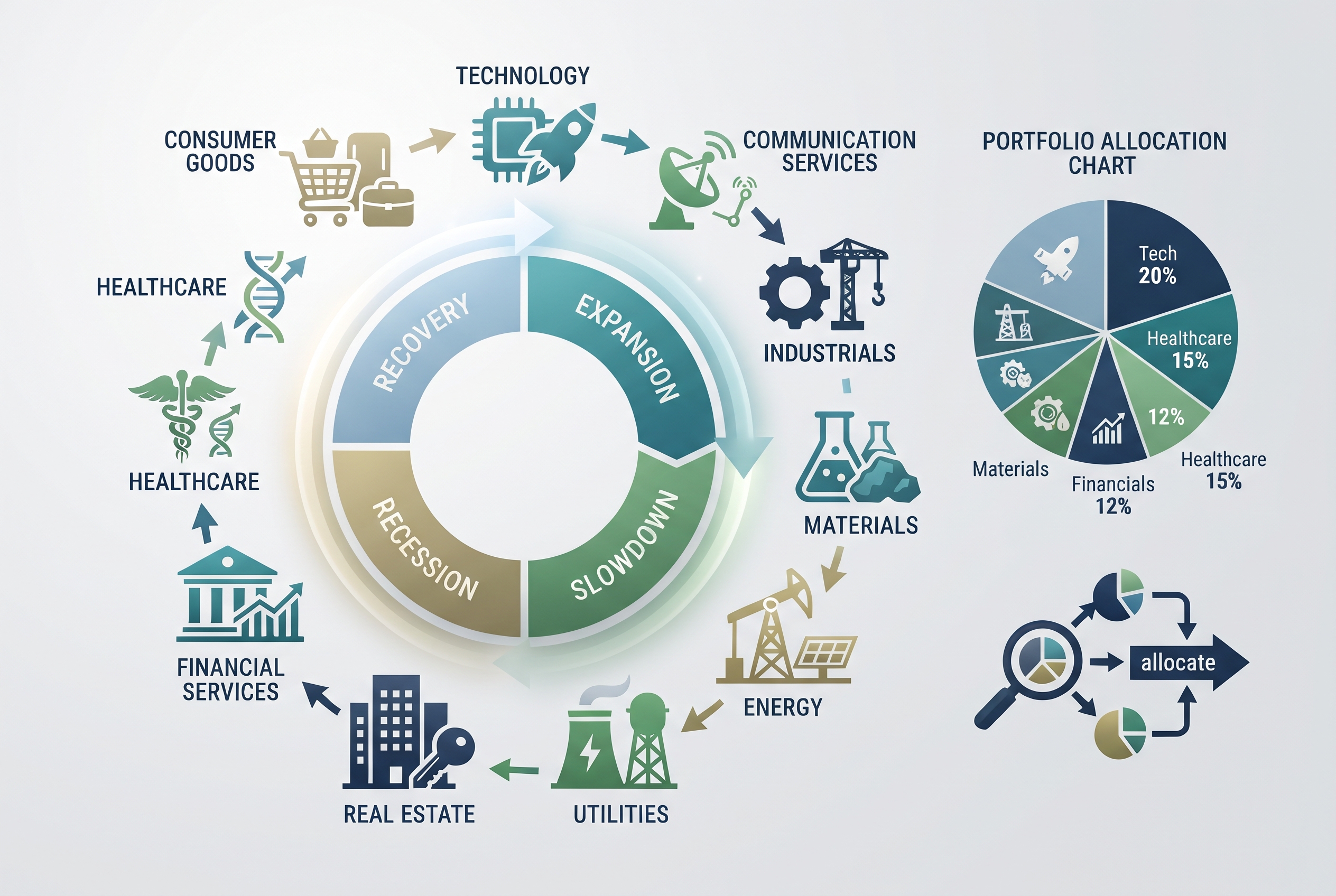
Sector Allocation: Which Sectors Should You Invest In and When?
One of the most important decisions investors face is not simply which stocks to buy, but which parts of the economy deserve a place in their portfolios.
Technology companies may attract attention during periods of innovation and strong economic growth. Healthcare and consumer staples businesses may demonstrate greater resilience when economic conditions weaken. Energy and materials companies can benefit from certain commodity-price environments, while financial stocks may respond strongly to changes in interest rates and credit conditions.
This is why sector allocation matters.
Different industries respond differently to economic growth, inflation, interest rates, consumer demand, and business cycles. Understanding these relationships can help investors build more diversified portfolios and identify potential opportunities as market conditions change.
However, there is no universal formula that identifies the best sector at every stage of the economy. Markets are forward-looking, economic cycles are difficult to predict, and sector performance depends on more than macroeconomic conditions alone.
In this guide, we explain how sector allocation works, explore the characteristics of major stock market sectors, and examine how investors can develop a disciplined sector rotation strategy.
30-Second Summary: How to Allocate Investments Across Sectors
- Sector allocation means distributing investments across different industries or segments of the economy.
- Different sectors respond differently to economic growth, recessions, inflation, interest rates, and changes in consumer demand.
- Cyclical sectors, such as consumer discretionary, industrials, and some financial businesses, can benefit when economic activity accelerates.
- Defensive sectors, such as consumer staples, healthcare, and utilities, may demonstrate greater resilience during economic slowdowns.
- Technology and communication services are influenced by both long-term structural trends and economic conditions.
- Sector rotation involves adjusting portfolio exposure as economic conditions and market expectations change.
- Investors can use individual stocks, sector mutual funds, and exchange-traded funds (ETFs) to implement sector strategies.
- Diversification, valuation discipline, and risk management remain essential because no sector consistently outperforms the market.
What Is Sector Allocation?
Sector allocation is the process of distributing investment capital among different sectors of the economy rather than concentrating a portfolio in a single industry or a small number of companies.
For example, an investor may allocate part of a stock portfolio to technology, healthcare, financials, energy, industrials, and consumer-related businesses.
The objective is to gain exposure to different economic activities while managing the risks associated with individual industries.
Sector allocation can serve two main purposes:
- Strategic allocation: Maintaining exposure to different sectors as part of a long-term portfolio diversification strategy.
- Tactical allocation: Adjusting sector weights based on changing economic conditions, valuations, market trends, and investment expectations.
For example, an investor who expects economic growth to accelerate may consider increasing exposure to cyclical industries. An investor concerned about a potential slowdown may prefer to emphasize businesses with more stable demand.
These decisions should be based on analysis rather than short-term predictions. Sector allocation is a way to manage portfolio exposure, not a reliable method of forecasting which industry will deliver the highest return next month.
Why Does Sector Allocation Matter?
Companies operate in different economic environments and face different business risks. As a result, their financial performance and stock prices do not always move in the same direction or at the same pace.
Consider two businesses:
- A luxury travel company depends heavily on consumer confidence, disposable income, and discretionary spending.
- A healthcare company providing essential medical services may experience more stable demand across different economic conditions.
If consumer confidence weakens, the travel company may face pressure as households reduce nonessential spending. The healthcare business may be less affected because its services remain necessary.
Sector allocation helps investors recognize these differences and avoid relying too heavily on a single economic outcome.
1. Different Sectors Respond Differently to Economic Growth
When economic activity accelerates, businesses may increase investment, consumers may spend more, and corporate earnings may improve.
Industries that depend on economic expansion can benefit from stronger demand. These may include industrials, consumer discretionary, financials, and certain technology businesses.
2. Some Sectors May Be More Resilient During Economic Slowdowns
Businesses selling essential products and services may experience relatively stable demand even when households and companies reduce spending.
Consumer staples, healthcare, and some utility businesses are often considered defensive because their products and services remain important during weaker economic conditions.
3. Interest Rates and Inflation Affect Industries Differently
Changes in monetary policy can influence borrowing costs, consumer spending, corporate investment, and asset valuations.
Higher interest rates may create pressure for highly leveraged businesses, while some financial institutions may benefit from improved lending margins under certain conditions.
Inflation can also affect sectors differently depending on their pricing power, input costs, commodity exposure, and ability to protect profit margins.
4. Sector Exposure Can Reduce Single-Industry Concentration
A portfolio concentrated in one industry may become vulnerable to developments specific to that industry.
For example, a technology-focused portfolio could face significant pressure if technology valuations decline or corporate spending on software and hardware weakens.
Adding exposure to other industries may help reduce dependence on a single source of returns. However, sector diversification does not eliminate market risk, especially when correlations increase during periods of financial stress.
The 11 Major Stock Market Sectors
In the United States, the Global Industry Classification Standard (GICS) divides the equity market into 11 major sectors. This classification system helps investors compare businesses with similar economic characteristics.
The 11 sectors are:
- Information Technology
- Health Care
- Financials
- Consumer Discretionary
- Consumer Staples
- Industrials
- Energy
- Materials
- Real Estate
- Communication Services
- Utilities
Each sector contains multiple industries, and companies within the same sector may still have very different business models and risk profiles.
Which Sectors May Benefit During Different Economic Conditions?
One way to understand sector allocation is to examine how different industries have historically responded to the business cycle.
The business cycle is commonly divided into four broad phases:
- Early-cycle recovery
- Mid-cycle expansion
- Late-cycle slowdown
- Recession or contraction
These phases are analytical frameworks, not a fixed sequence that every economy follows. Economic cycles can be interrupted by unexpected events, and financial markets may anticipate changes before they appear in official economic data.
1. Early-Cycle Recovery: When Economic Activity Starts Improving
The early-cycle phase generally begins as an economy recovers from a recession or a period of significant weakness.
Economic activity starts improving, consumer confidence may recover, companies gradually increase production, and employment conditions may strengthen.
Monetary and fiscal policies may still be supportive, although the exact policy environment varies across economic cycles.
During this phase, cyclical sectors may benefit from improving demand and better earnings expectations.
Sectors that may perform relatively well include:
- Consumer Discretionary: Households may begin spending more on travel, entertainment, restaurants, automobiles, and other nonessential products.
- Financials: Improving economic activity can support loan demand, capital markets, and credit conditions, although interest-rate and credit risks remain important.
- Industrials: Businesses may increase investment in machinery, equipment, transportation, and infrastructure.
- Information Technology: Companies may resume technology spending as confidence and business investment recover.
- Materials: Higher industrial production and construction activity can increase demand for metals, chemicals, and other raw materials.
However, investors should not assume that every cyclical company will benefit equally. Businesses with excessive debt, weak balance sheets, or poor competitive positions may struggle even during an economic recovery.
2. Mid-Cycle Expansion: When Growth Becomes More Established
During the mid-cycle phase, economic expansion becomes more established. Corporate earnings may continue to grow, employment conditions may improve, and consumer and business spending may remain relatively healthy.
However, growth may become less rapid than during the initial recovery.
Potential beneficiaries may include:
- Information Technology: Businesses may increase spending on cloud computing, cybersecurity, software, automation, and digital infrastructure.
- Industrials: Manufacturing, logistics, transportation, and capital-equipment demand may benefit from sustained business activity.
- Financials: Stronger economic activity may support lending, investment banking, insurance, and asset management businesses.
- Communication Services: Advertising, digital platforms, and communication-related services may benefit from healthy business and consumer activity.
Sector leadership during this phase can vary considerably. Valuations, corporate earnings, interest rates, and technological developments may become more important than the broad economic expansion alone.
3. Late-Cycle Slowdown: When Growth Begins to Lose Momentum
In the late-cycle phase, economic growth may begin to slow. Inflationary pressures may remain elevated, borrowing costs may be restrictive, and companies may become more cautious about investment and hiring.
Consumers may also become more selective with discretionary spending.
Investors may begin paying greater attention to businesses with stable demand, strong balance sheets, and reliable cash generation.
Sectors that may demonstrate relative resilience include:
- Consumer Staples: Demand for essential products such as food, household goods, and personal-care products may be more stable.
- Healthcare: Many healthcare services and products remain necessary regardless of economic conditions.
- Utilities: Electricity, water, and other essential services may experience relatively predictable demand, although regulation, capital requirements, and debt levels remain important.
- Energy: Energy companies may benefit from supply constraints or elevated commodity prices, but the sector can remain highly volatile.
Late-cycle conditions do not automatically mean that defensive sectors will outperform. If inflation falls, interest rates decline, or economic growth proves stronger than expected, other sectors may perform better.
4. Recession: When Economic Activity Contracts
A recession is generally associated with a broad decline in economic activity. Consumer spending, business investment, employment, and corporate earnings may weaken.
Investors may become more cautious, and companies with high operating leverage or significant debt can face substantial pressure.
During recessions, defensive sectors have historically demonstrated greater resilience in some periods.
Sectors that investors often examine include:
- Consumer Staples: Essential household purchases may be less sensitive to economic conditions.
- Healthcare: Demand for many medical products and services may remain relatively stable.
- Utilities: Essential services can provide more predictable demand, although financial leverage and regulation still matter.
- Communication Services: Some communication services remain essential, but advertising-dependent businesses can be sensitive to economic weakness.
Investors should remember that defensive does not mean risk-free. Even defensive stocks can decline significantly during broad market sell-offs, particularly if their valuations are high or their earnings expectations deteriorate.
Sector Allocation Across the Business Cycle: A Quick Comparison
| Economic Phase | Typical Conditions | Sectors Investors May Examine |
|---|---|---|
| Early Recovery | Improving demand, recovering confidence, stronger production | Consumer Discretionary, Financials, Industrials, Technology, Materials |
| Mid-Cycle | Established growth, expanding business activity, rising corporate investment | Technology, Industrials, Financials, Communication Services |
| Late Cycle | Slowing growth, potential inflation pressure, tighter financial conditions | Consumer Staples, Healthcare, Utilities, selected Energy companies |
| Recession | Weakening demand, lower earnings expectations, cautious consumers | Consumer Staples, Healthcare, Utilities, selected defensive businesses |
This table is a historical framework, not a forecast or a trading signal. Sector performance can differ significantly from one economic cycle to another.
How Do Interest Rates Affect Different Sectors?
Interest rates are among the most important macroeconomic variables influencing stock market performance.
Central bank decisions affect borrowing costs, consumer demand, corporate investment, bond yields, and the valuation of future cash flows.
However, the effect of an interest-rate change depends on why rates are changing and how each business is positioned.
Financials
Banks and other financial institutions can be sensitive to interest-rate changes.
For banks, one important factor is net interest margin (NIM), which measures the difference between interest income earned on assets and interest expense paid on funding sources relative to interest-earning assets.
Higher interest rates may improve lending margins in some circumstances, especially when loan yields adjust faster than deposit costs. However, the relationship is not automatic.
If deposit costs rise rapidly, loan demand weakens, or borrowers struggle to repay debt, higher rates can put pressure on bank profitability.
Investors should also monitor credit quality, loan-loss provisions, funding stability, and capital adequacy.
Real Estate
Real estate companies, including Real Estate Investment Trusts (REITs), can be sensitive to borrowing costs because property businesses often use debt to finance acquisitions and development.
Higher interest rates may increase refinancing costs and reduce the relative attractiveness of dividend-paying real estate investments compared with bonds.
However, real estate performance also depends on rental income, occupancy rates, property valuations, supply conditions, and lease structures.
Utilities
Utilities often require substantial capital investment in infrastructure, power generation, and distribution networks.
Many companies in the sector also carry significant debt. Higher borrowing costs can therefore pressure earnings and valuations.
On the other hand, regulated business models and relatively predictable demand may provide some stability, depending on the company and regulatory environment.
Technology
Technology stocks can be sensitive to changes in interest rates because their valuations may reflect expectations of earnings and cash flows many years into the future.
When discount rates rise, the present value of distant future cash flows may decline, potentially putting pressure on valuation multiples.
However, technology companies with strong current cash flows, competitive advantages, and limited debt may be less vulnerable than businesses whose valuations depend heavily on distant growth expectations.
How Does Inflation Affect Sector Performance?
Inflation affects companies through input costs, wages, financing expenses, consumer purchasing power, and selling prices.
The impact varies according to a company’s pricing power, cost structure, supply chain, and exposure to commodities.
Energy
Energy companies may benefit when oil and natural gas prices rise, particularly if higher commodity prices are not offset by increases in operating and production costs.
However, energy prices can be driven by supply disruptions, geopolitical developments, production decisions, and global demand. Inflation alone does not guarantee stronger energy-sector returns.
Materials
Materials companies produce or process commodities and industrial inputs such as metals, chemicals, construction materials, and packaging products.
Some businesses may benefit from rising commodity prices, but higher energy, labor, and transportation costs can also reduce margins.
Consumer Staples
Consumer staples companies sell essential products that households continue purchasing even when budgets become tighter.
These businesses may have some ability to pass higher costs on to consumers, but pricing power differs across companies. If customers switch to cheaper alternatives or reduce volumes, profitability can suffer.
Industrials
Industrial companies may face higher costs for raw materials, energy, labor, and transportation.
Businesses with strong pricing power and long-term contracts may be better positioned to manage inflationary pressures than companies operating with tight margins and limited pricing flexibility.
For a broader explanation of how inflation affects financial decisions, read our guide to protecting purchasing power during periods of high inflation.
How to Build a Sector Allocation Strategy
Understanding economic cycles is useful, but investors need a repeatable process to translate macroeconomic information into portfolio decisions.
The following steps can help create a more disciplined approach.
Step 1: Define Your Investment Objectives
Before selecting sectors, determine what you want your portfolio to achieve.
Are you primarily focused on long-term capital appreciation, income generation, capital preservation, or a combination of these objectives?
Your investment horizon and risk tolerance should influence how much exposure you take to cyclical, defensive, and high-volatility sectors.
Step 2: Understand the Economic Environment
Monitor indicators that provide information about economic growth, inflation, employment, interest rates, and business activity.
Useful indicators include:
- GDP growth: Provides a broad measure of economic activity.
- Inflation indicators: Consumer Price Index (CPI) and Personal Consumption Expenditures (PCE) price indexes help monitor price changes.
- Employment data: Unemployment, payroll growth, and wage trends provide information about labor-market conditions.
- Interest rates: Federal Reserve policy decisions and Treasury yields influence financial conditions and asset valuations.
- Purchasing Managers’ Indexes (PMIs): Survey-based indicators can provide insights into manufacturing and services activity.
- Consumer confidence: Helps investors understand household expectations and spending intentions.
- Corporate earnings: Revenue growth, profit margins, and management guidance provide company-level evidence of economic conditions.
No single indicator should determine your sector allocation. Economic data can be revised, and markets may respond to expectations before official statistics confirm a change.
Step 3: Identify Cyclical and Defensive Exposure
Classify the sectors in your portfolio according to their general sensitivity to economic conditions.
Cyclical sectors tend to be more sensitive to economic growth and consumer or business spending. Examples include consumer discretionary, industrials, and some financial businesses.
Defensive sectors tend to include businesses with relatively stable demand, such as consumer staples, healthcare, and utilities.
This classification is not absolute. Individual companies can have very different risk profiles within the same sector.
Step 4: Evaluate Sector Valuations
A sector may have attractive business prospects but still be a poor investment if its stocks are already priced for unrealistic expectations.
Investors can compare valuation indicators such as:
- Price-to-Earnings (P/E)
- Price-to-Book (P/B)
- Enterprise Value-to-EBITDA (EV/EBITDA)
- Price-to-Sales (P/S)
- Free Cash Flow Yield
- Dividend Yield
Different valuation metrics are more useful for different industries. For example, price-to-book may be relevant for certain financial businesses, while EV/EBITDA is frequently used to compare capital-intensive companies.
Compare sectors with their own historical valuations and relevant peers. A low valuation does not automatically mean that a sector is undervalued.
Step 5: Review Sector Fundamentals
Sector-level data can hide important differences between individual companies.
For example, two technology businesses may face very different growth prospects, profitability levels, debt burdens, and competitive threats.
Examine:
- Revenue and earnings growth
- Operating and profit margins
- Cash-flow generation
- Debt and liquidity
- Competitive position
- Management quality
- Industry-specific risks
Our guide to using fundamental analysis to select stocks explains how to evaluate these factors at the company level.
Step 6: Diversify Across Sectors
A portfolio concentrated in one or two sectors can become vulnerable to industry-specific risks.
Consider spreading exposure across different economic activities, while recognizing that simply holding many sector funds does not guarantee diversification.
For example, a portfolio that owns several technology ETFs may still be highly concentrated in the same underlying companies.
Review both sector weights and the individual holdings inside each investment.
Step 7: Rebalance Periodically
Sector weights can change over time because some investments outperform others.
Rebalancing involves reviewing the portfolio and adjusting positions when allocations move significantly away from the investor’s intended structure.
This process can help manage concentration risk and maintain consistency with long-term objectives.
However, frequent changes based on short-term market forecasts can increase transaction costs and lead to poor timing decisions.
What Is Sector Rotation?
Sector rotation is an investment strategy that involves increasing or decreasing exposure to different sectors as economic conditions, market expectations, and business fundamentals change.
The strategy is based on the observation that different sectors have historically performed differently across economic cycles.
For example, an investor who expects economic activity to strengthen may increase exposure to cyclical industries. If the outlook later deteriorates, the investor may shift some exposure toward businesses with more stable demand.
The objective is to position a portfolio in sectors that may be better placed to perform under changing conditions.
How Does Sector Rotation Work?
A simplified sector rotation process may look like this:
- Monitor economic indicators and corporate earnings trends.
- Assess whether the economy is expanding, slowing, or contracting.
- Identify sectors whose business models may be better positioned for the expected environment.
- Compare their valuations and fundamentals.
- Adjust portfolio exposure gradually and within predefined risk limits.
- Review the investment thesis as new information becomes available.
Sector rotation is a form of tactical asset allocation. It can be used alongside a long-term core portfolio rather than replacing broad diversification entirely.
How Can Investors Invest in Different Sectors?
Investors can gain sector exposure in several ways. The most appropriate method depends on investment knowledge, available capital, costs, and the desired level of diversification.
1. Individual Stocks
Investors can select individual companies within specific sectors.
For example, an investor seeking healthcare exposure may choose pharmaceutical companies, medical-device manufacturers, healthcare providers, or biotechnology businesses.
This approach offers greater control over company selection but requires more detailed research. It also exposes investors to company-specific risks.
2. Sector Exchange-Traded Funds (ETFs)
Sector ETFs provide exposure to a group of companies within a particular industry or sector through a single investment vehicle.
For example, investors can find ETFs focused on technology, healthcare, financials, energy, industrials, and other sectors.
In the United States, examples of widely followed sector ETF families include:
- Technology: Technology Select Sector SPDR Fund (XLK)
- Healthcare: Health Care Select Sector SPDR Fund (XLV)
- Financials: Financial Select Sector SPDR Fund (XLF)
- Energy: Energy Select Sector SPDR Fund (XLE)
- Consumer Discretionary: Consumer Discretionary Select Sector SPDR Fund (XLY)
- Consumer Staples: Consumer Staples Select Sector SPDR Fund (XLP)
- Industrials: Industrial Select Sector SPDR Fund (XLI)
- Utilities: Utilities Select Sector SPDR Fund (XLU)
- Materials: Materials Select Sector SPDR Fund (XLB)
- Real Estate: Real Estate Select Sector SPDR Fund (XLRE)
- Communication Services: Communication Services Select Sector SPDR Fund (XLC)
These are examples, not recommendations. Before investing, review each fund’s expense ratio, index methodology, holdings, sector classification, liquidity, concentration, and tracking performance.
3. Sector Mutual Funds
Sector mutual funds invest in companies within a defined sector or industry. Some are actively managed, while others follow an index.
Actively managed funds may offer professional security selection, but investors should compare management fees, performance consistency, portfolio concentration, and investment strategy.
4. Broad-Market ETFs and Mutual Funds
Investors who do not want to make frequent sector allocation decisions may prefer broad-market funds.
These funds provide exposure to companies across multiple sectors and can serve as the core of a diversified equity portfolio.
Investors can then decide whether a limited tactical sector allocation is appropriate for their objectives.
Practical Example: Building a Sector-Based Portfolio
Imagine an investor named Alex who has $100,000 allocated to a long-term equity portfolio.
Alex wants exposure to different areas of the US economy but does not want the portfolio to depend entirely on technology stocks.
After reviewing financial goals, risk tolerance, and investment horizon, Alex creates the following hypothetical sector allocation:
| Sector | Portfolio Weight | Dollar Allocation |
|---|---|---|
| Information Technology | 20% | $20,000 |
| Healthcare | 15% | $15,000 |
| Financials | 12% | $12,000 |
| Consumer Staples | 10% | $10,000 |
| Industrials | 10% | $10,000 |
| Consumer Discretionary | 8% | $8,000 |
| Communication Services | 8% | $8,000 |
| Energy | 5% | $5,000 |
| Utilities | 5% | $5,000 |
| Materials | 4% | $4,000 |
| Real Estate | 3% | $3,000 |
| Total | 100% | $100,000 |
This allocation is purely illustrative. It is not a model portfolio or a recommendation for any particular investor.
It demonstrates how an investor can spread exposure across all 11 major sectors while assigning different weights based on the investor’s assessment of risk and opportunity.
What Happens When Market Conditions Change?
Suppose economic data begin to indicate a slowdown. Alex reviews the portfolio and discovers that cyclical businesses may face greater earnings pressure than initially expected.
Rather than making an immediate, dramatic shift, Alex reviews company fundamentals, valuations, and portfolio concentration. If the investment thesis supports a change, Alex may gradually adjust some sector weights while maintaining the portfolio’s long-term diversification.
Later, if economic activity begins to recover, Alex may reassess the relative attractiveness of cyclical sectors.
The important point is that sector allocation should be reviewed systematically. It should not be based on a single economic report or a short-term market headline.
Common Mistakes to Avoid in Sector Investing
Sector investing can help investors manage portfolio exposure, but it also creates opportunities for costly mistakes.
1. Investing in a Sector Only Because It Recently Outperformed
Investors often become interested in a sector after it has already delivered strong returns.
However, recent performance may reflect expectations that are already priced into stocks. Buying after a sharp rally can expose investors to valuation risk and potential reversals.
2. Assuming Economic Cycles Are Easy to Predict
Economic indicators can provide useful information, but identifying the exact beginning or end of a cycle is extremely difficult.
Markets may move ahead of official economic data, and unexpected events can disrupt historical patterns.
3. Treating All Companies in a Sector as Identical
Companies within the same sector can have different debt levels, business models, competitive advantages, and growth prospects.
A strong sector outlook does not guarantee that every company in that sector will perform well.
4. Ignoring Valuation
Even a sector with attractive long-term prospects can be a poor investment if investors pay too much for expected growth.
Valuation should be considered alongside earnings quality, cash flow, balance-sheet strength, and competitive position.
5. Concentrating Too Much in One Sector
Investors may unintentionally create concentration risk by holding several funds with similar underlying companies.
For example, owning multiple technology ETFs does not necessarily provide meaningful diversification if their largest holdings overlap substantially.
6. Rotating Too Frequently
Frequent changes in sector exposure can increase transaction costs, taxes, and the risk of making decisions based on short-term market noise.
A clear investment process and predefined review schedule can help reduce unnecessary portfolio activity.
7. Confusing Defensive Sectors With Risk-Free Investments
Healthcare, utilities, and consumer staples businesses may have more stable demand, but their stocks can still decline because of high valuations, regulatory changes, rising costs, or company-specific problems.
Defensive characteristics should never replace fundamental analysis.
How to Monitor Sector Performance
Investors do not need to analyze every company in every sector to understand broad market trends. Several tools and indicators can help monitor sector performance.
1. Compare Sector Index Performance
Sector indexes allow investors to compare the performance of different parts of the stock market over various time periods.
Useful comparisons include:
- Year-to-date performance
- One-year performance
- Three-year and five-year performance
- Relative performance versus the S&P 500
- Volatility and maximum drawdown
Performance should be examined over multiple periods. A sector that leads over the past month may not be the strongest performer over a full economic cycle.
2. Track Earnings Growth and Analyst Expectations
Sector earnings growth can provide insights into whether business conditions are improving or deteriorating.
Investors should monitor revenue trends, earnings revisions, profit margins, and management guidance.
3. Follow Interest Rates and Commodity Prices
Changes in Treasury yields, central bank policy expectations, oil prices, natural gas prices, and industrial commodity prices can influence sector performance.
However, the relationship between these indicators and stock returns is not always straightforward.
4. Monitor Fund Holdings and Concentration
Sector ETFs and mutual funds publish information about their holdings. Reviewing these disclosures can help investors understand whether a fund is diversified or concentrated in a small number of large companies.
5. Use Reliable Financial Information Sources
Investors can use company annual reports, quarterly earnings releases, economic data publications, index providers, and fund fact sheets to monitor developments.
For US market research, useful resources include the Federal Reserve, the Bureau of Economic Analysis, the Bureau of Labor Statistics, and the SEC EDGAR database.
Sector Allocation vs. Stock Selection: What Is the Difference?
Sector allocation and stock selection are related, but they answer different investment questions.
Sector allocation determines how much of a portfolio should be invested in different areas of the economy.
Stock selection determines which individual companies within those sectors may represent attractive investment opportunities.
For example, an investor may believe that the healthcare sector has favorable long-term prospects. That is an allocation decision.
The investor must then decide whether to invest in pharmaceutical companies, medical-device manufacturers, healthcare providers, or biotechnology businesses. That is a stock-selection decision.
Both steps matter. A favorable sector outlook does not automatically make every company within that sector attractive.
Investors should combine macroeconomic analysis with company-level research and valuation discipline. Our guide to the factors that influence stock prices explains why business fundamentals, market expectations, and economic conditions all matter.
Final Thoughts: Build a Sector Strategy Around Discipline, Not Predictions
Sector allocation can help investors understand how different parts of the economy contribute to portfolio performance and risk.
Technology, healthcare, financials, energy, consumer-related businesses, and other sectors respond differently to economic growth, inflation, interest rates, and changes in market expectations.
Understanding these relationships can help investors build more diversified portfolios and make more informed allocation decisions.
However, sector rotation is not a shortcut to guaranteed returns. Economic cycles are difficult to predict, markets are forward-looking, and historical sector relationships do not always repeat.
A disciplined approach should combine economic analysis, sector fundamentals, company research, valuation, and risk management.
For many long-term investors, broad diversification can serve as the foundation of a portfolio, while selective sector exposure can be used to express specific investment views.
Ultimately, the goal is not to identify the next winning sector with perfect timing. It is to build a portfolio that can withstand different economic environments while remaining aligned with your financial objectives and investment horizon.
Frequently Asked Questions (FAQs)
1. What is sector allocation in investing?
Sector allocation is the process of distributing investments across different industries or sectors of the economy. It helps investors manage exposure to different business activities, economic trends, and industry-specific risks.
2. Why is sector allocation important?
Different sectors respond differently to economic growth, inflation, interest rates, and consumer demand. Allocating investments across multiple sectors can reduce dependence on a single industry and help diversify portfolio risk.
3. What are the 11 major stock market sectors?
The 11 major GICS sectors are Information Technology, Health Care, Financials, Consumer Discretionary, Consumer Staples, Industrials, Energy, Materials, Real Estate, Communication Services, and Utilities.
4. Which sectors tend to perform well during economic growth?
Cyclical sectors such as Consumer Discretionary, Industrials, Financials, and some Technology businesses may benefit from stronger economic activity. Actual performance depends on valuations, earnings expectations, and market conditions.
5. Which sectors are considered defensive?
Consumer Staples, Health Care, and Utilities are commonly classified as defensive sectors because demand for many of their products and services may remain relatively stable during economic slowdowns.
6. Which sectors may be more resilient during a recession?
Consumer Staples, Health Care, and some Utilities businesses have historically demonstrated defensive characteristics in certain recessions. However, no sector is immune to market declines or company-specific risks.
7. What is sector rotation?
Sector rotation is an investment strategy that involves adjusting portfolio exposure to different sectors as economic conditions, market expectations, and business fundamentals change.
8. How do interest rates affect stock market sectors?
Interest rates influence borrowing costs, consumer demand, corporate investment, and the valuation of future cash flows. Financials, Real Estate, Utilities, and Technology can be particularly sensitive to changes in interest rates, although the impact varies by company.
9. Which sectors may benefit from rising interest rates?
Some banks may benefit if lending income increases faster than deposit and funding costs. However, higher rates can also weaken loan demand and increase credit risk. There is no sector-wide guarantee of better performance.
10. Which sectors may benefit from inflation?
Some Energy and Materials companies may benefit from higher commodity prices, while businesses with strong pricing power may protect their margins. However, inflation can also increase operating costs and reduce consumer purchasing power.
11. How can investors invest in different sectors?
Investors can use individual stocks, sector ETFs, sector mutual funds, or broad-market funds. Each option has different costs, diversification characteristics, and research requirements.
12. What is a sector ETF?
A sector ETF is an exchange-traded fund that provides exposure to companies operating in a particular sector or industry. It allows investors to gain exposure to multiple companies through a single fund.
13. Are sector ETFs diversified?
Sector ETFs provide diversification across companies within a sector, but they may remain concentrated in one industry or a small number of large holdings. They are not necessarily as diversified as broad-market funds.
14. How often should investors rebalance sector allocations?
There is no universal schedule. Some investors review their allocations quarterly or annually, while others use predefined thresholds that trigger a review. Rebalancing frequency should reflect investment objectives, costs, taxes, and risk tolerance.
15. Can sector rotation outperform the overall stock market?
It can outperform during certain periods, but consistent outperformance is difficult. Incorrect economic forecasts, valuation changes, transaction costs, and rapid market shifts can cause sector rotation strategies to underperform broad-market indexes.
16. Is technology a cyclical or defensive sector?
Technology is influenced by both economic cycles and long-term structural trends. Some technology businesses depend heavily on corporate spending, while others benefit from long-term developments such as cloud computing, cybersecurity, and automation.
17. Why are healthcare stocks often considered defensive?
Many healthcare products and services remain necessary regardless of economic conditions. However, healthcare companies can still face regulatory changes, patent expirations, pricing pressures, clinical risks, and valuation declines.
18. What is the difference between strategic and tactical sector allocation?
Strategic allocation establishes long-term portfolio weights across sectors. Tactical allocation involves adjusting those weights in response to changing market conditions, economic expectations, or investment opportunities.
19. Should beginners use sector rotation strategies?
Beginners may find sector rotation challenging because it requires economic analysis, valuation research, and risk management. A broadly diversified portfolio can provide a simpler foundation before adding tactical sector exposure.
20. What is the most important factor when choosing a sector?
There is no single most important factor. Investors should consider their financial objectives, economic conditions, sector fundamentals, company valuations, investment horizon, and risk tolerance together.