How to Set SMART Financial Goals: Turn Your Money Dreams Into an Action Plan
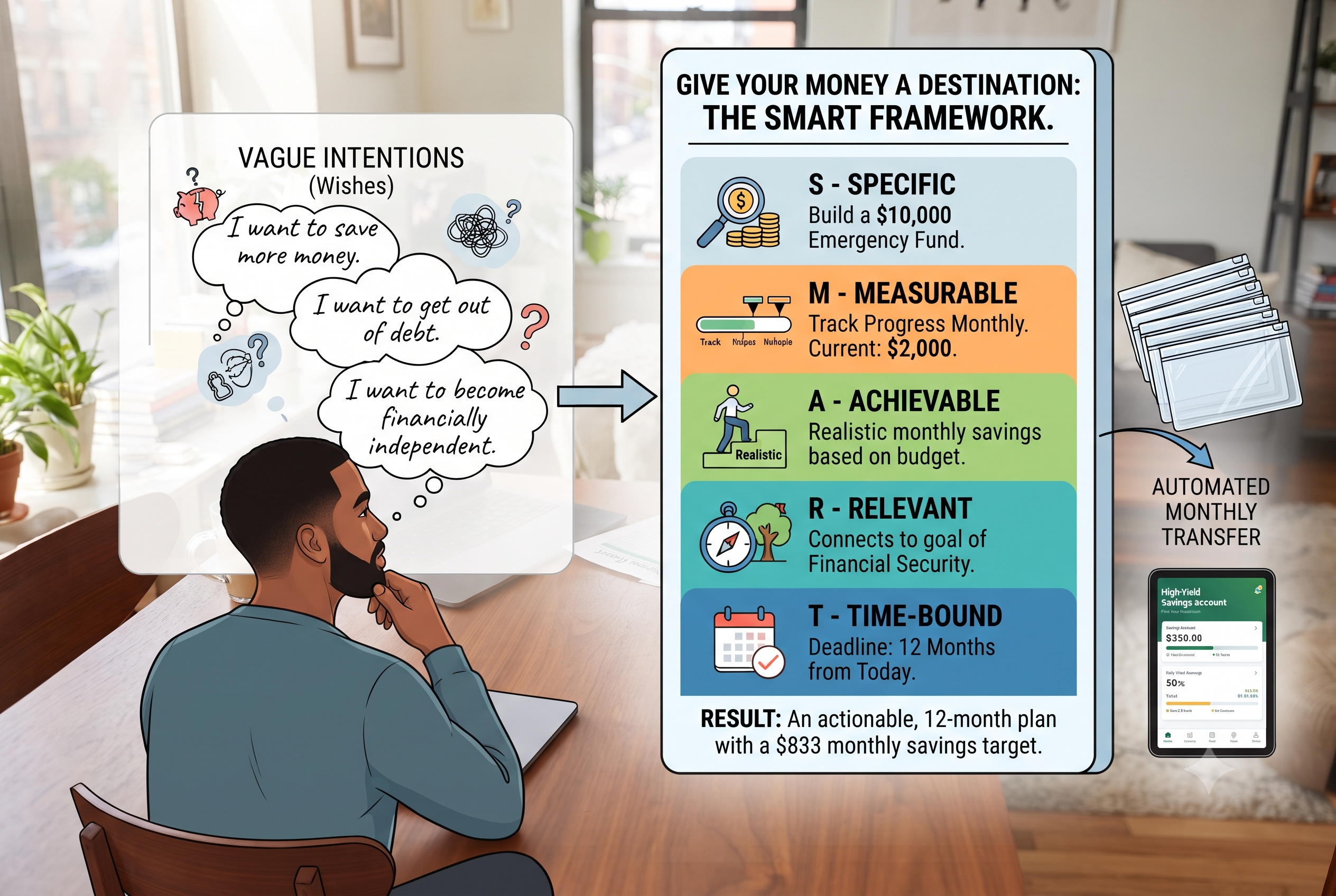
“I want to save more money.”
“I want to get out of debt.”
“I want to become financially independent.”
These sound like good financial goals.
But there is one problem.
They aren’t really goals yet.
They’re intentions.
The difference matters because vague intentions rarely tell you what to do next.
A real financial goal should answer several important questions:
- What exactly are you trying to accomplish?
- How much money is involved?
- When do you want to achieve it?
- How much do you need to save each month?
- How will you measure your progress?
This is where the SMART framework becomes extremely useful.
SMART financial goals transform vague financial wishes into specific, measurable, realistic, and time-bound plans.
Instead of saying, “I need to save more,” you might say:
“I will build a $10,000 emergency fund within 12 months by automatically saving $833 from each monthly paycheck.”
Now you have something you can actually act on.
In this guide, we’ll explain how SMART financial goals work, how to create them step by step, common mistakes to avoid, and how to turn your goals into a financial system that keeps you moving forward.
If you want to understand the broader foundation first, start with our guide to Money Management and Budgeting.
What Are SMART Financial Goals?
SMART is an acronym consisting of five characteristics:
- Specific – The goal is clearly defined.
- Measurable – You can track your progress.
- Achievable – The target is realistic given your circumstances.
- Relevant – The goal supports your broader financial priorities.
- Time-bound – The goal has a clear deadline.
Each element solves a different problem.
Specificity eliminates ambiguity.
Measurement creates accountability.
Achievability prevents unrealistic expectations.
Relevance keeps you focused on what actually matters.
A deadline creates urgency.
Together, these five elements turn a financial wish into an executable plan.
Why Vague Financial Goals Usually Fail
Consider two people who want to save for an emergency fund.
Person A says:
“I really need to start saving.”
Person B says:
“I will save $6,000 over the next 12 months by automatically transferring $500 into a high-yield savings account every month.”
Who has the better chance of succeeding?
Obviously, Person B.
The reason isn’t necessarily greater discipline.
The difference is that Person B has created a system.
There is a number.
There is a deadline.
There is a monthly action.
There is a specific destination for the money.
That makes the goal much easier to execute.
The Five Elements of a SMART Financial Goal
1. Specific: Define Exactly What You Want
The first step is removing ambiguity.
“I want to improve my finances” isn’t specific.
Neither is “I want to save more.”
Instead, define exactly what you want to accomplish.
For example:
- Build a $10,000 emergency fund.
- Pay off $8,000 of credit card debt.
- Save $25,000 for a home down payment.
- Invest $500 every month for retirement.
- Build enough savings to cover six months of essential expenses.
The more clearly you define the destination, the easier it becomes to determine the route.
2. Measurable: Put a Number on It
A financial goal should almost always contain a measurable number.
Compare these two statements:
Weak: “I want to reduce my debt.”
Strong: “I want to reduce my credit card debt from $12,000 to $4,000.”
The second version allows you to measure progress.
You can track the balance every month.
You can calculate how much remains.
You can celebrate milestones along the way.
Numbers turn financial progress into something visible.
3. Achievable: Make the Goal Realistic
A goal should challenge you without being impossible.
Suppose your household has $5,000 in monthly take-home income and $4,300 in essential expenses.
Trying to save $3,000 every month probably isn’t realistic.
A $500 monthly savings target may be much more achievable.
That doesn’t mean you should always choose the easiest possible goal.
It means your target should reflect your actual financial circumstances.
When goals are unrealistic, failure becomes predictable.
Repeated failure can then destroy motivation.
A realistic goal, on the other hand, creates momentum.
4. Relevant: Connect the Goal to Your Bigger Picture
A financial goal should have a meaningful purpose.
Why are you saving?
Why are you paying off debt?
Why are you investing?
Maybe you want greater financial security.
Maybe you want to leave a stressful job.
Maybe you want to buy a home.
Maybe you want to retire earlier.
Maybe you simply want to stop worrying about unexpected expenses.
A goal becomes much more powerful when it connects to something you genuinely value.
Our guide to Financial Goals explores how meaningful objectives can become the foundation of a long-term financial plan.
5. Time-Bound: Give Yourself a Deadline
This is one of the most frequently overlooked elements of financial planning.
“I’ll save $10,000 eventually” isn’t a strong goal.
“I’ll save $10,000 within 18 months” is much better.
A deadline allows you to reverse-engineer the goal.
For example:
$10,000 ÷ 18 months = approximately $556 per month.
Now the goal has become a monthly action.
That’s the real power of time-bound financial planning.
How to Turn a SMART Goal Into a Monthly Plan
Creating the goal is only the beginning.
The next step is turning it into a repeatable financial system.
Let’s say your goal is:
“Build a $12,000 emergency fund within 24 months.”
Divide the target by the number of months:
$12,000 ÷ 24 = $500 per month.
Your goal is now actionable.
You could set up an automatic $250 transfer every two weeks or a $500 monthly transfer into a dedicated savings account.
This is where SMART goals connect with good financial habits.
Our guide to How to Build a Saving Habit explains why automation is often more effective than relying on motivation.
Build Three Levels of Financial Goals
Trying to accomplish ten financial goals simultaneously can become overwhelming.
A better approach is to divide your objectives into three time horizons.
Short-Term Goals
These usually involve the next few months to two years.
Examples include:
- Building a starter emergency fund.
- Paying off a credit card.
- Saving for a vacation.
- Replacing an aging vehicle.
- Building a cash reserve.
Medium-Term Goals
These might take two to five years.
Examples include:
- Saving for a home down payment.
- Paying off significant consumer debt.
- Starting a business.
- Saving for education.
Long-Term Goals
These generally extend beyond five years.
Examples include:
- Retirement.
- Financial independence.
- Long-term wealth building.
- Funding a child’s education.
Having goals across different time horizons helps prevent you from focusing entirely on the present or entirely on the distant future.
SMART Goals When You Have Debt
Debt doesn’t mean you have to postpone financial planning.
In fact, debt is often a reason to become more specific about your goals.
Instead of saying:
“I need to get out of debt.”
Create a measurable target.
For example:
“I will pay off my $7,500 credit card balance within 15 months by paying at least $500 per month and directing all unexpected income toward the balance.”
Now you have a clear strategy.
If you’re dealing with multiple debts, you can also use structured approaches such as the Debt Snowball Method or the Debt Avalanche Method.
The important point is that debt repayment should become a measurable project rather than an indefinite source of stress.
SMART Financial Goals on a Lower Income
You don’t need a six-figure salary to set SMART financial goals.
You simply need goals that match your current circumstances.
Suppose you can only save $100 per month.
That may seem insignificant.
But $100 per month equals $1,200 per year.
More importantly, it establishes the behavior of saving consistently.
As your income increases, you can increase the amount.
You might also combine savings with debt reduction.
The objective isn’t to compare your progress with someone else’s.
Your objective is to improve your own financial position.
A Real-Life Example: From Vague Goal to SMART Goal
Imagine an American household with $6,500 in monthly take-home income.
The couple has $4,800 in monthly living expenses and $7,200 in credit card debt.
Their original goal is:
“We want to get better with money.”
That’s a good intention but a weak financial plan.
They could transform it into this:
“We will pay off our $7,200 credit card balance within 12 months by allocating $600 per month to debt repayment and directing at least 50% of unexpected income toward the balance.”
Now every month has a purpose.
At the end of each month, they can ask one simple question:
Are we on track to eliminate the balance within 12 months?
That is the difference between hoping for financial improvement and managing toward it.
Don’t Forget to Make Your Goals Flexible
SMART doesn’t mean rigid.
Life changes.
You may lose your job.
Your rent may increase.
You may have a medical expense.
You may receive a promotion.
Your family situation may change.
A good financial plan should be reviewed and adjusted when circumstances change.
If you originally planned to save $800 per month but your income temporarily falls, reducing the target to $400 doesn’t mean you failed.
It means you’re adapting.
The important thing is to keep the financial direction intact.
Common SMART Financial Goal Mistakes
Setting Too Many Goals
Trying to save for a house, pay off debt, build an emergency fund, invest aggressively, travel, and buy a new car simultaneously can dilute your focus.
Prioritize.
Choosing Unrealistic Numbers
A goal that requires money you simply don’t have isn’t a plan.
Adjust the target or extend the timeline.
Ignoring Existing Spending Habits
You can’t build an effective savings plan without understanding where your money currently goes.
Track your spending before setting aggressive targets.
Our guide to Spending Habits can help you identify where unnecessary spending may be undermining your goals.
Forgetting to Automate
A goal that requires you to remember the same action every month is vulnerable to procrastination.
Automate whenever possible.
Never Reviewing Progress
A goal isn’t something you write down once and forget.
Review your progress regularly.
Monthly reviews are often enough to identify problems before they become serious.
SMART Goals and Financial Freedom
Financial freedom can sound like an enormous and distant objective.
That’s exactly why breaking it down matters.
Instead of saying:
“I want to be financially free.”
You might create a sequence of SMART goals:
- Build a $5,000 emergency fund within 10 months.
- Pay off $10,000 of high-interest debt within 18 months.
- Invest $750 per month for retirement starting next month.
- Increase the retirement contribution by 1% whenever income increases.
Each individual goal may seem manageable.
Together, they create a financial freedom strategy.
If you’re interested in the bigger picture, read our Financial Freedom Guide.
30-Second Summary
- Specific: Define exactly what you want.
- Measurable: Attach a number to the goal.
- Achievable: Make the target realistic.
- Relevant: Connect it to something meaningful.
- Time-bound: Set a clear deadline.
Then divide the goal into monthly or weekly actions.
Finally, automate those actions whenever possible.
Frequently Asked Questions About SMART Financial Goals
What is a SMART financial goal?
A SMART financial goal is a financial objective that is specific, measurable, achievable, relevant, and time-bound.
Why are SMART goals better than general financial goals?
They turn vague intentions into concrete actions that can be tracked and evaluated.
How many financial goals should I have?
There is no universal number, but focusing on a few high-priority goals is usually more effective than trying to pursue too many simultaneously.
Can I create SMART goals if I have debt?
Absolutely. Debt repayment is one of the best areas for SMART goal setting because balances, payment amounts, and deadlines are measurable.
What should my first financial goal be?
For many households, a reasonable first goal is building a starter emergency fund while addressing high-interest debt.
How long should a financial goal take?
It depends on the objective. Some goals can take a few months, while retirement and financial independence may require decades.
What if I can’t afford my monthly target?
Reduce the target, extend the deadline, or adjust your spending plan. A sustainable goal is better than an unrealistic one.
Should I prioritize saving or paying off debt?
It depends on the interest rate, debt type, emergency savings, and personal circumstances. High-interest debt generally deserves serious priority, while maintaining some emergency savings can protect you from taking on new debt.
Can SMART goals change?
Yes. Your financial plan should evolve when your income, expenses, family situation, or priorities change.
What is the biggest mistake when setting financial goals?
The biggest mistake is creating a goal without a concrete action plan and deadline.
Final Thoughts: Give Your Money a Destination
Financial progress rarely happens by accident.
It happens when your money has a destination.
SMART financial goals give you that destination.
They transform “I want to save more” into a number.
They transform “I want to get out of debt” into a deadline.
They transform “I want to become financially independent” into a series of manageable steps.
You don’t need to change your entire financial life tomorrow.
Start with one important goal.
Make it specific.
Give it a number.
Set a realistic deadline.
Automate the necessary actions.
Then review your progress every month.
Because financial freedom isn’t usually created by one spectacular decision.
It’s created by small, intentional decisions repeated consistently over time.
Give your money a destination, and your financial future becomes much easier to navigate.