
How to Manage Money with an Irregular Income: A Practical Guide for Freelancers, Entrepreneurs, and Gig Workers
How to Budget with an Irregular Income: Smart Money Strategies for Freelancers and Variable Earners
Traditional budgeting advice often assumes one thing:
You receive the same paycheck every month.
But for millions of people, that simply isn’t reality.
Freelancers, entrepreneurs, consultants, commission-based sales professionals, real estate agents, content creators, and gig workers frequently experience fluctuating income.
Some months bring abundance. Other months feel unexpectedly tight.
This unpredictability can make budgeting, saving, and financial planning feel nearly impossible.
The good news is that managing money with an irregular income is absolutely possible.
It simply requires a different approach.
In this guide, you’ll learn practical strategies to create financial stability even when your income varies from month to month.
Before diving into irregular income management, it’s important to understand the foundations of Money Management and Budgeting, because financial control always starts with understanding cash flow.
Why Irregular Income Creates Financial Challenges
When income is unpredictable, traditional budgeting becomes more difficult.
Problems often include:
- Difficulty planning monthly expenses
- Inconsistent savings contributions
- Cash flow shortages during slow months
- Greater reliance on credit cards
- Higher financial stress and uncertainty
The challenge isn’t necessarily earning too little.
Often, it’s the inconsistency that creates financial pressure.
The Biggest Mistake People Make
One of the most common mistakes among people with variable income is building their lifestyle around their highest-earning months.
For example, if you earn:
- $4,000 in January
- $8,000 in February
- $3,500 in March
- $7,000 in April
Using the $8,000 month as your spending benchmark can quickly create financial problems.
Instead, successful money management starts with planning around your lower-income months.
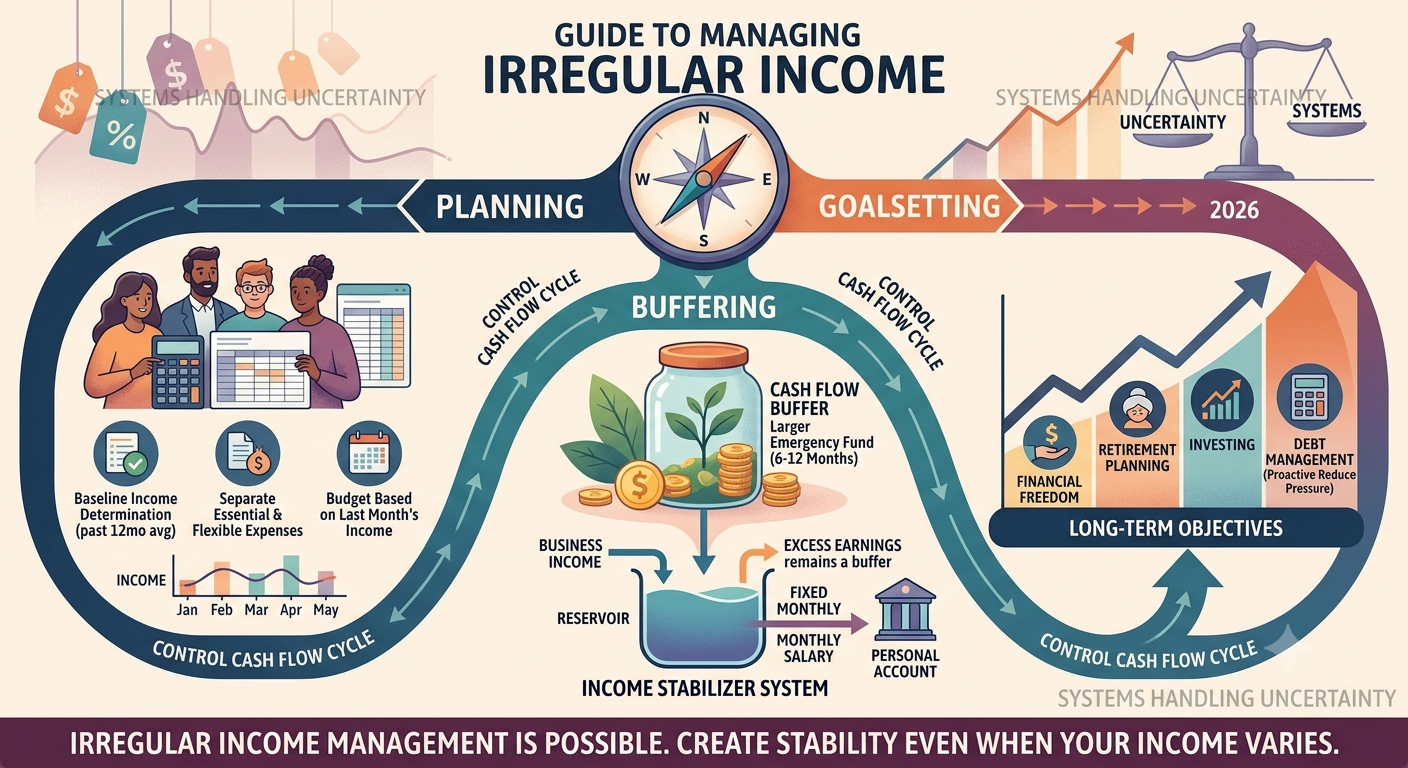
Step 1: Determine Your Baseline Income
The first step is identifying your minimum reliable monthly income.
Review your earnings from the past 12 months.
Focus on:
- Your lowest earning months
- Your average monthly income
- Your most consistent income sources
Many financial professionals recommend building your budget around a conservative baseline rather than optimistic projections.
This creates a safety margin when income fluctuates.
Step 2: Separate Essential and Non-Essential Expenses
When income varies, flexibility becomes crucial.
Divide expenses into two categories:
Essential Expenses
- Housing
- Utilities
- Insurance
- Food
- Transportation
- Minimum debt payments
Flexible Expenses
- Dining out
- Entertainment
- Travel
- Shopping
- Subscriptions
This distinction helps you adjust spending quickly when income declines.
Step 3: Build a Larger Emergency Fund
For people with stable salaries, three to six months of expenses is often recommended.
For those with irregular income, a larger cushion may provide greater security.
Many freelancers and self-employed professionals aim for six to twelve months of essential expenses.
This fund acts as an income stabilizer during slower periods.
To learn more, read our guide on Saving Money and Building Financial Security.
Step 4: Use a Monthly Salary System
One of the most effective strategies for variable-income earners is paying yourself a fixed monthly amount.
Here’s how it works:
- Deposit all business or freelance income into a dedicated account.
- Determine a reasonable monthly “salary.”
- Transfer that amount to your personal account each month.
- Leave excess earnings in the business account as a buffer.
This creates greater predictability and simplifies budgeting.
Step 5: Budget Based on Last Month’s Income
Many people with irregular income find it easier to budget using money already earned rather than money they expect to earn.
Instead of planning based on future income, use last month’s earnings to fund the current month.
This approach reduces uncertainty and improves financial stability.
Step 6: Prioritize Cash Flow Management
For variable-income households, cash flow is often more important than net worth.
You may have strong annual earnings but still experience short-term cash shortages.
This is why tracking incoming and outgoing money is essential.
A realistic Monthly Budget can help identify upcoming gaps before they become problems.
Step 7: Avoid Lifestyle Inflation
When income spikes, it is tempting to increase spending immediately.
However, higher income today does not guarantee higher income tomorrow.
Successful freelancers and entrepreneurs often save a significant portion of unusually strong months rather than increasing fixed expenses.
This creates resilience during slower periods.
How Debt Can Become More Dangerous with Irregular Income
Variable income and debt can be a risky combination.
Monthly loan payments remain fixed even when income declines.
This is why managing debt proactively is especially important.
If you’re carrying consumer debt, consider strategies such as the Debt Snowball Method, the Debt Avalanche Method, or How to Pay Off Credit Card Debt to reduce financial pressure.
Financial Goals Matter Even More
People with fluctuating income often become focused solely on short-term cash flow.
While understandable, this can cause long-term goals to be neglected.
Retirement planning, investing, emergency savings, and wealth building should remain part of your financial strategy.
Our guide on Financial Goals can help you stay focused on long-term priorities while managing short-term uncertainty.
Common Mistakes to Avoid
Budgeting Based on Best-Case Scenarios
Always plan conservatively.
Ignoring Slow Months
Financial stability comes from preparing for low-income periods before they arrive.
Mixing Business and Personal Finances
Separate accounts create better visibility and control.
Saving Only When Convenient
Consistent saving is even more important when income fluctuates.
How Irregular Income Can Become an Advantage
While unpredictable income creates challenges, it also offers opportunities.
Many entrepreneurs, freelancers, and commission-based professionals have higher income potential than traditional salaried workers.
The key is learning how to manage volatility effectively.
Once you build strong financial systems, irregular income becomes less stressful and more empowering.
Final Thoughts
Managing money with an irregular income requires flexibility, discipline, and planning.
The goal is not to eliminate uncertainty.
The goal is to create systems that can handle uncertainty.
By budgeting conservatively, building larger cash reserves, controlling expenses, and maintaining clear financial goals, you can create stability even when your income fluctuates.
Because financial success is not determined by how predictable your income is.
It is determined by how well you manage the money you earn.