
Living Paycheck to Paycheck? A Practical Financial Recovery Plan
Living paycheck to paycheck is one of the most frustrating financial situations a person can experience.
Your paycheck arrives.
You pay the rent or mortgage.
You pay the bills.
You use your credit card for groceries, transportation, and everyday expenses.
A few weeks later, your bank balance is close to zero again.
Then the next paycheck arrives.
And the cycle starts over.
Many people assume this happens because they simply do not earn enough money.
Sometimes that is true.
But income is not always the entire problem.
Two people earning the same salary can have completely different financial lives.
One may have savings, manageable debt, and investments.
The other may have no emergency fund and rely on credit cards before every payday.
The difference is often not income.
It is the financial system they have built around their income.
The good news is that living paycheck to paycheck is not necessarily permanent.
You can gradually regain control by changing the order in which your money is used.
This guide presents a practical financial recovery plan designed for people who feel financially stuck, overwhelmed by expenses, or unable to save despite having a regular income.
30-Second Summary
- Living paycheck to paycheck is often a cash-flow problem, not simply an income problem.
- The first step is to understand exactly where your money goes.
- Track every expense for at least 30 days.
- Separate essential expenses from discretionary spending.
- Create a realistic budget instead of an overly restrictive one.
- Prioritize high-interest debt because it can consume future income.
- Build an emergency fund before taking excessive investment risk.
- Automate savings immediately after receiving your paycheck.
- Look for ways to increase income instead of cutting expenses forever.
- Control lifestyle inflation when your income increases.
- Start investing after your financial foundation becomes reasonably stable.
- The objective is not perfection. It is creating a system you can maintain.
What Does Living Paycheck to Paycheck Actually Mean?
Living paycheck to paycheck does not necessarily mean that you are poor.
It means your current income is being consumed by current financial obligations and spending, leaving little or no margin between one paycheck and the next.
Someone earning $45,000 per year can experience it.
Someone earning $75,000 can experience it.
Even someone earning $150,000 can experience it if expenses, debt payments, housing costs, and lifestyle spending rise faster than income.
This is why the problem should be viewed through cash flow.
Your monthly financial equation is essentially:
Net income − essential expenses − debt payments − discretionary spending = financial surplus.
If that final number is close to zero every month, you have very little financial flexibility.
If it is negative, you are effectively financing your lifestyle through debt, savings, or future income.
If it is positive, you have money that can eventually be directed toward emergency savings, debt reduction, investing, and other financial goals.
The first objective is therefore not to become wealthy.
The first objective is to create a surplus.
Step 1: Stop Guessing Where Your Money Goes
The first stage of financial recovery is uncomfortable.
You need to look at the numbers.
Not what you think you spend.
Not what you planned to spend.
What you actually spent.
For the next 30 days, track every expense.
That includes:
- Rent or mortgage
- Utilities
- Groceries
- Restaurants and takeout
- Transportation
- Gasoline
- Insurance
- Subscriptions
- Entertainment
- Online shopping
- Credit card payments
- Interest charges
- Small cash purchases
Do not try to change everything immediately.
The first month is primarily an observation period.
You are trying to discover the truth about your financial behavior.
The $10 Problem
A $10 purchase feels insignificant.
But spending $10 every day adds up to approximately $300 per month.
That is $3,600 per year.
The problem is rarely one $10 purchase.
The problem is repeating the same behavior hundreds of times.
This is why detailed spending tracking can be so powerful.
It turns vague financial anxiety into measurable information.
Step 2: Separate Fixed, Essential, and Discretionary Expenses
Once you have 30 days of data, divide your spending into categories.
A useful structure is:
| Category | Examples | Priority |
|---|---|---|
| Fixed Essentials | Rent, mortgage, insurance, minimum debt payments | Very High |
| Variable Essentials | Groceries, transportation, utilities | High |
| Financial Priorities | Emergency savings, debt repayment, retirement contributions | High |
| Discretionary | Dining out, entertainment, shopping | Flexible |
| Optional Recurring | Streaming, memberships, subscriptions | Review |
This classification immediately gives you something valuable:
Not every dollar has equal importance.
You should not treat rent and a streaming subscription as equally unavoidable.
You should not treat groceries and an impulse purchase as the same type of expense.
Once the categories become visible, you can start making decisions.
Step 3: Build a Budget That You Can Actually Follow
Many people fail at budgeting because they create a budget that looks perfect on paper but is impossible to maintain.
They decide they will suddenly spend almost nothing on restaurants.
They eliminate every entertainment expense.
They set an extremely aggressive savings target.
They follow the plan for two weeks.
Then they abandon it completely.
A sustainable budget is usually more effective than a perfect budget that lasts for ten days.
One common starting framework is the 50/30/20 rule:
- 50%: Needs and essential expenses
- 30%: Wants and discretionary spending
- 20%: Savings, investing, and debt reduction
But these percentages are not laws.
If you live in an expensive U.S. city, housing alone may consume more than 30% of your take-home pay.
If you are recovering from significant debt, more than 20% may need to go toward debt reduction.
If your income is temporarily unstable, your priorities may look different.
The important thing is to create a system that gives every dollar a purpose.
You can also review our guide to the 50/30/20 budgeting method for a more detailed framework.
Step 4: Find the Invisible Money Leaks
When people analyze their finances, they often search for one enormous expense.
Sometimes there is one.
But many financial problems are caused by dozens of smaller recurring expenses.
Consider a hypothetical monthly spending pattern:
| Expense | Monthly Cost |
|---|---|
| Unused subscriptions | $45 |
| Food delivery | $180 |
| Impulse shopping | $150 |
| Premium memberships | $40 |
| Frequent coffee/snacks | $100 |
| Other small purchases | $85 |
| Total | $600 |
That is $7,200 per year.
None of the individual expenses looks catastrophic.
Together, they create a significant financial leak.
This does not mean you need to eliminate everything you enjoy.
The goal is to identify spending that provides little value relative to its cost.
Step 5: Use the 24-Hour Rule for Nonessential Purchases
Impulse spending is often emotional.
You see something you want.
You buy it.
The immediate reward feels good.
Later, the purchase may feel unnecessary.
A simple behavioral tool is the 24-hour rule.
For nonessential purchases above a predetermined amount, wait 24 hours before buying.
You might choose:
- $50 for everyday discretionary purchases
- $100 for larger purchases
- $250 or more for significant purchases
The exact threshold does not matter as much as the pause.
The pause separates the emotional decision from the financial decision.
After 24 hours, ask:
- Do I still need this?
- Will I use it frequently?
- Does it support an important goal?
- Could I use the money for something more valuable?
Sometimes you will still buy it.
That is fine.
Financial discipline does not mean eliminating every enjoyable expense.
It means making those expenses intentional.
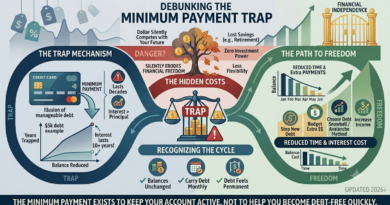
Step 6: Attack High-Interest Debt
For many people living paycheck to paycheck, debt is the biggest obstacle to financial recovery.
Credit card balances are especially dangerous because high interest rates can consume a significant portion of every payment.
Imagine that you owe $8,000 on a credit card with a high annual interest rate.
Even if you make regular payments, a substantial amount of your money may go toward interest rather than reducing the principal.
This creates a vicious cycle.
Income → debt payment → interest → less available cash → new credit card spending → more debt.
The goal is to break that cycle.
The Debt Avalanche Method
The debt avalanche approach prioritizes the debt with the highest interest rate.
You continue making minimum payments on other debts while directing extra money toward the most expensive balance.
Once that balance is eliminated, you redirect the payment toward the next debt.
This approach can reduce total interest costs.
Learn more in our guide to the debt avalanche method.
The Debt Snowball Method
The debt snowball method takes a different approach.
You pay off the smallest balance first, regardless of its interest rate.
This can create quick psychological wins.
For some people, that motivation is extremely valuable.
The mathematically optimal strategy and the psychologically sustainable strategy are not always identical.
The best method is often the one you can actually follow until the debt is gone.
Step 7: Do Not Confuse Investing With Financial Recovery
This is an important distinction.
If you have no emergency savings and significant high-interest debt, putting every available dollar into stocks may not improve your financial position.
You could invest $500.
The market could fall 20%.
Then your car breaks down.
Without cash reserves, you may have to put the repair on a credit card.
Now you own an investment that has declined in value while simultaneously accumulating expensive debt.
The problem was not necessarily the investment.
The problem was the financial sequence.
A healthier sequence may look like:
Stabilize cash flow → control expensive debt → build emergency savings → invest consistently.
The exact order can vary depending on your circumstances, but financial stability should generally come before aggressive risk-taking.
Step 8: Build an Emergency Fund
An emergency fund is the financial equivalent of a shock absorber.
It does not make your portfolio grow.
It does something equally important.
It prevents a financial emergency from turning into expensive debt.
A common long-term target is approximately three to six months of essential expenses.
You do not necessarily need to reach six months immediately.
Start with a smaller milestone.
Emergency Fund Milestones
| Milestone | Purpose |
|---|---|
| $500 | Handle smaller emergencies |
| $1,000 | Create an initial financial buffer |
| 1 Month of Essentials | Reduce dependence on credit |
| 3 Months | Meaningful financial protection |
| 6 Months | Stronger protection against income disruption |
The appropriate amount depends on job stability, household income, insurance, dependents, and other circumstances.
The key is having accessible cash available for genuine emergencies.
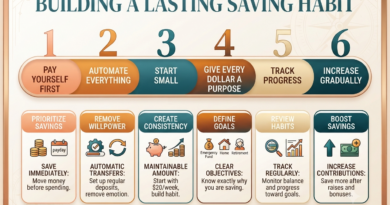
Step 9: Pay Yourself First
One of the most common savings mistakes is saying:
“I’ll save whatever is left at the end of the month.”
For people living paycheck to paycheck, there is usually nothing left.
Instead, reverse the process.
Income → savings → essential spending → discretionary spending.
When your paycheck arrives, automatically transfer a predetermined amount to a separate savings account.
Even $25 or $50 can be a starting point.
As your financial situation improves, increase the amount.
Automation matters because it removes the need to make the same decision every month.
Step 10: Create Separate Accounts for Different Jobs
One reason people overspend is that all their money sits in one account.
The balance looks available.
So it gets spent.
Creating separate accounts can provide a psychological barrier.
For example:
- Checking account: everyday spending
- Emergency savings: unexpected expenses
- Short-term savings: planned purchases
- Investment account: long-term wealth building
The exact structure is not important.
The principle is.
Give your money different jobs.
When every dollar has a destination, it becomes harder to spend money that was meant for another purpose.
Step 11: Control Lifestyle Inflation
One of the most dangerous financial patterns is lifestyle inflation.
Your salary increases.
Your spending increases.
Your financial situation barely improves.
Imagine that you receive a $7,000 annual raise.
Instead of saving or investing part of it, you upgrade your car, move into a more expensive apartment, increase restaurant spending, and add several subscriptions.
Your income is higher.
But your financial margin may remain exactly the same.
A better approach is to split income increases.
The Raise Rule
When your income increases, consider dividing the additional money between:
- Investing
- Emergency savings
- Debt repayment
- Higher-quality spending
You do not have to send the entire raise into savings.
The objective is to ensure that your lifestyle does not consume 100% of every financial improvement.
Step 12: Increase Income Instead of Cutting Forever
Expense reduction has a limit.
You can cancel subscriptions.
You can eat at home more often.
You can reduce unnecessary shopping.
But there is a minimum level of spending required to live.
Income has a different characteristic.
There is theoretically no fixed ceiling on how much your income can grow.
That makes income growth an important part of financial recovery.
Potential Income Strategies
- Negotiating a salary increase
- Changing employers when appropriate
- Developing higher-value professional skills
- Freelancing
- Consulting
- Online services
- Part-time work
- Building a small business
- Monetizing specialized knowledge
You do not need five side hustles.
One additional income stream can make a meaningful difference.
Step 13: Build a Financial Recovery Timeline
Financial recovery becomes easier when you stop thinking about it as one giant project.
Break it into stages.
Days 1–30: Discover the Problem
- Track every expense.
- Calculate take-home income.
- List all debts.
- Identify subscriptions.
- Calculate fixed expenses.
- Identify spending leaks.
Days 31–60: Create Control
- Create a realistic budget.
- Cancel unnecessary recurring expenses.
- Set automatic savings.
- Choose a debt repayment strategy.
- Reduce discretionary spending.
Days 61–90: Build Stability
- Grow the emergency fund.
- Increase debt payments.
- Look for income opportunities.
- Automate financial transfers.
- Review your progress.
After 90 Days: Build Wealth
- Continue eliminating expensive debt.
- Build a stronger emergency reserve.
- Increase retirement contributions.
- Start or increase long-term investing.
- Review insurance and financial goals.
The purpose of the first 90 days is not to become wealthy.
It is to stop the financial bleeding.
A Realistic Example: From Financial Chaos to Stability
Consider a fictional American worker named Alex.
Alex earns $4,500 per month after taxes.
At the end of every month, almost nothing remains.
Alex initially believes the problem is insufficient income.
After tracking expenses for 30 days, the numbers tell a different story.
| Category | Monthly Amount |
|---|---|
| Housing | $1,600 |
| Utilities and Insurance | $500 |
| Transportation | $500 |
| Groceries | $500 |
| Dining and Delivery | $400 |
| Subscriptions | $150 |
| Shopping and Entertainment | $400 |
| Debt Payments | $450 |
| Total | $4,500 |
Alex is not necessarily overspending on one enormous category.
The problem is that almost every dollar already has a destination.
Alex makes several changes:
- Reduces food delivery by $200.
- Cuts unused subscriptions by $75.
- Reduces discretionary shopping by $150.
- Finds $75 in other recurring expenses.
That creates approximately $500 of monthly financial margin.
Alex then uses the margin to build a starter emergency fund while aggressively addressing high-interest debt.
Later, once the debt situation improves, part of the $500 is redirected toward retirement investing.
The important transformation was not a sudden increase in salary.
It was the creation of a system.
What If Your Income Is Simply Too Low?
This is an important reality.
Not every financial problem can be solved by budgeting.
If your essential expenses consume nearly all of your income, eliminating a few subscriptions will not fix the problem.
You may need to address the income side.
That could involve:
- Seeking a higher-paying position
- Developing new skills
- Adding part-time income
- Relocating to reduce housing costs
- Refinancing eligible debt when appropriate
- Reducing transportation costs
- Finding ways to monetize existing expertise
The correct response is not to feel guilty about spending $5 on coffee while ignoring a structural income problem.
Financial planning should distinguish between behavioral problems and structural problems.
When Should You Start Investing?
Investing should eventually become part of your financial system.
But the timing matters.
If you have no emergency savings and expensive credit card debt, aggressively investing in volatile assets may not be the highest priority.
Once your financial foundation becomes stronger, you can gradually increase long-term investments.
For many U.S. workers, that may include:
- 401(k) contributions
- Employer matching contributions
- Traditional IRA
- Roth IRA
- Taxable brokerage investments
- Broad-market ETFs and index funds
The right combination depends on your circumstances.
But the broader principle is simple:
First create financial resilience. Then increase financial growth.
Why Psychology Matters More Than Most People Think
Personal finance is not purely mathematical.
People spend money when they are stressed.
They shop when they are bored.
They spend to impress other people.
They use credit because they want immediate gratification.
They increase spending after receiving a raise.
They abandon budgets after one bad month.
These behaviors are not solved by spreadsheets alone.
You need systems that reduce the number of emotional decisions you make.
Automation is one such system.
Separate accounts are another.
Waiting 24 hours before large discretionary purchases is another.
Automatic debt payments can help.
Automatic retirement contributions can help.
Financial recovery becomes easier when good behavior requires less willpower.
Our guide on investment psychology explores the behavioral side of financial decisions in greater detail.
The Biggest Mistakes People Make During Financial Recovery
1. Trying to Fix Everything in One Month
Extreme changes are difficult to sustain.
2. Creating an Unrealistic Budget
A budget that leaves no room for normal life often fails quickly.
3. Ignoring Small Recurring Expenses
Small expenses can become significant when repeated.
4. Taking New Debt While Paying Off Old Debt
This keeps the debt cycle alive.
5. Investing Before Creating Financial Stability
Investing does not replace emergency savings or debt management.
6. Depending Entirely on Willpower
Automation is usually more reliable than motivation.
7. Increasing Lifestyle Spending With Every Raise
Higher income does not automatically create wealth.
8. Comparing Your Finances With Other People
Social media rarely shows the full financial picture.
9. Giving Up After One Bad Month
A financial plan does not need to be perfect to work.
10. Focusing Only on Cutting Expenses
Income growth should be part of the long-term strategy.
A Simple Monthly Financial System
Once you have recovered from the immediate crisis, your monthly system can become remarkably simple.
| When Money Arrives | Action |
|---|---|
| Step 1 | Automatic emergency savings |
| Step 2 | Automatic retirement/investment contribution |
| Step 3 | Pay essential bills |
| Step 4 | Make planned debt payments |
| Step 5 | Use remaining money for discretionary spending |
This structure changes the traditional paycheck-to-paycheck model.
Instead of:
Income → spending → nothing left
You create:
Income → financial priorities → essential spending → discretionary spending.
That small change can fundamentally alter your financial trajectory.
How Long Does Financial Recovery Take?
There is no universal timeline.
Someone with $2,000 of credit card debt and stable income may improve quickly.
Someone with $50,000 of high-interest debt and limited income may need several years.
The important thing is to measure progress.
Track:
- Net worth
- Total debt
- Credit card balances
- Emergency fund
- Monthly savings rate
- Investment contributions
- Monthly financial surplus
If these numbers are gradually improving, your system is working.
What Financial Recovery Really Looks Like
Financial recovery is not necessarily about suddenly having a large bank balance.
It can look like this:
You stop checking your bank account nervously before payday.
You stop using your credit card for groceries because your checking account is empty.
You have $500 available for an unexpected repair.
Then $1,000.
Then one month of expenses.
Your credit card balance begins falling.
Your retirement contributions become automatic.
Your financial decisions become less emotional.
You can finally think about the future instead of constantly solving the current month.
That is financial progress.
Frequently Asked Questions
Why do I keep living paycheck to paycheck?
It can result from insufficient income, high fixed expenses, debt payments, lifestyle inflation, uncontrolled discretionary spending, or a combination of these factors.
Can I stop living paycheck to paycheck without earning more money?
Sometimes. If your current spending contains meaningful waste, improving cash flow can create financial margin. However, if essential expenses already consume most of your income, increasing income may be necessary.
How much should I save from each paycheck?
There is no universal percentage. Start with an amount you can sustain and increase it as your financial situation improves.
Is the 50/30/20 budget rule realistic?
It can be a useful framework, but it is not a universal formula. Housing costs, debt, income, and family circumstances may require different percentages.
Should I pay off debt or invest first?
It depends on the debt interest rate, investment options, tax benefits, and your financial situation. High-interest debt generally deserves significant priority.
Should I invest while paying off credit card debt?
Some people may continue small retirement contributions, especially to capture an employer match, while aggressively paying down high-interest debt. The appropriate balance depends on individual circumstances.
How much should an emergency fund contain?
A common long-term target is three to six months of essential expenses, although the appropriate amount depends on income stability, household obligations, and other risks.
Where should I keep my emergency fund?
Emergency savings should generally be accessible and relatively low-risk. A high-yield savings account can be one option for eligible U.S. savers.
Should I stop spending on entertainment?
Not necessarily. A sustainable financial plan should leave room for reasonable discretionary spending. The goal is intentional spending rather than eliminating enjoyment.
How can I stop impulse spending?
Use practical barriers such as a 24-hour waiting rule, removing saved payment information, unsubscribing from promotional emails, and creating a separate discretionary spending limit.
Why does my budget always fail?
Your budget may be unrealistic, too restrictive, or disconnected from your actual spending behavior. Use your real spending data to create the next budget.
Should I cancel all my subscriptions?
No. Review them individually. Cancel services you rarely use or that provide little value relative to their cost.
How can I increase my income?
Potential options include salary negotiation, changing jobs, developing valuable skills, freelancing, consulting, part-time work, or building a small business.
Should I invest if I have no emergency fund?
Building an emergency reserve is generally an important priority before taking significant investment risk. Retirement contributions needed to capture an employer match can be a special consideration.
How much should I invest after becoming financially stable?
The amount depends on your income, expenses, retirement goals, age, risk tolerance, and other financial objectives. The important principle is to invest consistently rather than waiting for the perfect amount.
Can budgeting make me wealthy?
Budgeting alone does not create wealth. It creates financial surplus. That surplus can then be used for debt reduction, emergency savings, investing, and other wealth-building activities.
What is lifestyle inflation?
Lifestyle inflation occurs when spending rises as income rises. Controlling it allows more of your income growth to become savings or investments.
What should I do first if I am completely overwhelmed?
Start with one month of expense tracking. Do not try to solve your entire financial life in one weekend. Get the numbers first, then prioritize the biggest problems.
How quickly can I build an emergency fund?
It depends on your monthly surplus. Start with a small target such as $500 or $1,000, then gradually work toward one to three months and eventually a larger reserve.
When should I start investing?
Once your basic financial foundation is stable, investing can become an important part of long-term wealth building. The appropriate timing depends on debt, emergency savings, retirement opportunities, and your goals.
Final Thoughts: Financial Recovery Is a System, Not a Sacrifice
Living paycheck to paycheck can feel like an endless cycle.
But you do not necessarily need a dramatically higher salary to begin changing your financial direction.
You need clarity.
You need a realistic budget.
You need control over expensive debt.
You need an emergency buffer.
You need automated savings.
You need a plan for increasing income.
And eventually, you need a consistent investment strategy.
The biggest mistake is trying to solve everything at once.
Instead, build your financial system step by step.
First, understand your cash flow.
Then create a surplus.
Then control debt.
Then build financial resilience.
Then increase long-term investments.
Your first goal is not financial independence.
Your first goal is simply reaching the point where your next paycheck is no longer required to solve the problems created by the previous one.
Once you achieve that, something important happens.
You gain financial breathing room.
That breathing room can become savings.
Savings can become investments.
Investments can become wealth.
And wealth can eventually create financial freedom.
Financial recovery is not a sprint. It is a system you build one decision at a time.