
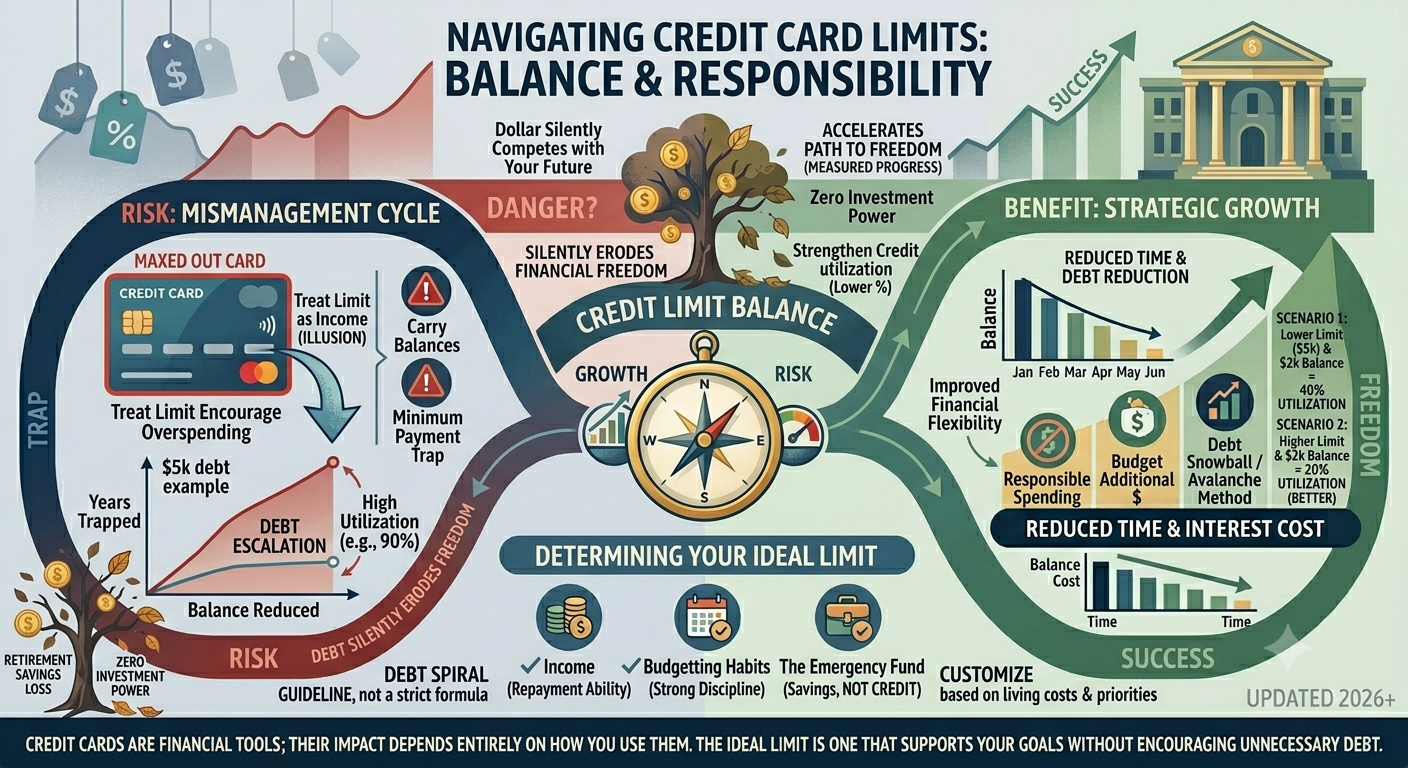
How Much Credit Card Limit Should You Have? Finding the Right Balance for Financial Health and Credit Scores
Many people assume that a higher credit card limit automatically leads to financial problems.
Others believe the opposite—that the larger the limit, the better.
The truth lies somewhere in between.
A credit card limit is neither inherently good nor bad. Its impact depends entirely on how you use it.
When managed responsibly, a higher credit limit can actually improve your financial flexibility and support a stronger credit profile. When mismanaged, it can encourage overspending and lead to long-term debt problems.
In this guide, we’ll explore how credit card limits work, how they affect your credit score, and how to determine the right limit for your financial situation.
Before discussing credit limits, it’s important to understand the broader principles of Money Management and Budgeting, because even the best credit tools can become dangerous without a solid financial foundation.
What Is a Credit Card Limit?
A credit card limit is the maximum amount of money your card issuer allows you to borrow at any given time.
For example, if your card has a $10,000 limit, your total outstanding balance cannot exceed that amount.
Your available credit changes as you make purchases and repayments.
While the limit represents borrowing capacity, it should never be viewed as spending capacity.
One of the biggest financial mistakes consumers make is treating their credit limit as money they actually own.
Why Credit Card Limits Matter
Your credit limit affects more than just purchasing power.
It also influences:
- Credit utilization ratio
- Credit score health
- Financial flexibility during emergencies
- Debt management effectiveness
- Lender risk assessments
Because of these factors, choosing the right credit limit is an important part of overall financial planning.
Understanding Credit Utilization
One of the most important concepts in credit management is credit utilization.
Credit utilization measures how much of your available credit you are currently using.
For example:
- Credit limit: $10,000
- Current balance: $2,000
Your utilization rate is 20%.
Generally speaking, lower utilization ratios are viewed more favorably by lenders.
Many financial experts recommend keeping utilization below 30%, while lower levels often provide even greater benefits.
Why a Higher Limit Can Sometimes Help Your Credit Score
This surprises many people.
Increasing your credit limit can potentially improve your credit profile—even if you never spend more money.
Here’s why:
If your spending remains constant while your available credit increases, your utilization ratio decreases.
For example:
- $2,000 balance on a $5,000 limit = 40% utilization
- $2,000 balance on a $10,000 limit = 20% utilization
Same spending.
Better utilization.
Potentially stronger credit health.
For a deeper understanding of credit scoring, see our guide on Credit Scores and Financial Reputation.
When a Higher Credit Limit Becomes Dangerous
A larger limit can also create risk.
If access to more credit leads to higher spending, financial problems can develop quickly.
Common warning signs include:
- Carrying balances month after month
- Frequently using more than half of available credit
- Relying on credit cards for everyday expenses
- Making only minimum payments
If these behaviors sound familiar, read our guide on the Minimum Payment Trap.
How Much Credit Limit Is Appropriate?
There is no universal number that works for everyone.
The right credit limit depends on several factors:
Your Income
Your available credit should be proportionate to your ability to repay borrowed money.
Your Spending Habits
Individuals with strong budgeting habits can generally manage higher limits more safely.
If you’re unsure how your spending patterns affect your finances, review our article on Spending Habits and Financial Behavior.
Your Financial Discipline
The most important factor is behavior.
A disciplined user can safely manage a large limit.
An undisciplined user may struggle even with a relatively small one.
The Emergency Fund Alternative
Many consumers rely on available credit as a backup plan for emergencies.
While credit can provide short-term flexibility, it is not a substitute for savings.
An emergency fund provides financial security without interest costs or repayment obligations.
Our guide on Saving Money and Building Financial Security explains how to create that safety net.
Should You Request a Credit Limit Increase?
A credit limit increase may make sense if:
- Your income has increased.
- You consistently pay balances on time.
- You maintain responsible spending habits.
- You want to reduce your utilization ratio.
However, if you already struggle with overspending, a higher limit may create additional financial risk.
How Credit Limits Fit Into Financial Freedom
Credit cards are financial tools.
Used wisely, they can improve convenience, support credit building, and provide short-term flexibility.
Used carelessly, they can delay wealth creation and increase financial stress.
The ultimate goal is not maximizing available credit.
The goal is maximizing financial control.
This mindset is central to achieving Financial Freedom.
Common Mistakes to Avoid
Treating Your Limit as Income
Available credit is borrowed money—not earned money.
Maxing Out Credit Cards
High utilization can hurt both financial flexibility and credit health.
Making Only Minimum Payments
This habit can significantly increase long-term borrowing costs.
Ignoring Spending Behavior
The problem is rarely the credit limit itself.
The problem is how the limit is used.
Final Thoughts
The ideal credit card limit is not the highest amount a lender is willing to offer.
It is the amount that supports your financial goals without encouraging unnecessary debt.
A healthy credit limit should provide flexibility, support strong credit utilization, and fit comfortably within your overall financial plan.
Remember:
Financial success is not determined by how much credit you have available.
It is determined by how responsibly you manage it.