
How to Build a 10-Year Financial Freedom Plan: A Roadmap to Reclaiming Your Time
What if you could change your relationship with money over the next 10 years?
Not by becoming a millionaire overnight.
Not by finding the next hot stock.
Not by taking enormous financial risks.
But by building a system that gradually reduces your dependence on a paycheck.
That’s the real idea behind financial freedom.
Financial freedom doesn’t necessarily mean owning a mansion, driving a luxury car, or having millions of dollars sitting in a brokerage account.
For many people, financial freedom simply means having enough financial resources to make choices without being forced to work solely to pay the bills.
You may want to leave a stressful job.
You may want to spend more time with your family.
You may want to start a business.
You may want to work part-time instead of full-time.
Or you may simply want to wake up without worrying about your next paycheck.
Those goals are fundamentally about one thing:
Time.
Money is valuable partly because it can give you more control over your time.
A 10-year financial freedom plan is therefore not simply an investment strategy. It is a long-term system for increasing savings, eliminating expensive debt, building investments, controlling lifestyle inflation, and eventually creating enough assets or income streams to cover a meaningful portion of your living expenses.
The journey won’t look the same for everyone. Your income, expenses, starting net worth, family situation, taxes, investment returns, and risk tolerance all matter.
But the framework is surprisingly simple.
Build the foundation first.
Increase your savings rate.
Invest consistently.
Give compound growth time to work.
Then gradually shift from accumulation toward financial independence.
Let’s break that process down into a practical 10-year roadmap.
What Does Financial Freedom Actually Mean?
Before creating a 10-year plan, you need to define what you’re trying to achieve.
Financial freedom doesn’t have one universal definition.
For one person, it might mean having enough investments to retire at 55.
For another, it might mean having enough passive income to cover basic living expenses.
For someone else, it could mean having a large enough investment portfolio to work only when they want to.
That’s why your first question shouldn’t be:
“How much money do I need?”
Instead, ask:
“What do I want my money to allow me to do?”
That answer determines the rest of your strategy.
The Financial Freedom Equation
A useful way to think about financial independence is to compare your reliable investment or passive income with your essential living expenses.
Financial Independence Becomes Possible When Sustainable Portfolio Income Can Cover Your Lifestyle Expenses.
This doesn’t mean you should assume that investment income will always remain constant.
Markets fluctuate.
Inflation changes purchasing power.
Taxes matter.
Unexpected expenses happen.
That’s why a financial freedom plan should include a margin of safety rather than targeting the absolute minimum amount necessary to survive.
Year 1: Take a Financial X-Ray
The first year is about preparation.
Don’t worry about building a huge investment portfolio immediately.
Your first job is to understand your financial situation.
Start by calculating your net worth.
List Your Assets
- Checking accounts.
- Savings accounts.
- 401(k) accounts.
- IRAs.
- Taxable brokerage accounts.
- Real estate.
- Other investments.
List Your Liabilities
- Credit card balances.
- Student loans.
- Auto loans.
- Personal loans.
- Mortgage debt.
- Other obligations.
Then analyze your monthly cash flow.
Where does your income go?
Which expenses are essential?
Which expenses are discretionary?
Which subscriptions are rarely used?
How much are you currently saving?
How much are you investing?
This process may feel uncomfortable.
That’s exactly why it’s useful.
You can’t improve what you refuse to measure.
If your money-management system needs work, start with our guide to Money Management and Budgeting.
Your First-Year Financial Freedom Targets
A strong first year might focus on four major objectives:
- Increase your savings rate.
- Eliminate high-interest consumer debt.
- Build an emergency fund.
- Establish automatic investing and saving systems.
For some households, saving 20% of income may be realistic.
For others, it may take several years to reach that level.
Don’t let someone else’s savings rate become a source of unnecessary pressure.
The important thing is to create a sustainable upward trend.
At the same time, high-interest credit card debt can seriously undermine your progress.
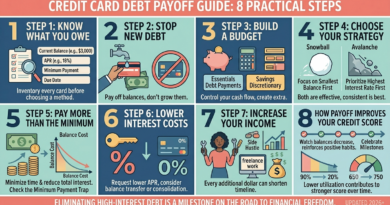
If you carry significant credit card debt, consider making debt reduction one of your highest priorities. Our guide to Paying Off Credit Card Debt can help you build a structured approach.
Build an Emergency Fund Before Chasing Financial Freedom
Financial independence is difficult to build when every unexpected expense creates new debt.
Your car needs a repair.
Your roof starts leaking.
Your employer restructures.
A medical expense appears.
Without cash reserves, these events can force you to sell investments at the worst possible time or rely on expensive credit.
That’s why an emergency fund should be part of your financial freedom foundation.
A commonly used target is three to six months of essential expenses, although the appropriate amount depends on your income stability, household situation, and risk tolerance.
Read our guide to Building an Emergency Fund for a more detailed strategy.
Years 2–3: Build the Savings Engine
Once the financial foundation is stronger, years two and three are about building momentum.
This is where your savings rate becomes increasingly important.
Think about every raise differently.
Instead of asking:
“What can I buy now?”
Ask:
“How much of this additional income can I use to buy future freedom?”
This doesn’t mean you should never improve your lifestyle.
It means your lifestyle shouldn’t automatically consume every increase in income.
If your salary rises by $10,000 and you direct $6,000 of that increase toward savings and investments, your lifestyle can improve while your financial independence accelerates.
This is one of the most powerful ways to fight lifestyle inflation.
Pay Yourself First
One of the simplest principles in personal finance is also one of the most effective:
Save and invest before you spend.
If you wait until the end of the month to see what’s left, you may discover that nothing is left.
Instead, automate your financial priorities when your paycheck arrives.
For example:
- 401(k) contribution happens automatically.
- Emergency savings transfer happens automatically.
- Brokerage investment contribution happens automatically.
- Debt payment happens automatically.
Then you live on what’s left.
This approach reduces the number of financial decisions you have to make.
For more ideas, see our guide on Building a Saving Habit Through Systems.
Use a Budget That Supports Financial Independence
A budget shouldn’t simply tell you what you’re not allowed to buy.
It should tell your money where to go.
The 50/30/20 framework can be a useful starting point:
- 50% for needs.
- 30% for wants.
- 20% for savings and financial goals.
However, someone aggressively pursuing financial independence may eventually choose to save significantly more than 20%.
The framework is a starting point, not a law.
Our guide to the 50/30/20 Budget Rule explains how to use the framework and where it can fall short.
Years 4–6: Let Compound Growth Start Working
By years four through six, something interesting can begin to happen.
Your investments are no longer growing only because of your contributions.
Your previous contributions can begin generating returns that themselves generate additional returns.
That’s the power of compounding.
Imagine investing $1,000 per month.
At a hypothetical 7% annual return, the contributions don’t simply accumulate linearly.
The money invested earlier has more time to grow.
Over long periods, that difference becomes significant.
But there’s an important warning.
A hypothetical return is not a promise.
Actual market returns vary considerably from year to year.
You may experience strong years, weak years, and periods of significant losses.
The advantage of a 10-year plan is that it gives you time to focus on the process instead of obsessing over every short-term market movement.
Don’t Interrupt the Compounding Process
One of the biggest mistakes investors make is spending their investment gains too early.
Your portfolio rises.
You see a large gain.
You decide to withdraw some of it for a lifestyle purchase.
That withdrawal doesn’t only remove today’s money.
It also removes the future growth that money might have generated.
This is why reinvesting and staying consistent can be so powerful during the accumulation phase.
Of course, your investment strategy should always reflect your financial goals, time horizon, liquidity needs, and risk tolerance.
A Simple 10-Year Financial Freedom Roadmap
| Period | Primary Objective | Key Actions |
|---|---|---|
| Year 1 | Financial Foundation | Budget, emergency fund, debt reduction, automate savings |
| Years 2–3 | Increase Savings | Raise savings rate, control lifestyle inflation, invest consistently |
| Years 4–6 | Accelerate Wealth Building | Maintain contributions, reinvest returns, stay disciplined |
| Years 7–8 | Optimize | Review asset allocation, expenses, risk, and income sources |
| Years 9–10 | Transition | Increase financial resilience and evaluate sustainable income needs |
Years 7–8: Optimize the System
At this stage, your financial situation may look very different from where you started.
Your debt may be substantially lower.
Your emergency fund may be fully established.
Your retirement accounts may have grown.
Your taxable investment portfolio may be larger.
Your financial habits may feel automatic.
Now the focus begins shifting from simply accumulating assets to optimizing the entire system.
Review Your Asset Allocation
Your portfolio should reflect your time horizon and ability to tolerate volatility.
As your financial goals become closer, you may decide that protecting a portion of your accumulated wealth is more important than maximizing potential returns.
This doesn’t necessarily mean abandoning stocks.
It means understanding the relationship between risk and the timing of your financial goals.
Review Your Expenses
A lower annual spending requirement can dramatically reduce the amount of wealth you need to achieve financial independence.
This is one of the most overlooked parts of the equation.
Increasing your income helps.
But controlling recurring expenses can also permanently lower the amount of money you need to support your lifestyle.
Years 9–10: Move Toward Financial Independence
The final stage is not simply about accumulating the largest possible portfolio.
It’s about determining whether your assets and income sources can realistically support the life you want.
Start asking different questions.
How much does my household actually need each year?
Which expenses are essential?
Which expenses are optional?
How much income can my investments reasonably support?
How much flexibility do I have if markets decline?
Do I need to stop working completely, or would part-time income be enough?
These questions transform financial independence from an abstract dream into a practical financial decision.
Passive Income Is Useful, But Don’t Overestimate It
The phrase “passive income” sounds attractive.
And it can be an important part of financial independence.
Dividend income, bond interest, rental income, and portfolio withdrawals can all potentially contribute to your cash flow.
But none should be treated as guaranteed or effortless.
Rental properties require management.
Dividends can be reduced.
Interest rates change.
Markets decline.
Taxes reduce after-tax income.
Therefore, a strong financial freedom plan should be built around diversified sources of financial resilience rather than a single “passive income” strategy.
A Mini Story: Sarah’s 10-Year Journey
Imagine Sarah, a 30-year-old professional living in the United States.
She earns $85,000 per year.
At the beginning of the journey, she has limited savings and several thousand dollars of consumer debt.
Her first year isn’t glamorous.
She tracks her spending.
Builds an emergency fund.
Eliminates high-interest debt.
And begins investing automatically through her retirement account.
During years two and three, Sarah receives raises.
Instead of allowing lifestyle inflation to consume all of the additional income, she directs a significant portion toward investments.
By years four through six, her portfolio begins to look meaningful.
There are still market declines.
Some years are frustrating.
But she continues investing.
By years seven and eight, Sarah begins thinking differently about money.
She realizes that her investment portfolio is no longer simply a number on a screen.
It represents options.
She could change careers.
She could take a sabbatical.
She could work fewer hours.
By years nine and ten, her investment assets and other financial resources cover a significant portion of her lifestyle expenses.
Sarah may not have completely eliminated the need for earned income.
But something important has changed.
She has more control over her time.
And that’s the real objective.
Can You Really Become Financially Free in 10 Years?
For some people, yes.
For others, it may take considerably longer.
There is no universal 10-year formula.
Your starting point matters enormously.
Someone earning $200,000 with low expenses and a high savings rate has a very different path from someone earning $50,000 while supporting a family.
Investment returns also cannot be guaranteed.
Anyone promising that a specific annual return will make you financially independent within exactly 10 years should be treated cautiously.
What you can control is your savings rate, spending, debt, investment discipline, career development, and financial planning.
Those variables deserve your attention.
What If You Have Irregular Income?
A 10-year plan can still work if your income changes from month to month.
Freelancers, contractors, entrepreneurs, commission-based professionals, and business owners simply need a different cash-flow strategy.
Instead of building the entire plan around a fixed monthly paycheck, establish a minimum baseline for essential expenses and create savings and investment targets around your average or conservative income.
During strong income months, direct more money toward savings, investments, and debt reduction.
During weaker months, rely on the reserves you’ve already built.
Our guide to Managing Money With Irregular Income provides a useful framework for this situation.
The Biggest Enemy Isn’t the Stock Market
Market volatility can be uncomfortable.
But over a 10-year journey, impatience can be even more damaging.
You may start investing.
The market falls.
You panic.
You sell.
Then the market recovers.
You buy again at higher prices.
This cycle can destroy the benefits of long-term investing.
Investment psychology therefore becomes a critical part of financial independence.
Before making major portfolio decisions during stressful market conditions, revisit your original plan.
Ask whether your financial circumstances actually changed or whether your emotions simply changed.
Our guide to Investment Psychology explores why investors often become their own biggest obstacle.
Common Mistakes That Can Destroy a 10-Year Plan
1. Lifestyle Inflation
Your income rises and your spending rises just as quickly.
2. High-Interest Debt
Credit card interest can consume cash that could otherwise build wealth.
3. Chasing Quick Returns
Trying to accelerate a 10-year plan through excessive risk can have the opposite effect.
4. Constantly Changing Strategies
Jumping from one investment strategy to another can make consistency almost impossible.
5. Ignoring Taxes
Your investment returns should be considered in the context of taxes, account types, and after-tax outcomes.
6. Forgetting Inflation
$50,000 of annual spending today will not necessarily have the same purchasing power 10 years from now.
7. Focusing Only on Income
Earning more is valuable, but keeping and investing more is what ultimately builds financial flexibility.
How to Measure Progress Every Year
You don’t need to obsess over your portfolio every day.
Instead, conduct a detailed annual review.
Track:
- Net worth.
- Savings rate.
- Total debt.
- Emergency fund.
- Investment contributions.
- Portfolio allocation.
- Annual living expenses.
- Investment income.
- Progress toward financial independence.
One particularly useful metric is your savings rate.
If your income increases but your savings rate remains unchanged, lifestyle inflation may be absorbing your progress.
If your savings rate gradually increases over several years, you’re building financial momentum.
30-Second Summary
- Financial freedom is primarily about gaining control over your time.
- Start with a complete financial snapshot.
- Eliminate high-interest debt.
- Build an emergency fund.
- Increase your savings rate gradually.
- Automate savings and investments.
- Control lifestyle inflation.
- Invest consistently for the long term.
- Let compound growth work over time.
- Review your portfolio and spending regularly.
- Build flexibility instead of relying on one income source.
- Define financial independence according to the life you actually want.
Frequently Asked Questions About a 10-Year Financial Freedom Plan
Is financial freedom really possible in 10 years?
It can be possible for some people, but there is no universal timeline. Your income, starting assets, expenses, savings rate, investment returns, taxes, and lifestyle all influence how quickly you can become financially independent.
How much should I save to become financially independent?
There is no single number that works for everyone. Your target depends largely on your annual spending, desired lifestyle, other income sources, and investment portfolio.
Should I invest while paying off debt?
It depends on the type and interest rate of the debt. High-interest consumer debt often deserves significant priority, while maintaining retirement contributions that capture an available employer match may also be important.
How much should I have in an emergency fund?
A common guideline is three to six months of essential expenses, although households with variable income or higher financial uncertainty may prefer a larger reserve.
What savings rate is needed for financial freedom?
There is no universal percentage. A higher savings rate generally accelerates wealth accumulation, but the appropriate level depends on income, expenses, debt, family responsibilities, and goals.
Can I achieve financial freedom with an average income?
Yes. A high income can accelerate the process, but disciplined spending, consistent investing, and a long time horizon can also create substantial financial flexibility.
Should I invest aggressively to reach financial freedom faster?
Taking excessive risk can actually delay financial independence if major losses occur. Your portfolio should reflect your time horizon, goals, and ability to tolerate volatility.
What role does compound growth play?
Compounding allows investment returns to generate additional returns over time. The longer your money remains invested, the more important this effect can become.
Can passive income replace my salary?
It can potentially replace some or all of your earned income, but the sustainability of that income depends on the underlying assets, withdrawal rate, market conditions, taxes, and expenses.
What if I can’t save 40% or 50% of my income?
Don’t abandon the plan. Start with a savings rate that is realistic for your circumstances and work to increase it gradually as your income rises or expenses fall.
Should I focus on investing or increasing my income?
Ideally, both. Increasing income expands your financial capacity, while controlling expenses and investing the difference converts that income into long-term wealth.
How often should I review my financial freedom plan?
A detailed annual review is essential. A monthly or quarterly check-in can help you monitor cash flow, savings, debt, and investment contributions.
Final Thoughts: Your Goal Isn’t to Become Rich. It’s to Buy Back Your Time.
Ten years can feel like a long time.
But consider how quickly the last ten years of your life passed.
The next decade will pass too.
The question is what you will have built by then.
You could spend the next 10 years earning, spending, borrowing, and starting over every month.
Or you could spend the next decade gradually building a financial system that gives you more choices.
You don’t need to predict the next great stock.
You don’t need to become an investing genius.
You don’t need to eliminate every enjoyable expense.
You need a sustainable system.
Build your emergency fund.
Eliminate expensive debt.
Increase your savings rate.
Invest consistently.
Control lifestyle inflation.
Protect your portfolio from unnecessary risk.
And give compound growth enough time to work.
Most importantly, remember what you’re actually building.
You’re not simply building a portfolio.
You’re building options.
The option to change careers.
The option to work fewer hours.
The option to spend more time with your family.
The option to walk away from a bad financial situation.
The option to decide how you spend the most valuable asset you have:
Your time.
Financial freedom is therefore not simply a number in a brokerage account.
It’s the growing ability to make life decisions without money making every decision for you.
And the best time to start building that freedom is not ten years from now.
It’s today.