
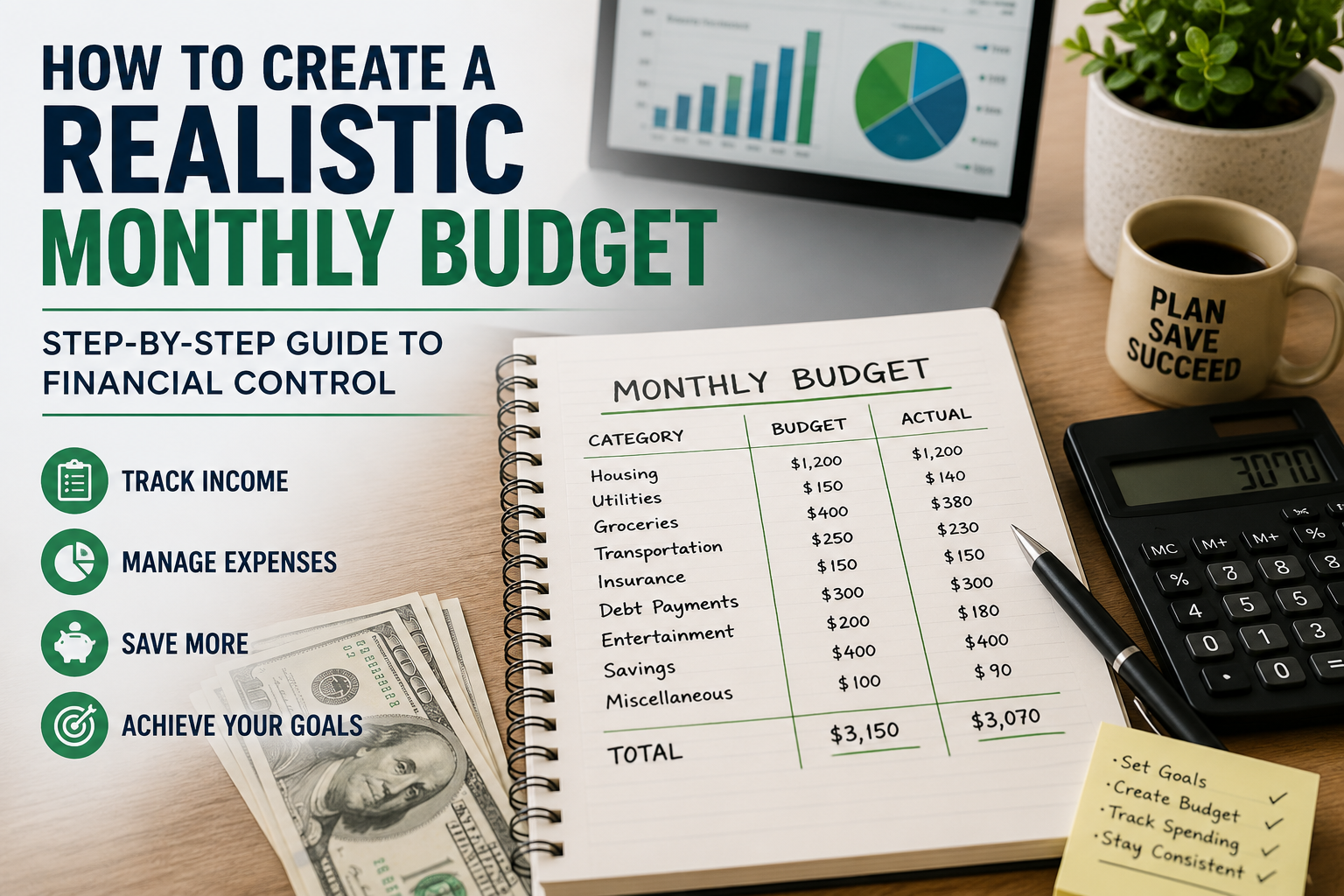
How to Create a Realistic Monthly Budget: A Step-by-Step Guide
Most people know they should budget.
But very few actually stick to a system that works in real life.
The problem is not lack of information.
The problem is lack of simplicity and consistency.
A monthly budget is not just a spreadsheet or a financial exercise.
It is a system that tells your money where to go before it disappears.
In this guide, you will learn how to build a realistic monthly budget step by step—one that you can actually maintain long-term.
Before starting, it is important to understand the foundation of all personal finance systems: Money Management and Budgeting.
Why Monthly Budgeting Matters
A monthly budget gives you control over your financial life.
Without it, money tends to disappear without clarity.
With it, every dollar has a purpose.
It helps you:
- Track income and expenses clearly
- Avoid unnecessary debt
- Increase savings capacity
- Reduce financial stress
- Build long-term financial stability
In short, budgeting transforms uncertainty into structure.
Step 1: Calculate Your True Monthly Income
The first and most important step is understanding your real income.
This means your net income—what actually lands in your bank account after taxes and deductions.
Include:
- Salary or wages
- Freelance or side income
- Investment income
- Any recurring additional income
If your income is irregular, use a conservative average based on your lowest earning months.
For a detailed approach, read our guide on How to Budget with an Irregular Income.
The goal is accuracy, not optimism.
Step 2: Track Your Spending Patterns
You cannot control what you do not measure.
Start by reviewing your past two or three months of spending.
Look at bank statements and categorize your expenses into groups such as:
- Housing
- Food and groceries
- Transportation
- Utilities
- Entertainment
- Subscriptions
- Debt payments
This step often reveals hidden spending patterns that are not obvious day to day.
Many people are surprised when they see where their money actually goes.
If you discover spending habits that repeatedly sabotage your budget, our guide on Spending Habits explains how to build healthier financial behaviors.
Step 3: Define Fixed and Variable Expenses
Not all expenses behave the same way.
Fixed Expenses
These are predictable monthly costs:
- Rent or mortgage
- Loan payments
- Insurance premiums
- Subscription services
Variable Expenses
These change from month to month:
- Groceries
- Dining out
- Fuel and transportation
- Shopping
Separating these categories makes your budget more flexible and realistic.
Step 4: Assign Every Dollar a Job
Now comes the core of budgeting.
Allocate your income across your categories intentionally.
A simple structure might look like:
- Essentials (housing, food, bills)
- Debt payments
- Savings and investments
- Lifestyle spending
If you need a starting framework, you can also explore the 50/30/20 Budget Rule as a reference model.
Step 5: Build a Debt-Aware Budget
If you have debt, your budget must account for repayment from the beginning.
Debt is not just a financial obligation—it is a cash flow constraint.
You can use structured repayment methods such as:
If you’re carrying expensive credit card balances, you may also benefit from our guide on How to Pay Off Credit Card Debt.
These strategies help ensure your budget leads toward financial freedom instead of ongoing financial pressure.
Step 6: Prioritize Savings Early
One of the most common budgeting mistakes is saving only what is left over.
In reality, savings should be planned first—not last.
Even small consistent contributions build long-term stability.
Emergency savings prevent unexpected expenses from turning into new debt.
For a deeper strategy, see our guide on Saving Money and Financial Security.
Step 7: Adjust and Optimize Monthly
A budget is not static.
It evolves with your life.
Each month, review:
- What you actually spent
- Where you exceeded limits
- Where you can optimize
The goal is not perfection.
The goal is improvement over time.
Common Budgeting Mistakes
Being Too Restrictive
Overly strict budgets often fail because they are unsustainable.
Ignoring Small Expenses
Small daily spending adds up significantly over time.
Not Tracking Regularly
A budget only works if it is reviewed consistently.
Setting Unrealistic Expectations
Your budget must reflect your real life—not ideal conditions.
How Budgeting Connects to Financial Freedom
Budgeting is not about restriction.
It is about control.
When you manage your money intentionally, you create space for saving, investing, and long-term planning.
This is the foundation of Financial Freedom.
Final Thoughts
A successful monthly budget is not complicated.
It is consistent, realistic, and adaptable.
Once you understand your income, track your spending, and assign purpose to your money, everything else becomes easier.
Financial success is not built in one big decision.
It is built in small monthly habits repeated over time.


Pingback: Smart Ways to Save and Build Wealth During High Inflation - Daily Stock Markets
Pingback: How Can You Start Investing Without a Side Income? A Practical Guide for Beginners - Daily Stock Markets