
How to Choose the Best Personal Loan: A Step-by-Step Guide to Comparing Loan Offers
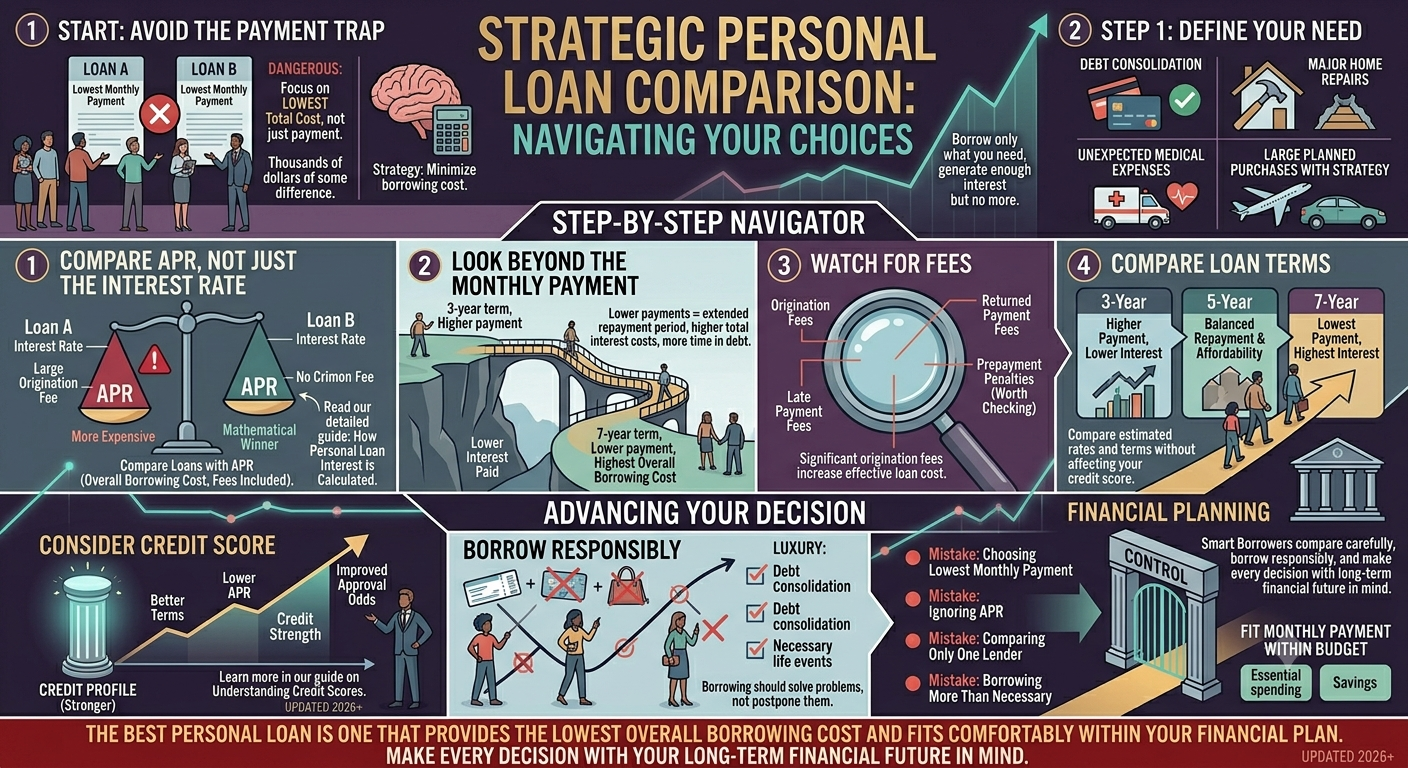
Choosing a personal loan isn’t simply about finding the lowest monthly payment.
In fact, that’s one of the biggest mistakes borrowers make.
The best loan is the one that fits your financial situation while minimizing the total cost of borrowing.
Two loans may have nearly identical monthly payments but cost thousands of dollars apart over their lifetime.
That’s why comparing loans correctly is one of the most valuable financial skills you can develop.
In this guide, you’ll learn exactly what to compare before accepting a loan offer and how to avoid common borrowing mistakes.
Before borrowing money, make sure you understand the fundamentals of Money Management and Budgeting, because the right loan should support your financial goals—not create new financial stress.
Why Comparing Loans Matters
Personal loans often look similar on the surface.
Many lenders advertise low monthly payments or attractive introductory rates.
However, the true cost of borrowing depends on much more than the advertised payment.
A proper comparison should include:
- APR (Annual Percentage Rate)
- Loan term
- Monthly payment
- Total repayment cost
- Fees
- Repayment flexibility
Financial experts consistently recommend comparing APR rather than the advertised interest rate because APR reflects the overall cost of borrowing, including many required fees.
For a broader perspective on evaluating loans before applying, see our guide to Personal Loan Financial Health Checklist.
Step 1: Compare APR, Not Just the Interest Rate
Many borrowers focus on the interest rate.
Professional borrowers focus on the APR.
The Annual Percentage Rate (APR) provides a more complete picture because it includes the interest rate and many mandatory lender fees.
A loan with a slightly lower interest rate may actually be more expensive if it carries significant fees.
Always compare loans using APR whenever possible.
If you’d like to understand this concept in more detail, read our guide on How Personal Loan Interest Is Calculated.
Step 2: Look Beyond the Monthly Payment
A lower monthly payment may seem attractive.
But lower payments are often achieved by extending the repayment period.
Longer loan terms usually mean:
- Lower monthly payments
- Higher total interest costs
- More time in debt
Instead of asking, “Can I afford this payment?” also ask, “How much will this loan cost me in total?”
Step 3: Watch for Fees
Interest isn’t the only cost of borrowing.
Some lenders charge additional fees such as:
- Origination fees
- Late payment fees
- Returned payment fees
- Prepayment penalties (less common today but still worth checking)
Even a modest origination fee can significantly increase the effective cost of your loan.
Step 4: Compare Loan Terms
The repayment period has a major impact on affordability.
For example:
- 3-year loan → Higher monthly payment, lower total interest
- 5-year loan → Lower monthly payment, higher total interest
- 7-year loan → Lowest monthly payment, highest overall borrowing cost
The ideal loan balances manageable monthly payments with minimizing total interest paid.
Step 5: Consider Your Credit Score Before Applying
Your credit score plays a major role in determining:
- Your approval odds
- Your APR
- Your available loan amount
- Your repayment terms
Improving your credit profile before applying may qualify you for significantly better borrowing terms.
Learn more in our guide on Understanding Credit Scores. You may also find How to Improve Your Credit Score Fast helpful before submitting a loan application.
Step 6: Use Prequalification When Available
Many lenders allow borrowers to prequalify using a soft credit inquiry.
This allows you to compare estimated rates and terms without affecting your credit score.
Comparing several offers before formally applying often leads to better borrowing decisions.
Step 7: Borrow Only What You Need
Qualifying for a larger loan doesn’t mean you should accept it.
Every additional dollar borrowed generates additional interest.
Borrow enough to accomplish your financial goal—but no more.
When a Personal Loan Makes Sense
A personal loan can be a smart financial tool when used for:
- Debt consolidation
- Major home repairs
- Unexpected medical expenses
- Necessary life events
- Large planned purchases with a repayment strategy
Replacing high-interest credit card debt with a lower-rate personal loan can reduce interest costs—but only if new credit card balances are not accumulated afterward.
If you’re considering this strategy, read Should You Use a Personal Loan to Pay Off Debt?.
When You Should Think Twice
A personal loan may not be the best choice if you’re borrowing for:
- Luxury purchases
- Vacations you cannot comfortably afford
- Everyday living expenses
- Impulse purchases
Borrowing should solve financial problems—not postpone them.
How Budgeting Helps You Choose the Right Loan
Before accepting any loan, calculate how the monthly payment fits into your existing budget.
If the payment creates financial pressure every month, the loan may not be appropriate.
Our guide on Creating a Realistic Monthly Budget can help you evaluate affordability before signing a loan agreement.
Common Loan Comparison Mistakes
Choosing the Lowest Monthly Payment
Lower payments often result in higher lifetime borrowing costs.
Ignoring APR
APR provides a more complete measure of borrowing costs than the advertised interest rate.
Comparing Only One Lender
Shopping around may uncover significantly better rates and terms.
Borrowing More Than Necessary
Higher loan amounts increase interest costs and repayment obligations.
Before committing to any loan, it’s also worth reviewing Personal Loan Financial Health Checklist to make sure borrowing fits your overall financial plan.
Final Thoughts
The best personal loan isn’t necessarily the one with the biggest approval amount or the lowest monthly payment.
It’s the loan that provides the lowest overall borrowing cost while fitting comfortably within your financial plan.
Compare APR, evaluate fees, review repayment terms, and understand the total amount you’ll repay—not just what you’ll pay each month.
Smart borrowers don’t simply accept the first offer they receive.
They compare carefully, borrow responsibly, and make every financing decision with their long-term financial future in mind.