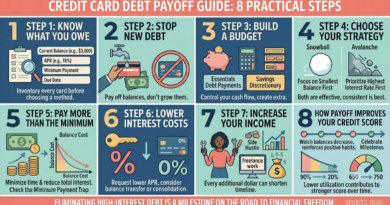

Which Debt Should You Pay Off First? A Practical Debt Payoff Strategy
Should you pay off your credit card first?
What about a personal loan?
Should you eliminate your car loan before investing?
What if you have student loans and a mortgage at the same time?
And perhaps the most difficult question:
Should you use your extra money to pay down debt or invest it?
When you have multiple debts, simply making the minimum payment on everything may not be the most efficient way to improve your financial position.
The order in which you attack your debts can affect how much interest you pay, how quickly you become debt-free, how much cash flow you eventually free up, and how confident you feel about your financial progress.
There is no universal debt-payoff order that works perfectly for every household.
But there are established strategies that can help you decide where your extra money should go.
- Start by listing every debt, its balance, interest rate, minimum payment, and due date.
- High-interest credit-card debt is generally one of the most urgent debts to eliminate.
- The Debt Avalanche Method directs extra money toward the debt with the highest interest rate first.
- The Debt Snowball Method targets the smallest balance first, regardless of interest rate.
- Avalanche can reduce total interest costs, while Snowball can provide faster psychological wins.
- You should continue making at least the required minimum payment on every debt while attacking your priority debt.
- An emergency fund matters because paying debt aggressively while keeping no cash reserve can leave you vulnerable to new borrowing.
- Mortgage, student loan, and auto-loan decisions require consideration of interest rates, taxes, terms, and financial goals.
- Employer retirement matches can change the debt-versus-investing decision because a match may provide an immediate benefit.
- The best debt strategy is one that is mathematically sensible and realistic enough for you to follow consistently.
Why Does the Order of Debt Repayment Matter?
Imagine you owe money on four different accounts:
| Debt | Balance | Interest Rate | Minimum Payment |
|---|---|---|---|
| Credit Card A | $8,000 | 24% | $240 |
| Credit Card B | $3,000 | 19% | $90 |
| Auto Loan | $15,000 | 7% | $320 |
| Student Loan | $25,000 | 5% | $275 |
You have $500 per month available beyond the minimum payments.
Where should that $500 go?
You could distribute it equally among all four debts.
Or you could concentrate it on one debt while continuing to make the minimum payment on the others.
The second approach can be more efficient because it accelerates the elimination of one balance and allows the payment amount associated with that debt to be redirected toward the next debt.
The key question is:
Which debt should receive the extra payment first?
Step One: Make a Complete Debt Inventory
Before choosing a repayment strategy, you need to know exactly what you owe.
Create a list containing:
- Creditor
- Current balance
- Interest rate or APR
- Minimum payment
- Remaining term
- Due date
- Whether the rate is fixed or variable
- Whether the debt has tax-related considerations
- Any prepayment penalties or fees
Do not rely on memory.
Log into each account and use the actual numbers.
This exercise can be uncomfortable, but financial problems become much easier to manage once they are visible.
Your budget and money-management system should include debt balances alongside your income and expenses.
The Most Important Number: The Interest Rate
When deciding which debt is financially expensive, the interest rate is one of the most important variables.
Consider two debts:
Debt A: $10,000 at 24%
Debt B: $20,000 at 5%
Debt B has twice the balance.
But Debt A has a dramatically higher interest rate.
That means the smaller debt may be costing you more relative to its size.
This is the basic logic behind the Debt Avalanche Method.
What Is the Debt Avalanche Method?
The Debt Avalanche Method prioritizes debts according to their interest rates.
The process is:
- Make the minimum payment on every debt.
- Identify the debt with the highest interest rate.
- Direct all available extra money toward that debt.
- Continue until the balance is paid off.
- Move the freed-up payment to the debt with the next-highest interest rate.
- Continue until all debts are eliminated.
For example:
| Debt | Interest Rate | Avalanche Priority |
|---|---|---|
| Credit Card A | 27% | 1 |
| Credit Card B | 21% | 2 |
| Personal Loan | 12% | 3 |
| Auto Loan | 7% | 4 |
| Student Loan | 5% | 5 |
You still pay the required minimum on every debt.
But every additional dollar goes toward the debt with the highest rate.
The Consumer Financial Protection Bureau describes this as the highest-interest-rate method and notes that it can reduce the costliest debt first and potentially save money over time.
Why Does the Debt Avalanche Method Save Money?
Interest is the cost of borrowing.
If one debt costs 25% per year while another costs 6%, reducing the 25% balance generally produces a larger interest-cost reduction per dollar of principal repaid.
That is the mathematical appeal of the avalanche method.
Investor.gov explicitly notes that eliminating high-interest debt can be more attractive than taking investment risk because investments do not provide guaranteed returns comparable to the interest cost of high-interest debt.
What Is the Debt Snowball Method?
The Debt Snowball Method uses a different principle.
Instead of prioritizing the highest interest rate, you prioritize the smallest balance.
The process is:
- Make the minimum payment on every debt.
- Identify the debt with the smallest balance.
- Put all extra money toward that debt.
- Pay it off as quickly as possible.
- Take the payment you were making on that debt and add it to the next-smallest debt.
- Continue until all debts are eliminated.
For example:
| Debt | Balance | Snowball Priority |
|---|---|---|
| Medical Bill | $800 | 1 |
| Credit Card B | $2,500 | 2 |
| Credit Card A | $7,500 | 3 |
| Personal Loan | $15,000 | 4 |
| Student Loan | $25,000 | 5 |
The CFPB notes that the snowball approach can create quicker visible progress, which can be motivating, although it may result in higher total interest costs when more expensive debt remains outstanding.
Debt Avalanche vs. Debt Snowball
| Feature | Debt Avalanche | Debt Snowball |
|---|---|---|
| Priority | Highest interest rate | Smallest balance |
| Main objective | Reduce interest cost | Create fast psychological wins |
| Mathematical efficiency | Usually stronger when rates differ significantly | May cost more interest |
| Motivation | Progress may initially feel slower | Small balances disappear quickly |
| Best suited for | People focused on minimizing interest | People who benefit from visible progress |
The important point is not that one method is universally correct.
The important point is to choose a strategy deliberately rather than making random extra payments.
Which Debt Should Usually Be Paid First?
For many households, the starting point is high-interest revolving debt, especially credit-card balances that are not paid in full each month.
Investor.gov states that virtually no investment strategy can reliably provide returns equivalent to the high interest charged by many credit cards, which is why eliminating high-interest debt is generally emphasized before taking significant investment risk.
A typical debt hierarchy might look like:
| Debt Type | Typical Planning Question |
|---|---|
| High-interest credit card | Can I eliminate this aggressively? |
| High-interest personal loan | Can I reduce this expensive interest cost? |
| Variable-rate consumer debt | Could the borrowing cost rise? |
| Auto loan | Is the rate high relative to other uses of cash? |
| Student loan | What are the rate, repayment terms, and tax considerations? |
| Mortgage | How does the rate compare with alternatives and my broader financial goals? |
This is a framework, not a rigid universal ranking. Tax treatment, loan terms, employer retirement matches, liquidity needs, and personal circumstances can change the optimal strategy.
Credit Card Debt: Often the First Problem to Solve
Credit-card debt can be particularly difficult because balances can remain outstanding for long periods while interest compounds.
Consider a hypothetical $10,000 balance at a 24% annual interest rate.
The annual interest cost, using a simple approximation, is:
$10,000 × 24% = $2,400
Actual credit-card interest calculations depend on the issuer’s methodology, payment timing, and changing balances, so this is only an illustration.
The lesson is more important than the exact number:
A high interest rate creates a powerful reason to prioritize repayment.
If you are dealing with revolving credit-card debt, our guide on how to pay off credit-card debt provides a more detailed framework.
What About Personal Loans?
Personal loans can have substantially different interest rates depending on creditworthiness, loan terms, lender, and market conditions.
A personal loan at 8% is fundamentally different from a personal loan at 25%.
Therefore, the label “personal loan” is less important than the actual cost of the debt.
Look at:
- APR
- Remaining balance
- Remaining term
- Monthly payment
- Origination fees
- Prepayment terms
- Whether the rate is fixed or variable
If you are considering a personal loan to consolidate other debts, do not assume consolidation automatically makes the debt cheaper. The CFPB notes that a consolidation loan can sometimes increase total costs through fees or a higher rate, and that consolidating debt does not solve the underlying problem if spending continues to exceed income.
You can also review our guide on using a personal loan for debt consolidation.
What About Car Loans?
Auto loans deserve a more nuanced analysis.
Suppose you have:
$20,000 auto loan at 4%
and:
$8,000 credit-card debt at 24%.
Even though the auto loan has a larger balance, the credit card is likely the more expensive debt to attack aggressively.
However, if the auto loan has a high rate or creates an excessive monthly payment, paying it down can also improve cash flow and financial flexibility.
The correct answer depends on the entire balance sheet.
What About Student Loans?
Student loans require more careful analysis because their structure can vary considerably.
Consider:
- Federal vs. private loans
- Fixed vs. variable rates
- Interest rate
- Remaining balance
- Repayment term
- Potential forgiveness or income-driven repayment features
- Tax considerations
- Employer assistance
A 4% student loan with favorable terms may not deserve the same repayment priority as a 25% credit-card balance.
But a private student loan at a high variable rate may deserve much more attention.
The lesson is simple:
Prioritize the economics of the debt, not merely its category.
What About Your Mortgage?
Mortgage debt is often treated differently from consumer debt because mortgages generally have longer terms and, depending on the borrower’s situation, may have different tax considerations.
Suppose you have:
$300,000 mortgage at 3.25%
and:
$12,000 credit-card balance at 24%.
Making aggressive extra payments on the mortgage while carrying the credit-card balance would generally require a strong reason.
But once high-interest debt is under control, the mortgage-versus-investing decision becomes more nuanced.
You may consider:
- Mortgage interest rate
- Potential tax treatment
- Investment risk
- Liquidity needs
- Retirement goals
- Desire for debt-free ownership
- Expected investment horizon
There is no universal requirement to eliminate every low-rate mortgage before investing.
Should You Pay Off Debt or Invest?
This is one of the most important personal-finance questions.
Suppose you have an extra $1,000.
You could:
A. Pay down a credit card charging 24%.
B. Invest the $1,000 in the stock market.
Option B could generate a positive return.
But that return is uncertain.
The 24% interest expense is contractual.
That asymmetry matters.
Investor.gov emphasizes that eliminating high-interest debt can be preferable to investing because investment returns are not guaranteed, while debt interest is an actual cost you must pay.
But What About a 401(k) Employer Match?
This is one of the most important exceptions to a simplistic “pay off all debt before investing” rule.
Suppose your employer matches part of your 401(k) contribution.
If you are eligible for a match, contributing enough to receive the available match may be worth considering even while you are paying down debt.
Why?
Because the employer contribution can provide an immediate benefit that is separate from the uncertain market return on your investments.
Investor.gov also highlights employer-sponsored retirement plans and employer matching contributions as an important consideration when building long-term financial security.
The precise strategy depends on the match structure, debt interest rates, tax situation, and cash-flow position.
Emergency Fund vs. Debt Repayment
Another difficult question is whether to use every available dollar to eliminate debt.
Suppose you have:
$10,000 credit-card debt
and only:
$500 in savings.
Using the entire $500 to pay debt would technically reduce the balance.
But what happens if your car breaks down the following week?
If you have no cash reserve, you may simply put the repair back on the credit card.
You would then be moving money in a circle.
For many households, building at least a basic emergency buffer while aggressively addressing high-interest debt can make the overall strategy more sustainable.
FINRA suggests that an emergency fund can ideally cover several months of expenses and can reduce the need to rely on investments or credit when unexpected costs occur.
A Practical Three-Stage Debt Strategy
Stage 1: Stabilize
- Pay all bills on time.
- Stop adding unnecessary high-interest debt.
- Create a basic emergency cash buffer.
- Understand every debt balance and interest rate.
Stage 2: Attack High-Cost Debt
- Choose Avalanche or Snowball.
- Make minimum payments on every account.
- Direct extra cash toward your target debt.
- Redirect freed-up payments when each balance disappears.
Stage 3: Accelerate Wealth Building
- Increase retirement contributions.
- Build diversified investments.
- Increase emergency reserves if necessary.
- Pay down lower-cost debt according to your broader plan.
This sequence can help prevent a common mistake: aggressively paying debt while never building the financial system that prevents the debt from returning.
A $50,000 Debt Example
Consider a hypothetical household with the following balances:
| Debt | Balance | APR |
|---|---|---|
| Credit Card A | $7,000 | 25% |
| Credit Card B | $4,000 | 21% |
| Personal Loan | $9,000 | 12% |
| Auto Loan | $15,000 | 7% |
| Student Loan | $15,000 | 5% |
Total debt:
$50,000
Under an Avalanche strategy, the priority would be:
- Credit Card A — 25%
- Credit Card B — 21%
- Personal Loan — 12%
- Auto Loan — 7%
- Student Loan — 5%
Under a Snowball strategy, the priority would be:
- Credit Card B — $4,000
- Credit Card A — $7,000
- Personal Loan — $9,000
- Auto Loan — $15,000
- Student Loan — $15,000
The difference illustrates the philosophical distinction between the two methods.
Avalanche focuses on interest cost.
Snowball focuses on psychological momentum.
What If the Smallest Debt Also Has the Highest Interest?
Then the two methods point in the same direction.
For example:
$2,000 credit card at 29%
If that is both your smallest and highest-rate debt, both Avalanche and Snowball would put it first.
That can make the decision especially straightforward.
What If Two Debts Have Almost the Same Interest Rate?
If the interest rates are very close, you may reasonably consider other factors.
For example:
- Smaller balance
- Higher minimum payment
- Variable vs. fixed rate
- Fees
- Administrative complexity
- Psychological motivation
If one debt is 10.2% and another is 10.0%, the mathematical difference may be relatively small compared with the practical value of eliminating one balance and simplifying your finances.
What If You Receive a Bonus or Tax Refund?
A lump-sum payment can be a powerful opportunity to improve your balance sheet.
Possible uses include:
- Paying down high-interest debt
- Building emergency savings
- Capturing an employer retirement match
- Investing for long-term goals
- Reducing other financial obligations
Investor.gov specifically recommends considering high-interest debt reduction and emergency savings when deciding how to use a financial windfall.
For example, suppose you receive a $5,000 bonus and have:
$4,000 credit-card debt at 25%
and:
$1,000 emergency savings.
Using the entire bonus to invest may not be the most sensible first step.
A more balanced approach might involve eliminating or substantially reducing the high-interest debt while also strengthening the emergency reserve.
Debt Payoff and Cash Flow
Debt repayment does more than reduce your balance.
It eventually frees monthly cash flow.
Suppose you have:
- $300 credit-card payment
- $250 personal-loan payment
- $400 auto-loan payment
Once those debts are eliminated, you potentially free up:
$950 per month.
That money can then be redirected toward:
- Retirement contributions
- Taxable investments
- Emergency savings
- Mortgage payments
- Other financial goals
This is the transition from debt reduction to wealth building.
The “Debt Avalanche to Wealth Avalanche” Concept
Imagine that you initially use every extra dollar to eliminate your highest-interest debt.
Once that debt disappears, you redirect the same payment toward the next debt.
Eventually, the debt payments disappear entirely.
Instead of stopping the habit, redirect the money into investments.
For example:
| Stage | Monthly Extra Cash | Destination |
|---|---|---|
| Stage 1 | $800 | Highest-interest debt |
| Stage 2 | $1,050 | Next debt after first balance disappears |
| Stage 3 | $1,350 | Final debt |
| Stage 4 | $1,350+ | Long-term investing |
The amount available for wealth building can grow because the debt payments that previously consumed your cash flow have disappeared.
Should You Stop Investing Completely While Paying Debt?
Not necessarily.
A blanket rule can be misleading.
Several factors matter:
- Interest rate on the debt
- Employer retirement match
- Emergency savings
- Tax benefits
- Investment horizon
- Debt repayment timeline
- Income stability
- Risk tolerance
For example, aggressively paying a 25% credit-card balance while receiving an employer match in a 401(k) may call for a different approach from aggressively paying a 3% mortgage while investing for retirement over several decades.
The key is to evaluate each situation rather than applying one rule to every debt.
How Your Budget Determines Your Debt-Payoff Speed
You cannot create an effective debt strategy without understanding your monthly cash flow.
Suppose your after-tax income is:
$7,000 per month.
Your essential expenses are:
$4,500.
Your debt minimums are:
$1,000.
You have:
$1,500 available.
That $1,500 is the engine of your debt strategy.
If lifestyle spending consumes the entire amount, the debt plan may never accelerate.
This is why debt repayment and creating a realistic monthly budget are inseparable.
Common Debt-Payoff Mistakes
1. Paying Only the Minimum
Minimum payments can keep accounts current, but they may allow high-interest balances to remain outstanding for a long time.
2. Ignoring Interest Rates
Two debts with identical balances can have dramatically different financial costs.
3. Spreading Extra Money Across Every Debt
Equal payments can feel fair, but concentrating extra money on one priority debt can create faster progress.
4. Emptying Your Emergency Fund
Becoming debt-free while having no cash reserve can leave you vulnerable to new borrowing.
5. Taking New Debt to Solve an Old Debt Problem
Debt consolidation can be useful in some circumstances, but it does not automatically reduce the underlying financial problem.
6. Increasing Spending After Paying Off a Debt
If the freed-up payment immediately becomes lifestyle inflation, your balance sheet may improve more slowly than expected.
7. Ignoring Retirement Benefits
Employer matching contributions can be an important part of the debt-versus-investing calculation.
8. Using Investment Gains as a Debt-Payoff Plan
Market returns are uncertain. Building a debt strategy around expected investment returns can create unnecessary risk.
9. Refinancing Without Comparing Total Costs
A lower monthly payment does not necessarily mean a lower total cost.
10. Continuing the Behavior That Created the Debt
If spending consistently exceeds income, changing the repayment method alone may not solve the underlying problem.
Should You Consolidate Your Debt?
Debt consolidation can combine multiple debts into a single payment.
Potential benefits include:
- Fewer monthly payments
- Simpler administration
- Potentially lower interest rate
- More predictable payments
But potential disadvantages include:
- Origination fees
- Longer repayment periods
- Higher total interest
- Variable rates
- Collateral risk for secured loans
- Behavioral risk if spending continues
The CFPB specifically advises consumers to examine fees, rates, repayment terms, and the underlying reason for the debt before using consolidation.
If you are considering consolidation, our debt consolidation guide provides a deeper framework.
A Simple Debt-Payoff Decision Tree
| Question | If Yes | If No |
|---|---|---|
| Are you missing minimum payments? | Stabilize cash flow immediately. | Continue to next question. |
| Do you have high-interest credit-card debt? | Prioritize aggressive repayment. | Continue to next question. |
| Do you have any emergency savings? | Continue debt plan while maintaining a reasonable buffer. | Consider building a basic emergency reserve. |
| Does your employer offer a retirement match? | Evaluate contributing enough to capture the match. | Continue evaluating debt vs. investing. |
| Are remaining debts low-rate? | Compare debt repayment with long-term investing. | Consider prioritizing higher-cost debt. |
| Is your debt caused by persistent overspending? | Address the spending/cash-flow problem. | Continue the repayment strategy. |
How to Create Your Own Debt-Payoff Plan
Follow these steps:
- List every debt.
- Record each balance.
- Record each interest rate.
- Record each minimum payment.
- Calculate your monthly disposable cash flow.
- Establish a basic emergency reserve.
- Choose Avalanche or Snowball.
- Automate minimum payments.
- Automate the extra payment toward your priority debt.
- When one debt disappears, redirect its payment to the next debt.
- Once consumer debt is under control, redirect the freed cash flow toward long-term wealth building.
A Monthly Debt-Payoff Template
| Item | Amount |
|---|---|
| Monthly after-tax income | $________ |
| Essential expenses | $________ |
| Minimum debt payments | $________ |
| Emergency savings contribution | $________ |
| Retirement contribution | $________ |
| Extra debt payment | $________ |
| Remaining discretionary cash | $________ |
Debt-Free Does Not Automatically Mean Wealthy
Paying off debt is a major financial milestone.
But debt freedom is not the same thing as wealth.
Imagine someone who becomes debt-free but has no savings and no investments.
They have improved their balance sheet, but they still need to build financial assets.
This is why the post-debt phase matters.
Once expensive debt disappears, the same discipline that eliminated the debt can be redirected toward:
- Retirement accounts
- Taxable investment accounts
- Emergency savings
- Other long-term financial goals
Investor.gov emphasizes the combination of controlling high-interest debt, maintaining emergency savings, and investing consistently for long-term goals as part of a broader wealth-building framework.
Frequently Asked Questions About Debt Payoff Strategies
Which debt should I pay off first?
For many people, the highest-interest debt is the logical starting point, especially high-interest credit-card debt. However, the Snowball method may be useful for people who benefit from quickly eliminating smaller balances.
What is the Debt Avalanche Method?
The Debt Avalanche Method directs extra payments toward the debt with the highest interest rate while minimum payments continue on all other debts.
What is the Debt Snowball Method?
The Debt Snowball Method targets the smallest balance first, regardless of interest rate. After that debt is eliminated, its payment is rolled into the next-smallest debt.
Which is better: Avalanche or Snowball?
The Avalanche method focuses on minimizing interest costs, while Snowball focuses on quick psychological wins. The more important question is which method you can follow consistently.
Should I pay off credit cards before investing?
High-interest credit-card debt generally deserves priority because its interest cost can be substantially higher than the uncertain return from investments.
Should I stop contributing to my 401(k) while paying debt?
Not necessarily. If your employer provides a matching contribution, the match may be an important factor in deciding how to divide your available cash between debt repayment and retirement savings.
Should I pay off my mortgage early?
That depends on the mortgage rate, tax considerations, investment alternatives, liquidity needs, and personal preference. A low-rate mortgage is different from high-interest consumer debt.
Should I pay off my car loan early?
Consider the interest rate, remaining balance, monthly payment, emergency savings, and competing financial goals. A high-rate auto loan may deserve more aggressive repayment than a very low-rate loan.
Should I pay off student loans before investing?
It depends on the interest rate, loan type, repayment terms, potential forgiveness programs, tax considerations, and your overall financial situation.
How much emergency savings should I have while paying debt?
There is no universal number. Many financial professionals recommend building a cash reserve covering several months of essential expenses, but the appropriate amount depends on income stability, household obligations, and debt structure.
Should I use my emergency fund to pay off credit-card debt?
Using every dollar of emergency savings can leave you exposed to unexpected expenses. A more sustainable approach may involve maintaining a basic cash buffer while aggressively paying down high-cost debt.
Does debt consolidation always save money?
No. A consolidation loan can lower the interest rate or simplify payments, but fees, longer repayment periods, or variable rates can increase the total cost.
Should I pay off the smallest debt first?
If you use the Snowball method, yes. The purpose is to eliminate smaller balances quickly and create momentum.
Should I pay the highest-interest debt first?
If you use the Avalanche method, yes. This approach is designed to reduce expensive interest costs by attacking the highest-rate debt first.
What if two debts have similar interest rates?
If the rates are very close, you can consider balance size, minimum payments, fees, loan terms, and psychological motivation when deciding which one to prioritize.
What should I do with a bonus if I have debt?
Consider your high-interest debt, emergency savings, retirement contributions, and other financial goals. A bonus can be used to strengthen several parts of your balance sheet rather than automatically going into investments.
Can I invest while paying off debt?
Yes, depending on the type and cost of the debt. High-interest debt generally deserves greater priority, while low-rate debt may be compatible with long-term investing.
What happens after I pay off my first debt?
Redirect the payment you were making toward that debt to the next priority debt. This creates the “snowball” or “avalanche” effect.
Why do I keep getting back into debt after paying it off?
If spending consistently exceeds income, eliminating the existing balance may not solve the underlying problem. Review your budget, recurring expenses, credit use, and cash-flow system.
What is the biggest debt-payoff mistake?
There is no single mistake that applies to everyone, but common problems include ignoring interest rates, making only minimum payments, having no emergency buffer, continuing to borrow, and failing to change the cash-flow behavior that created the debt.
Final Thoughts: Attack the Right Debt, Then Redirect the Cash Flow
Being in debt does not mean you have failed financially.
But unmanaged debt can make it much harder to build wealth because interest payments consume money that could otherwise support savings and investments.
The first step is therefore visibility.
Know what you owe.
Know the interest rate.
Know the minimum payment.
Know how much extra cash you can realistically direct toward repayment each month.
Then choose a strategy.
If minimizing interest cost is your primary objective, the Debt Avalanche Method provides a logical framework: attack the highest-interest debt first.
If quick psychological progress is what keeps you motivated, the Debt Snowball Method may be easier to sustain.
For many people, the most important thing is not finding a mathematically perfect strategy that they abandon after three months.
It is finding a disciplined strategy they can actually follow.
And once the debt is gone, do not simply absorb the freed-up cash into lifestyle spending.
Redirect it.
Turn debt payments into emergency savings.
Turn emergency savings into investment contributions.
Turn investment contributions into long-term assets.
That is how a debt-payoff strategy can eventually become a wealth-building strategy.
The goal is not merely to become debt-free. The goal is to create a financial system in which your money increasingly works for you rather than being consumed by past borrowing.