
Cyclical Stocks: How to Invest in Companies That Move With the Economy
30-Second Summary
- Cyclical stocks are shares of companies whose revenues and earnings tend to rise and fall with the broader economy.
- Common examples include automakers, airlines, hotels, construction companies, banks, and manufacturers.
- These stocks often perform well during economic expansions but may struggle during recessions or periods of weak consumer demand.
- Economic indicators such as interest rates, consumer confidence, industrial production, and employment can help investors assess the business cycle.
- A low price-to-earnings (P/E) ratio does not necessarily mean a cyclical stock is cheap. Earnings may simply be near a cyclical peak.
- Successful cyclical investing requires analyzing both the economic environment and the company’s financial strength.
- Timing the business cycle is difficult. Diversification and a disciplined investment strategy remain essential.
What Are Cyclical Stocks?
Cyclical stocks are shares of companies whose financial performance is closely linked to changes in economic activity. Their revenues, earnings, and often share prices tend to strengthen when the economy expands and weaken when economic conditions deteriorate.
The underlying reason is relatively straightforward: when households feel financially secure and businesses are confident about the future, they generally spend more. Consumers may purchase new cars, book vacations, renovate their homes, or upgrade appliances. Companies may increase production, invest in equipment, and expand their operations.
These activities create favorable conditions for businesses that depend on discretionary spending, industrial demand, and economic growth.
However, when unemployment rises, borrowing becomes more expensive, or consumer confidence declines, households and businesses often postpone major purchases. Companies exposed to these spending patterns may experience lower sales, shrinking profit margins, and weaker earnings.
In other words, cyclical companies tend to benefit when economic activity accelerates and face greater pressure when it slows.
Common Examples of Cyclical Industries
Cyclical businesses operate across several sectors of the economy. Some of the most recognizable examples include:
| Industry | Why It Is Cyclical | Examples of Business Activities |
|---|---|---|
| Automobiles | Vehicle purchases are often postponed during economic uncertainty. | Car manufacturing and dealerships |
| Airlines | Travel demand is sensitive to income, business activity, and consumer confidence. | Passenger and business travel |
| Hotels and tourism | Leisure and business travel may decline when households and companies cut spending. | Hotels, resorts, travel services |
| Construction | Building activity depends on financing costs, investment, and demand. | Residential and commercial construction |
| Industrial manufacturing | Demand depends on business investment and production activity. | Machinery, equipment, industrial components |
| Steel and materials | Demand is linked to construction, infrastructure, and manufacturing. | Steel, aluminum, building materials |
| Consumer discretionary | Consumers can postpone many nonessential purchases. | Retail, apparel, luxury goods |
| Transportation and logistics | Freight volumes often reflect broader economic activity. | Shipping, trucking, freight services |
Not every company in these industries behaves in exactly the same way. A financially strong automaker with a diversified customer base may be more resilient than a highly indebted competitor. Similarly, an airline with strong liquidity and disciplined cost management may withstand a downturn better than an airline with a weak balance sheet.
The industry provides a starting point for analysis, not a complete investment decision.
For an overview of the different categories of publicly traded companies, see our guide to the different types of stocks.
How Do Business Cycles Affect Cyclical Stocks?
To understand cyclical stocks, investors first need to understand the business cycle.
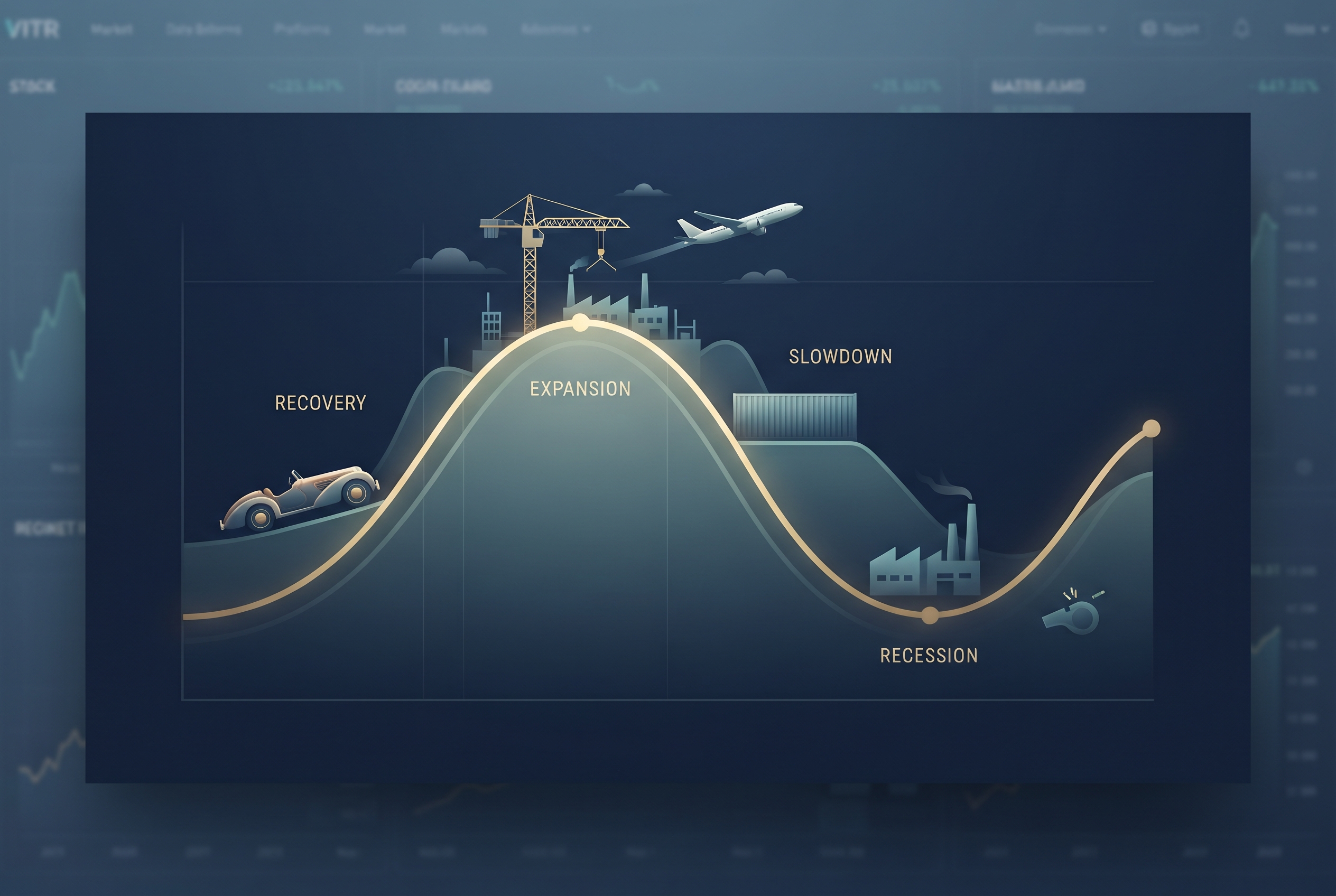
The business cycle describes the recurring fluctuations in economic activity. Although no two economic cycles are identical, economists and investors commonly use four broad phases:
- Early expansion or recovery
- Mid-cycle expansion
- Late-cycle slowdown
- Recession or contraction
These phases influence corporate revenue, earnings, borrowing costs, consumer demand, and investor expectations.
1. Early Expansion: The Economy Begins to Recover
The early expansion phase generally follows a recession or a period of significant economic weakness.
Economic activity begins to improve. Employment conditions may stabilize, consumer confidence may recover, and businesses may gradually increase investment and production.
Cyclical stocks can benefit significantly during this phase because financial markets often anticipate an economic recovery before it becomes fully visible in economic data.
Industries that may benefit include:
- Automobiles and consumer discretionary businesses
- Banks and other financial companies
- Industrial manufacturers
- Construction-related companies
- Selected technology businesses
For example, if interest rates begin to decline and consumers regain confidence, demand for vehicle financing may improve. Automakers and auto suppliers could benefit from higher production and sales expectations.
However, investors should remember that a recovery is not guaranteed to be smooth. Economic growth may remain weak, and companies may take time to translate improving demand into stronger profits.
2. Mid-Cycle Expansion: Growth Becomes More Established
During the middle phase of an expansion, economic growth becomes more established.
Businesses may increase capital expenditure, consumers continue spending, and corporate earnings generally benefit from stronger demand.
Some cyclical industries can continue performing well, particularly those connected to business investment and industrial activity.
Potential beneficiaries may include:
- Industrial companies
- Technology hardware and equipment manufacturers
- Transportation businesses
- Selected financial companies
- Companies supplying materials and components
At this stage, investors should pay attention to whether earnings growth is sustainable.
A company reporting higher revenue is not necessarily becoming more profitable. Rising labor expenses, raw material costs, or financing costs may reduce margins even when sales are increasing.
3. Late-Cycle Expansion: Growth Starts to Slow
The late-cycle phase occurs when the economy continues expanding but the pace of growth begins to moderate.
Inflationary pressures may become more visible, labor markets may tighten, and central banks may maintain restrictive monetary policies to control inflation.
These conditions can create challenges for cyclical companies.
For example:
- Higher interest rates may reduce demand for homes and vehicles.
- Higher fuel costs may pressure airline profitability.
- Rising raw material prices may reduce manufacturing margins.
- Slower consumer spending may affect retailers and leisure businesses.
Some companies may still report strong earnings during this period. However, investors need to distinguish between current financial results and the company’s future earnings outlook.
A business reporting record profits today may be approaching a period of weaker demand.
4. Recession: Economic Activity Contracts
A recession is a period of broad economic weakness, typically involving declining activity across several areas of the economy.
Consumers may reduce discretionary purchases, companies may postpone investments, and credit conditions may become tighter.
Cyclical companies can be particularly vulnerable because their revenues and profits may decline at the same time.
For example, an automaker may face weaker vehicle demand, lower factory utilization, and pressure to offer discounts. An airline may experience reduced passenger demand while continuing to face substantial fixed operating costs.
During recessions, investors often pay greater attention to businesses with relatively stable demand, strong balance sheets, and predictable cash flows.
These characteristics are commonly associated with defensive companies, although defensive stocks are not immune to market declines.
Cyclical vs. Defensive Stocks: What Is the Difference?
Cyclical stocks and defensive stocks respond differently to changes in economic conditions.
Cyclical companies generally depend more heavily on economic growth and discretionary spending. Defensive companies tend to provide products or services that consumers and businesses continue using even when economic conditions weaken.
| Feature | Cyclical Stocks | Defensive Stocks |
|---|---|---|
| Economic sensitivity | Generally high | Generally lower |
| Revenue patterns | More sensitive to economic activity | Often more stable |
| Recession exposure | Usually higher | Often relatively lower |
| Expansion potential | Can benefit strongly from recoveries | May lag during strong expansions |
| Earnings stability | Often more variable | Often more predictable |
| Typical industries | Automobiles, airlines, construction, industrials | Consumer staples, healthcare, utilities |
| Investor focus | Economic growth and earnings recovery | Stability and resilience |
Consider two hypothetical companies.
The first operates an airline business. When households have more disposable income and companies increase business travel, passenger demand may rise. During a recession, both leisure and corporate travel may decline.
The second produces essential household products such as toothpaste and cleaning supplies. Consumers may continue purchasing these products even when they reduce spending on vacations or new vehicles.
This does not mean the second company is risk-free. Its costs, competitive position, debt, and valuation still matter. However, its demand may be less sensitive to the economic cycle.
Key Characteristics of Cyclical Stocks
Understanding the characteristics of cyclical companies can help investors identify opportunities and recognize risks.
1. High Operating Leverage
Many cyclical companies have substantial fixed operating costs.
These costs may include factories, aircraft, machinery, warehouses, employee expenses, and long-term operating commitments.
When sales increase, these fixed costs do not necessarily rise at the same rate. As a result, additional revenue can translate into disproportionately higher operating profits.
The reverse is also true.
When demand falls, a company may continue paying many of its fixed expenses despite generating less revenue. This can cause profits to decline much faster than sales.
Example:
Imagine a manufacturer with annual revenue of $1 billion and fixed operating costs of $300 million.
If demand increases and revenue rises to $1.2 billion, the company may generate a significant improvement in operating profit if variable costs remain controlled.
But if revenue falls to $800 million, the same fixed-cost structure can put substantial pressure on profitability.
This sensitivity is one reason cyclical stocks can experience sharp movements in both directions.
2. Sensitivity to Consumer and Business Demand
Many cyclical products and services can be postponed.
Consumers do not necessarily need to replace a car immediately, renovate a kitchen this year, or book an international vacation during a period of financial uncertainty.
Similarly, businesses may delay purchasing machinery, expanding factories, or investing in new equipment.
When these decisions are postponed across an entire economy, companies exposed to discretionary demand can experience a meaningful decline in sales.
3. Earnings Can Be Highly Volatile
Cyclical companies often experience substantial fluctuations in revenue and profitability.
An automaker may report strong earnings during a period of high vehicle demand but face significant margin pressure when sales decline and inventory levels rise.
An industrial manufacturer may benefit from strong infrastructure spending but struggle when customers reduce capital expenditure.
For investors, this means that a company’s latest quarterly results may not provide a reliable picture of its long-term earnings potential.
4. Commodity and Input-Cost Exposure
Some cyclical companies are particularly sensitive to raw material prices.
Steel producers, automobile manufacturers, airlines, and construction companies may be affected by changes in energy, metals, transportation, and other input costs.
For example, higher oil prices can increase operating expenses for airlines. If companies cannot pass those costs on to customers through higher ticket prices, profit margins may deteriorate.
The impact depends on the company’s business model, pricing power, hedging strategy, and competitive environment.
5. Valuation Ratios Can Be Misleading
One of the most important characteristics of cyclical stocks is that conventional valuation metrics can become misleading near economic turning points.
Consider the price-to-earnings ratio (P/E).
When a cyclical company is near the peak of its economic cycle, earnings may be unusually high. Its P/E ratio can therefore appear low.
Investors may interpret this as evidence that the stock is cheap.
However, if earnings are about to decline, the apparently low P/E ratio may be a warning rather than an opportunity.
The opposite can happen during a recession. Earnings may fall sharply, making the P/E ratio unusually high or even meaningless. Yet the market may already be anticipating an eventual recovery.
This is why investors should evaluate cyclical companies using normalized earnings, historical profitability, cash flow, balance-sheet strength, and industry conditions—not just one valuation ratio.
For a deeper explanation of valuation, read our guide to intrinsic value and how to estimate a stock’s real worth.
Why Do Investors Buy Cyclical Stocks?
Despite their volatility, cyclical stocks can play a role in an investment portfolio.
Potential to Benefit From Economic Recoveries
Cyclical companies may experience significant improvements in revenue and earnings when economic activity recovers.
Financial markets are forward-looking. Stock prices may begin rising before economic indicators confirm that a recovery is underway.
Investors who identify improving conditions early may benefit from changes in market expectations.
However, anticipating a recovery is difficult. A company can remain under pressure for longer than investors expect, and the market may already have priced in an optimistic outlook.
Exposure to Stronger Corporate Earnings
During economic expansions, businesses may increase production, consumers may spend more, and companies may become more willing to invest.
These developments can create favorable conditions for cyclical companies.
If a company also benefits from pricing power, efficient operations, and controlled costs, earnings growth may exceed revenue growth.
Portfolio Diversification Across Economic Environments
A portfolio containing companies from different industries may be less dependent on the performance of a single economic sector.
For example, combining cyclical businesses with companies that have relatively stable demand can help reduce concentration in one economic theme.
However, diversification does not eliminate market risk. During severe market stress, correlations between different stocks can increase, and many assets may decline simultaneously.
How to Identify the Right Time to Invest in Cyclical Stocks
Timing is one of the most challenging aspects of cyclical investing.
Investors should avoid relying on a single indicator or attempting to predict the exact bottom of the market. Instead, they can monitor several economic and company-specific signals together.
1. Interest Rates and Central Bank Policy
Interest rates influence borrowing costs for households and businesses.
When interest rates decline, financing may become more affordable. This can support demand for cars, homes, industrial equipment, and other credit-sensitive purchases.
Lower rates may therefore benefit certain cyclical industries.
However, interest rate cuts do not automatically indicate an economic recovery. Central banks may reduce rates because economic conditions are deteriorating.
Investors should examine the reason behind monetary policy changes, not simply the direction of interest rates.
2. Consumer Confidence
Consumer confidence surveys measure how households perceive current economic conditions and their financial prospects.
Improving confidence may indicate greater willingness to make discretionary purchases.
This can be relevant for industries such as automobiles, travel, retail, and leisure.
Nevertheless, consumer confidence is only one part of the picture. Actual spending, household debt, employment, and wage growth should also be considered.
3. Industrial Production
Industrial production measures the output of manufacturing, mining, and utilities.
Rising industrial activity may signal improving demand for machinery, raw materials, transportation, and industrial components.
For investors analyzing cyclical manufacturers, industrial production data can provide useful context.
4. Capacity Utilization
Capacity utilization measures how much of an industry’s available production capacity is being used.
When utilization rises, it may indicate stronger demand and increased production activity.
If utilization becomes very high, however, companies may face capacity constraints, higher costs, or the need for additional investment.
The indicator should therefore be interpreted alongside orders, inventories, and pricing trends.
5. Employment and Wage Growth
Employment trends influence household income and consumer spending.
A stronger labor market can support demand for vehicles, travel, restaurants, and other discretionary products.
On the other hand, rapidly rising wages may increase costs for labor-intensive businesses.
The impact depends on whether companies can pass higher costs on to customers.
6. Inventory Levels and New Orders
Inventory data can be especially useful when analyzing cyclical manufacturers and retailers.
If inventories rise faster than sales, companies may face excess stock and pressure to reduce prices.
If inventories decline while new orders improve, demand may be strengthening.
Investors should also examine the difference between actual orders and management expectations.
How to Evaluate a Cyclical Stock Before Investing
Identifying an economically sensitive industry is only the first step. Investors must also determine whether the individual company is financially strong enough to withstand changing conditions.
1. Examine Revenue and Earnings Across Multiple Economic Cycles
Do not evaluate a cyclical company based only on its latest annual or quarterly results.
Review its financial performance over several years, ideally including both expansionary and recessionary periods.
Ask:
- How much did revenue decline during the previous downturn?
- How quickly did earnings recover?
- Did the company remain profitable?
- Were margins stable or highly volatile?
- Did management maintain financial discipline?
A company that has consistently managed downturns may be better positioned than a competitor that relies heavily on favorable economic conditions.
2. Analyze Debt and Liquidity
Debt can become a major risk when revenue and cash flow decline.
Companies with high borrowing costs or large refinancing requirements may face difficulties during periods of economic weakness.
Important metrics include:
- Debt-to-equity ratio
- Net debt-to-EBITDA
- Interest coverage ratio
- Cash and cash equivalents
- Operating cash flow
- Debt maturity schedule
A strong balance sheet can provide flexibility during difficult periods.
Investors should also consider whether a company’s debt is fixed-rate or floating-rate and when major repayments are due.
3. Evaluate Profit Margins
Operating and net profit margins can reveal how efficiently a company manages its costs.
For cyclical businesses, investors should examine margins across different stages of the economic cycle.
A company with consistently better margins than its competitors may have advantages such as stronger pricing power, lower production costs, or a more efficient business model.
4. Assess Inventory and Working Capital
Inventory management is particularly important for manufacturers, retailers, and distributors.
Excess inventory can tie up cash and force companies to offer discounts.
A sudden increase in accounts receivable may also indicate that a company is taking longer to collect payments from customers.
Investors should compare inventory growth with revenue growth and monitor cash conversion.
5. Understand the Company’s Competitive Position
Not all cyclical companies benefit equally from an economic recovery.
A company with a strong brand, efficient production facilities, established distribution channels, and loyal customers may be better positioned than a weaker competitor.
Investors should assess:
- Market share
- Cost structure
- Pricing power
- Product quality
- Customer concentration
- Geographic diversification
- Management’s capital allocation decisions
6. Examine Valuation Using Normalized Earnings
As discussed earlier, current earnings can be unusually high or low depending on where the company stands in the economic cycle.
Investors may therefore consider normalized earnings: an estimate of the company’s sustainable profitability under more typical economic conditions.
A practical analysis could include:
- Historical average operating margins
- Average earnings over a full business cycle
- Free cash flow across multiple years
- Enterprise value relative to normalized EBITDA
- Valuation compared with industry peers
The objective is to avoid paying a premium for temporary peak earnings or assuming that unusually weak recessionary earnings will continue indefinitely.
For a broader framework, read our guide to using fundamental analysis to choose stocks.
A Practical Example: Investing in an Automotive Company During an Economic Slowdown
Imagine an investor named Michael who is evaluating a hypothetical US automaker called Horizon Motors.
The company has a recognized brand, several manufacturing facilities, and a meaningful share of the domestic vehicle market.
However, the economy is slowing. Interest rates remain relatively high, consumers are postponing major purchases, and vehicle inventories are increasing.
Michael notices that Horizon Motors’ share price has declined by 30%.
At first glance, the stock appears attractive. Its P/E ratio is also lower than the historical average.
But Michael decides to investigate further.
Step 1: Understand the Economic Environment
He reviews interest rates, vehicle sales, consumer confidence, employment data, and industry inventory levels.
He concludes that demand remains weak and that the timing of an economic recovery is uncertain.
Step 2: Examine Financial Strength
Michael reviews the company’s balance sheet and discovers that Horizon Motors has substantial debt and relatively limited cash reserves.
He also notices that interest expenses have increased.
This raises concerns about the company’s ability to withstand a prolonged downturn.
Step 3: Evaluate Earnings Quality
The company reported unusually high profits during the previous expansion.
Michael calculates a normalized earnings estimate based on several years of financial performance rather than relying solely on the latest results.
He discovers that the stock is not as inexpensive as its current P/E ratio initially suggested.
Step 4: Monitor Signs of Stabilization
Rather than immediately buying the stock, Michael monitors:
- Vehicle sales trends
- Inventory levels
- Financing costs
- Operating margins
- Management’s guidance
- Free cash flow
Several months later, industry demand begins to stabilize. Horizon Motors reduces inventory, improves cash generation, and reports stronger-than-expected operating margins.
Michael now has more evidence that the company’s financial position may be improving.
This example illustrates an important principle: a declining share price alone does not make a cyclical stock attractive. Investors should look for evidence that the business is stabilizing and that the valuation reflects realistic earnings expectations.
The example is hypothetical and does not represent an investment recommendation.
Common Mistakes to Avoid When Investing in Cyclical Stocks
Cyclical investing can be rewarding in favorable conditions, but it also creates opportunities for costly mistakes.
Mistake 1: Buying Only Because the Stock Price Has Fallen
A stock that has declined significantly may still be overvalued.
The decline could reflect deteriorating fundamentals, excessive debt, permanent changes in demand, or a weakening competitive position.
Investors should distinguish between temporary cyclical weakness and structural business problems.
Mistake 2: Assuming a Low P/E Ratio Means a Stock Is Cheap
Cyclical companies may have their highest earnings near the peak of an economic cycle.
A low P/E ratio at that point may reflect temporarily inflated profits.
Always examine normalized earnings and the sustainability of margins.
Mistake 3: Ignoring the Balance Sheet
A company may survive a short slowdown but struggle if the downturn lasts longer than expected.
High debt, weak liquidity, and significant refinancing needs can increase financial risk.
Mistake 4: Trying to Predict the Exact Market Bottom
Economic data are published with delays and may be revised. Stock prices, meanwhile, respond to expectations about the future.
By the time a recovery becomes obvious in official data, share prices may already have risen.
Instead of trying to identify the exact bottom, investors can use a disciplined process based on valuation, financial strength, and improving business conditions.
Mistake 5: Concentrating Too Much of the Portfolio in One Industry
Several cyclical companies may appear diversified because they operate under different brand names.
However, if they all depend on consumer spending, credit availability, or industrial production, they may be exposed to similar risks.
Diversification across sectors and business models is important.
Are Cyclical Stocks Suitable for Every Investor?
Cyclical stocks may be more suitable for investors who understand economic conditions, company fundamentals, and the possibility of significant price fluctuations.
They may appeal to investors who:
- Follow macroeconomic indicators.
- Understand industry-specific supply and demand.
- Can tolerate periods of substantial volatility.
- Have a medium- or long-term investment horizon.
- Are comfortable analyzing company financial statements.
- Use position sizing and risk-management rules.
They may be less appropriate for investors who need stable short-term capital, cannot tolerate significant losses, or prefer investments with relatively predictable earnings.
This does not mean that cyclical stocks should be avoided by beginners. However, investors who are new to the stock market may find it easier to begin with diversified funds and gradually develop their understanding of economic cycles.
How to Include Cyclical Stocks in a Portfolio
A sensible approach is to consider cyclical stocks as one component of a diversified portfolio rather than building an entire investment strategy around economic forecasts.
Investors can consider the following principles:
- Diversify across industries: Avoid excessive exposure to one economic driver.
- Evaluate company quality: Favor businesses with sustainable debt levels, competitive advantages, and sound cash flow.
- Monitor economic indicators: Use several data points rather than relying on a single forecast.
- Review valuations carefully: Consider normalized earnings instead of focusing only on current profits.
- Manage position sizes: Recognize that cyclical stocks can experience sharp price movements.
- Review the investment thesis: Reassess the company when demand, costs, debt, or competitive conditions change.
Investors who prefer a more diversified approach may also explore sector exchange-traded funds (ETFs). These funds provide exposure to groups of companies within particular industries, although they still carry market and sector-specific risks.
An ETF does not eliminate the risks associated with investing in cyclical industries.
For more context on choosing exposure across industries, see our guide to sector allocation and when to invest in different sectors.
Final Thoughts: Understanding the Economic Cycle Matters
Cyclical stocks can offer meaningful opportunities when economic activity improves, but their performance is closely connected to changes in demand, financing conditions, production, and corporate earnings.
The most important challenge is not simply identifying which industries are cyclical. It is understanding how the economic environment affects each company’s ability to generate sustainable profits.
A falling share price does not automatically create a bargain, just as strong current earnings do not guarantee future growth.
Investors should combine macroeconomic analysis with company-level research, examine balance-sheet strength, use normalized earnings when assessing valuation, and maintain a disciplined approach to risk management.
Most importantly, no investor can consistently predict the exact turning points of the business cycle. A sound investment process should therefore be built around preparation, diversification, and realistic expectations—not perfect market timing.
Frequently Asked Questions About Cyclical Stocks
1. What are cyclical stocks?
Cyclical stocks are shares of companies whose revenues and earnings tend to fluctuate with economic conditions. They often benefit from economic growth and face pressure during recessions.
2. Which industries are considered cyclical?
Common cyclical industries include automobiles, airlines, hotels, tourism, construction, industrial manufacturing, steel, transportation, and consumer discretionary businesses.
3. When do cyclical stocks usually perform well?
They have historically tended to perform well during economic recoveries and expansions, when consumer spending, business investment, and industrial activity improve. However, performance varies by company and market conditions.
4. Do cyclical stocks fall during recessions?
Many cyclical stocks face greater pressure during recessions because consumers and businesses may reduce discretionary spending and investment. However, individual company performance can differ significantly.
5. What is the difference between cyclical and defensive stocks?
Cyclical stocks are generally more sensitive to economic conditions, while defensive stocks tend to operate in industries where demand is relatively stable, such as consumer staples, healthcare, and utilities.
6. Are automobile stocks cyclical?
Yes. Automobile companies are generally considered cyclical because vehicle purchases are influenced by consumer confidence, employment, financing costs, and household income.
7. Are airline stocks cyclical?
Yes. Airlines are often cyclical because passenger demand and business travel can change with economic conditions. Fuel costs, labor expenses, and debt levels also influence their profitability.
8. Are technology stocks cyclical?
Some technology companies are highly cyclical, particularly hardware manufacturers and businesses that depend on corporate capital expenditure. Other technology businesses may have more recurring revenue and different economic sensitivities.
9. How can investors identify cyclical stocks?
Investors can examine the company’s industry, revenue history, earnings volatility, customer demand, and sensitivity to economic indicators such as interest rates, industrial production, and consumer confidence.
10. What economic indicators should investors monitor?
Useful indicators include GDP growth, employment, consumer confidence, interest rates, inflation, industrial production, capacity utilization, retail sales, new orders, and inventory levels.
11. Why can a low P/E ratio be misleading for cyclical stocks?
A cyclical company may report unusually high earnings near the peak of an economic cycle. This can make its P/E ratio look low even though earnings are likely to decline. Investors should consider normalized earnings.
12. What is normalized earnings?
Normalized earnings represent an estimate of a company’s sustainable profitability under more typical economic conditions. They help investors avoid relying too heavily on unusually strong or weak results from a particular stage of the business cycle.
13. Are cyclical stocks suitable for beginners?
They can be part of a beginner’s portfolio, but understanding economic cycles, valuation, and company financial statements is important. Beginners should be particularly careful about concentration and volatility.
14. Can cyclical stocks pay dividends?
Yes. Some cyclical companies distribute dividends. However, dividends may be reduced or suspended when earnings and cash flow deteriorate. Investors should assess dividend sustainability rather than focusing only on dividend yield.
15. Are cyclical stocks riskier than defensive stocks?
They often have greater exposure to economic downturns and earnings volatility. However, risk also depends on valuation, debt, management quality, competitive position, and the company’s specific business model.
16. Should investors buy cyclical stocks during a recession?
Some investors begin evaluating cyclical companies during recessions because market prices may reflect pessimistic expectations. However, a recession can last longer than expected, and companies with weak balance sheets may face serious difficulties. There is no universally correct entry point.
17. When should investors consider selling cyclical stocks?
Investors may reassess a cyclical stock when its valuation becomes excessive, earnings expectations deteriorate, the original investment thesis changes, or the company’s financial position weakens. Economic indicators alone should not determine a sell decision.
18. What is the biggest mistake investors make with cyclical stocks?
One of the most common mistakes is assuming that a stock is undervalued simply because its price has fallen or its P/E ratio is low. Investors need to determine whether the company’s earnings and competitive position can recover.
19. Can ETFs provide exposure to cyclical stocks?
Yes. Sector ETFs and broader market ETFs can provide exposure to companies in cyclical industries. Investors should review each fund’s holdings, sector concentration, expenses, and investment strategy before investing.
20. Can investors predict the business cycle accurately?
No. Economic turning points are difficult to identify because indicators are often delayed, revised, and influenced by unexpected events. Investors can monitor several indicators and prepare for different scenarios, but precise market timing is not consistently achievable.